White cloud minnow
Tanichthys albonubes · family Cyprinidae
- Ideal temperature
- 64–72°F
- Smallest tank
- 10 gallons
- Keep at least
- 6 together
The white cloud minnow (Tanichthys albonubes) is a small, peaceful freshwater fish from China (Guangdong, Hainan) that stays in the top and middle of the tank. It is easy to care for, needs a tank of at least 10 gallons and does best in a group of at least 6. The most important thing to know is that it prefers cool water (64–72°F), which rules out most tropical tank mates.
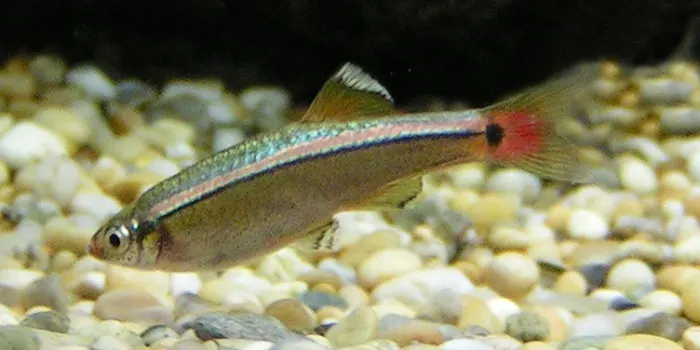
What they look like: dart-shaped slim body with pointed snout; green and silver scales with black and iridescent pink lateral stripes; red-tipped snout, black dot at tail base, red fins with white tips.
Native to: China (Guangdong, Hainan).
Edited by Marin Hale · last reviewed November 14, 2026 · How we check facts
White cloud minnow size, lifespan and how many per tank
How big do white cloud minnows get?
White cloud minnow size: adults reach about 1.6 inches (4.1 cm).
How long do white cloud minnows live?
4–6 years with good care.
Do white cloud minnows need hard or soft water?
White cloud minnows take a hardness (GH) of 5–20 dGH, about 90–360 ppm: moderately hard to very hard water. Compare it with the hardness on your water report, which is given in ppm or mg/L.
How hard is your tap water? Austin · Denver · New York City · all cities
Bands from the US Geological Survey (soft up to 60 ppm, moderately hard up to 120, hard up to 180, very hard above); 1 dGH is about 17.9 ppm (Aquariadise).
How many white cloud minnows can you keep in a 5, 10 or 20-gallon tank?
| 5 gallons | Too small. White cloud minnows need at least 10 gallons. |
|---|---|
| 10 gallons | Up to about 8 (keep at least 6) |
| 20 gallons | Up to about 16 (keep at least 6) |
A cautious estimate from our crowding model, based on the minimum tank and group size rather than a published stocking list. With strong filtration, plants and weekly water changes, many keepers stock more. With other fish in the same part of the tank, fewer fit. How it works · Check a mixed tank
Sizes and lifespans are cross-checked across our sources: see where each value comes from.
White cloud minnow care guide
Tank setup
| Heater | No heater. White cloud minnows are coolwater fish (64–72°F); keep the tank out of direct sun. |
|---|---|
| Substrate | Dark substrate in heavily planted set-up shows best colour |
Water for white cloud minnows: temperature, pH and hardness
White cloud minnow temperature: keep them at 64–72°F (18–22°C); they tolerate 64–72°F (18–22°C).
Measure pH with the test kit. For hardness, a GH test or your water supplier’s report tells you what comes out of your tap.
White cloud minnow behaviour and tank decor
Shoaling fish, most comfortable in a group of at least five; peaceful; usually top or middle-level swimmers, rarely near the bottom.
- Plants and hiding places: décor not critical; best colour in a heavily-planted tank with dark substrate; floating plants, driftwood and leaf litter appreciated.
- Filter flow: filtration need not be strong, but it appreciates some water movement and does well in a hill stream-type set-up.
Signs of stress: a lone fish becomes timid and loses its bright color; cycling a new tank with the fish in it can be stressful or fatal; nervous when kept in small numbers; shortened lifespan in permanently warm water; high temperatures wash out colours.
What do white cloud minnows eat?
White cloud minnow diseases and health problems
- Ich Dropsy, fin rot.
- Dropsy Fin rot.
- Fin rot
- Captive-bred stock varies in quality; some are strongly coloured and others dull, so shop around.
- Buy only from reputable dealers or breeders.
- Visually inspect each fish thoroughly before adding to the tank.
Male vs female white cloud minnows, and breeding
How to tell male and female white cloud minnows apart: males brighter and slimmer with fan-shaped dorsal/anal fins; females have whiter, distended abdomen.
Breeding: Egg scatterer. Easy to breed; parents can be left in the tank as they do not generally eat offspring.
How breeders do it (25 points from our sources)
- Easy to breed
- Feed infusoria-based food once yolk sacs are used up, then micro-worms and larval brine shrimp
- Separate small tank with moss and aquatic plants
- Egg-scatterers; parents rarely eat offspring so can be left in the tank
- Eggs hatch in 48-60 hours; fry need infusoria-grade food first
- Free-swimming fry fed finely powdered food or infusoria
- Egg-scattering continuous spawner, no parental care
- In a densely-planted mature tank, fry often appear without intervention
- For control, use a separate smaller dimly-lit tank with mesh, matting, marbles, fine-leaved plants or spawning mops
- Slightly acidic to neutral pH, temperature toward upper end of range
- Sponge filter or air stone for oxygenation
- Introduce one or two gravid pairs; spawning the following morning
- Remove adults after 2-3 days as they will eat the eggs
- Dropping the temperature with chilled water during a water change can induce spawning
- 45cm tank with sponge filter, bare bottom and a wool spawning mop at the surface
- One male and one plump female
- Remove parents after eggs are laid to prevent egg cannibalism
- Fry appear in two or three days and need very small food such as infusoria
- Breeding season March to October
- Temperature 64°F to 72°F
- Feed pair three live-food feedings daily
- Eggs hatch after 2 days
- Relatively simple, suitable for novices
- Eggs hatch in 36 to 48 hours
- Parents rarely eat fry but remove them when eggs start to hatch to be safe
- Needs a lid, can jump out
- Farm inbreeding makes stock weak and prone to disease and deformities
- Permanent warm water shortens lifespan
- Wild Hainan fish less tolerant of low temperatures
- High temperatures wash out colour and shorten life
- Males become territorial and aggressive when competing for mates
Care tips
- Keep a group of at least 6, since a lone white cloud minnow becomes timid and loses colour.
- Cycle the tank before adding fish, because they should not be exposed to ammonia or nitrite.Ammonia and nitrite: Poisons that build up from fish waste until the tank is cycled. A test kit measures them.
- Use a tight-fitting lid, as these fish can jump out.
- Keep the water within 64–72°F, because warm water washes out their colour and shortens their lives.
White cloud minnow tank mates
What can live with a white cloud minnow?
Verdicts against every species in our database, from our compatibility rules. How verdicts work
Easy picks for a 10-gallon tank: amano shrimp, chili rasbora, panda corydoras, zebra nerite snail. Use the stocking calculator to check how many of each fit.
| Verdict | Species | Why | Smallest tank * |
|---|---|---|---|
| Good match | Amano shrimp | Both are comfortable at 64–72°F, pH 6.0–7.6. Peaceful together, and neither can eat the other. Both swim mid-water. | 10 gal+ |
| Good match | Bronze corydoras | Both are comfortable at 68–72°F, pH 6.0–8.0. Peaceful together, and neither can eat the other. They share the tank well: bronze corydoras swim near the bottom, white cloud minnows near the top and mid-water. | 20 gal+ |
| Good match | Chili rasbora | Both are comfortable at 68–72°F, pH 6.0–7.0. Peaceful together, and neither can eat the other. Both swim near the top and mid-water. | 10 gal+ |
| Good match | Panda corydoras | Both are comfortable at 68–72°F, pH 6.0–7.7. Peaceful together, and neither can eat the other. They share the tank well: panda corydoras swim near the bottom, white cloud minnows near the top and mid-water. | 10 gal+ |
| Good match | Platy | Both are comfortable at 68–72°F, pH 7.0–8.0. Peaceful together, and neither can eat the other. Both swim near the top and mid-water. | 20 gal+ |
| Good match | Another white cloud minnow | Water needs overlap. Peaceful together, and neither can eat the other. | 10 gal+ |
| Good match | Zebra danio | Both are comfortable at 64–72°F, pH 6.0–8.0. Peaceful together, and neither can eat the other. | 20 gal+ |
| Good match | Zebra nerite snail | Both are comfortable at 65–72°F, pH 7.2–8.0. Peaceful together, and neither can eat the other. | 10 gal+ |
| Maybe | Cherry shrimp | White cloud minnows eat baby shrimp and may pick off adults. Dense plants and moss help a colony survive. | 10 gal+ |
| Maybe | Fancy goldfish | Adult fancy goldfish may eat small white cloud minnows. | 20 gal+ |
| Avoid | Angelfish | White cloud minnows need cool water; angelfish need tropical water. | — |
| Avoid | Betta fish | White cloud minnows need cool water; betta fish need tropical water. | — |
| Avoid | Bristlenose pleco | White cloud minnows need cool water; bristlenose plecos need tropical water. | — |
| Avoid | Cardinal tetra | White cloud minnows need cool water; cardinal tetras need tropical water. | — |
| Avoid | Celestial pearl danio | White cloud minnows need cool water; celestial pearl danios need tropical water. | — |
| Avoid | Common goldfish | White cloud minnows are small enough for adult common goldfish to eat. | — |
| Avoid | Ember tetra | White cloud minnows need cool water; ember tetras need tropical water. | — |
| Avoid | Guppy | White cloud minnows need cool water; guppies need tropical water. | — |
| Avoid | Harlequin rasbora | White cloud minnows need cool water; harlequin rasboras need tropical water. | — |
| Avoid | Honey gourami | White cloud minnows need cool water; honey gouramis need tropical water. | — |
| Avoid | Kuhli loach | White cloud minnows need cool water; kuhli loaches need tropical water. | — |
| Avoid | Molly | White cloud minnows need cool water; mollies need tropical water. | — |
| Avoid | Neon tetra | White cloud minnows need cool water; neon tetras need tropical water. | — |
| Avoid | Pygmy corydoras | White cloud minnows need cool water; pygmy corydoras need tropical water. | — |
| Avoid | Tiger barb | White cloud minnows need cool water; tiger barbs need tropical water. | — |
* Smallest tank: the larger of the two species’ own minimum tanks. It is not a stocking plan: a full group of each may need more room. Check exact numbers in the stocking calculator.
Questions
Do white cloud minnows need a heater?
Usually not. They do best at 64–72°F, which is also their ideal range, and permanently warm water shortens their lifespan and washes out their colour. Wild Hainan fish are less tolerant of low temperatures.
What do white cloud minnows eat?
They are omnivores and do well on standard flake or pellet food.
What fish can live with white cloud minnows?
Good matches are bronze corydoras, panda corydoras, platy, zebra danio and zebra nerite snails, plus other white cloud minnows. Most tropical fish, including bettas, guppies, neon tetras and tiger barbs, are a poor fit because they need warmer water than white clouds do. Cherry shrimp are a risk, since white clouds eat baby shrimp and may pick off adults, and fancy goldfish may eat small white clouds.
How big do white cloud minnows get, and how long do they live?
Adults reach about 1.6 inches. They can live 4 to 6 years, as long as the water isn't kept too warm.
Are white cloud minnows easy to breed?
Yes. They are egg scatterers and easy to breed, and the parents can stay in the tank because they do not generally eat their offspring. Males are brighter and slimmer with fan-shaped dorsal and anal fins, while females have a whiter, rounder belly.
Sources
(5 references, 26 facts with quotes)
Each value is cross-checked across the references below. Where they disagreed, an editor chose a value and recorded why.
- White Cloud Mountain minnow (en.wikipedia.org)
- Tanichthys albonubes (Seriously Fish) (www.seriouslyfish.com)
- How to set up a White Cloud biotope (www.practicalfishkeeping.co.uk)
- You Need to Know About White Cloud Mountain Minnow ... (petsnurturing.com)
- White Cloud Mountain Minnow | Ultimate Care Guide (www.fishlaboratory.com)
- GBIF taxonomy record
- Wikidata entry
Where each value comes from (26 facts)
| Fact | What each source says |
|---|---|
| Temperature editor decision | en.wikipedia.org: “the nominal temperature range for the species in the wild is 18–22 °C (64–72 °F), it can survive water temperatures down to 5 °C (41 °F)” seriouslyfish.com: “most comfortable between 14 – 22 °C57 – 72 °F” practicalfishkeeping.co.uk: “does best between 18-22°C/64-72°F” petsnurturing.com: “the ideal temperature is between 64°F to 72°F” fishlaboratory.com: “Wild colonies of white cloud minnows are usually found in waters with temperatures between 64–72 °F (18-22℃).” |
| pH editor decision | en.wikipedia.org: “pH levels should range between 6.0 and 8.0” seriouslyfish.com: “pH: 6.0 – 8.5” petsnurturing.com: “with 6.0 to 8.0 being the ideal pH level” fishlaboratory.com: “you should aim for a neutral pH of between 6.5 and 7.5” |
| Hardness (GH) | en.wikipedia.org: “Water hardness (dH) should be from 5 to 19” seriouslyfish.com: “Hardness: 5 – 20 dGH” |
| Adult size | en.wikipedia.org: “grows to approximately 4 cm (1.6 in)) in overall length” seriouslyfish.com: “Max size 40mm SL1.6in SL” practicalfishkeeping.co.uk: “Maximum size: 4cm/1.6”” petsnurturing.com: “a height of only 1.5 inches maximum” fishlaboratory.com: “adults will only grow to about 1.5 inches. There is some difference between different varieties; some can reach up to 2.5 inches.” |
| Lifespan | en.wikipedia.org: “A typical lifespan can last for five years or longer.” fishlaboratory.com: “will live for at least 3 years, but they can reach 6 or 7 years” |
| Group size | en.wikipedia.org: “They are shoaling fish, and feel most comfortable in a group of at least five.” seriouslyfish.com: “ideally a group comprising 10+ specimens should be purchased” petsnurturing.com: “They must be kept in a group of at least 6 fishes.” fishlaboratory.com: “They prefer to be kept in schools of at least five.” |
| Temperament | en.wikipedia.org: “White Clouds are generally peaceful and happy to coexist with other fish” seriouslyfish.com: “Very peaceful indeed and an ideal resident of a well-maintained community set-up” petsnurturing.com: “White cloud minnows are renown for their peaceful disposition, hardiness, and eager appetites.” |
| Swims | en.wikipedia.org: “The minnows are usually top or middle-level swimmers and rarely swim close to the bottom of a tank.” practicalfishkeeping.co.uk: “Swimming area: Midwater” petsnurturing.com: “They usually dwell in the top of the middle of the tank and are not seen in the bottom region” |
| Care level | en.wikipedia.org: “considered a good fish for beginners, as they are extremely forgiving with regard to aquarium temperature and water quality” seriouslyfish.com: “Difficulty 6 of 8 measures Easy” practicalfishkeeping.co.uk: “The fish are inexpensive, tolerant to a wide variation in temperature and water chemistry” petsnurturing.com: “You can care for them very easily” fishlaboratory.com: “Caring for White Cloud Mountain Minnows is not difficult since they are adaptable hardy fish.” |
| Diet | en.wikipedia.org: “The White Cloud Mountain minnow is an opportunistic omnivore.” fishlaboratory.com: “White cloud mountain minnows are omnivorous micro-predators.” |
| Water type editor decision | en.wikipedia.org: “hardy species of freshwater fish and coldwater fish often kept in an aquarium” seriouslyfish.com: “small cyprinid from Guangdong and Hainan in southern China” fishlaboratory.com: “White cloud fish originated in freshwater rivers and streams” |
| Breeding type | en.wikipedia.org: “White Clouds are egg-scatterers, dropping their eggs freely amongst the vegetation.” seriouslyfish.com: “this species is an egg-scattering, continuous spawner that exhibits no parental care” practicalfishkeeping.co.uk: “Egg-layer, so use spawning mops.” petsnurturing.com: “they have a long breeding season that lasts from March to October” |
| Native to | en.wikipedia.org: “This species is native to China.” seriouslyfish.com: “a small cyprinid from Guangdong and Hainan in southern China and from northeastern Vietnam” practicalfishkeeping.co.uk: “Chinese scientists have recently discovered another wild population in the southern Chinese island of Hainan” petsnurturing.com: “They are ancient to china and Vietnam” fishlaboratory.com: “small aquarium fish originating in China” |
| Telling males from females | en.wikipedia.org: “The male generally has brighter colors and a slimmer body” seriouslyfish.com: “Mature females are usually rounder-bellied and often a little larger than the slimmer, more colourful males.” practicalfishkeeping.co.uk: “Males are slimmer and more brightly coloured than females.” petsnurturing.com: “The male species are more colorful than the female species.” fishlaboratory.com: “Females are usually larger and have a slight rounder shape but no red coloring.” |
| Needs an established tank editor decision | en.wikipedia.org: “it is advisable to introduce the fish to an already cycled tank” practicalfishkeeping.co.uk: “Remember to fishless cycle the tank or use an existing mature filter before adding new fish.” fishlaboratory.com: “you must cycle it completely... we recommend doing it before you add your white cloud mountain minnows” |
| Feeding | en.wikipedia.org: “Standard flake or pellet food is accepted readily.” seriouslyfish.com: “regular meals of small live and frozen foods such as bloodworm, Daphnia, and Artemia alongside good quality dried flakes and granules” practicalfishkeeping.co.uk: “They are fed two to three times daily on dried, frozen and a quality flake food.” petsnurturing.com: “you can feed them invertebrates like bloodworms, brine shrimp nauplii, daphnia, and tubifex worms” fishlaboratory.com: “they’re still voracious feeders and need to be fed 2 to 3 times daily with live food and fish flakes” |
| Breeding | en.wikipedia.org: “Because they do not generally cannibalize their offspring, the parents can be left in the tank.” seriouslyfish.com: “small numbers of fry usually start to appear without further intervention” practicalfishkeeping.co.uk: “Dropping the temperature, via chilled water during water change, can induce spawning.” petsnurturing.com: “After they lay eggs the parents must be remove to prevent egg cannibalism.” fishlaboratory.com: “White cloud mountain minnow parents rarely eat their own fry, but it does happen occasionally.” |
| Warnings | en.wikipedia.org: “the aquarium should have a top. White Clouds have been known to jump out on rare occasions.” seriouslyfish.com: “Permanent exposure to warmer conditions is likely to result in a shortened lifespan” practicalfishkeeping.co.uk: “needlessly exposing them to toxic ammonia and nitrite is cruel” petsnurturing.com: “When kept in hotter water they may survive but lose their disease resistance and the life span get shorter” fishlaboratory.com: “A lid is also a must-have, as these tiny fish will likely try to jump out of their tank.” |
| Smallest tank editor decision | seriouslyfish.com: “Volume ~54litres~14US gal” practicalfishkeeping.co.uk: “Go for a 60 x 30 x 30cm/24 x 12 x 12” 54 l/12 gal aquarium.” petsnurturing.com: “it can comfortably live in tanks of size approximately 5 gallons” fishlaboratory.com: “2 gallons of water for each fish. This means you will need at least a 10-gallon aquarium for a school of 5 fish.” |
| Substrate | seriouslyfish.com: “it tends to show better colouration in a heavily-planted set-up with a dark substrate” practicalfishkeeping.co.uk: “A thin layer of river sand is added.” fishlaboratory.com: “it’s best to start with a gravel substrate, aquarium filter, large rocks, and various plants” |
| Safe with plants editor decision | petsnurturing.com: “white cloud minnows are plant-friendly as they are micro predators” |
| Eats shrimp/snails editor decision | fishlaboratory.com: “Larger shrimp species will likely be fine, but any that are too small may be eaten.” |
| Looks | petsnurturing.com: “They have shapes like darts with slim streamlined bodies and pointed snouts.” en.wikipedia.org: “is silver-green in color with a bright red caudal and dorsal fin” |
| Varieties | en.wikipedia.org: “Two variants are commonly available: the "Golden Cloud" and the longer-finned "Meteor Minnow", which can be gold as well.” seriouslyfish.com: “several ornamental strains are available including 'long-finned', 'golden', 'albino', and 'super red', for which care is identical.” practicalfishkeeping.co.uk: “There is also a golden form.” petsnurturing.com: “Meteor Minnows – they are mostly bred for long, trailing fins.” fishlaboratory.com: “The most common variants include Gold White Cloud Mountain Minnows and Longfin White Cloud Mountain Minnows.” |
| Diseases and signs | en.wikipedia.org: “inbreeding in farms has led to genetically weak stock that is vulnerable to disease and prone to physical deformities.” seriouslyfish.com: “many of the fish available today are genetically weak and prone to disease or develop physical deformities.” fishlaboratory.com: “these include streptococcus, ich, dropsy, and fin rot.” |
| How often to feed | practicalfishkeeping.co.uk: “They are fed two to three times daily on dried, frozen and a quality flake food.” fishlaboratory.com: “they’re still voracious feeders and need to be fed 2 to 3 times daily with live food and fish flakes.” |
Editor decisions (7)
- Four of five sources give 64–72°F; Seriously Fish goes down to 57°F. A coolwater fish: fine unheated in most homes.
- Wikipedia and Pets Nurturing give 6.0–8.0, Seriously Fish 6.0–8.5; Fish Laboratory's 6.5–7.5 is a preference within that.
- All three sources say freshwater. Wikipedia's 'coldwater' describes temperature, which the temperature range already covers.
- Cycled is not the same as mature. Wikipedia, Practical Fishkeeping and Fish Laboratory only say to cycle the tank before adding fish, which applies to every fish; none says white clouds need an established tank.
- 10 gallons is the common minimum for a group of 6 (Fish Laboratory); Practical Fishkeeping and Seriously Fish suggest a 54-litre (12–14 gal) tank.
- Pets Nurturing calls them plant-friendly and Seriously Fish recommends a heavily planted tank. Wikipedia says wild fish eat some plant matter; no source reports damage to aquarium plants.
- Fish Laboratory says larger shrimp are fine and only very small ones may be eaten: they may take newborn shrimp, not adults.
Cite this page
“White cloud minnow care.” Fish Tank Atlas, last reviewed November 14, 2026. https://fishtankatlas.com/fish/white-cloud-minnow/