Amano shrimp
Caridina multidentata · family Atyidae
- Ideal temperature
- 70–80°F
- Smallest tank
- 5 gallons
- Keep at least
- 1
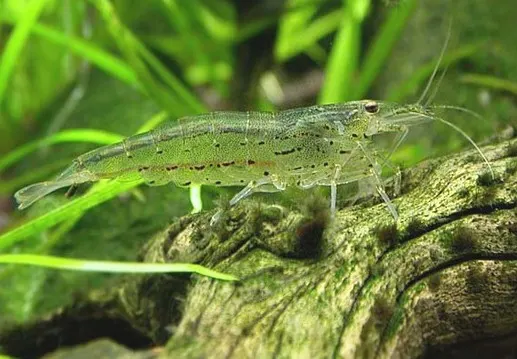
The Amano shrimp (Caridina multidentata) is a peaceful, easy freshwater shrimp from Japan and Taiwan. It grows to 1.5–2 inches, lives about 4 years, and does well in a tank of 5 gallons or more. The most important thing to know is that copper is lethal to them, so check every medication, food and fertilizer before it goes in the tank.
What they look like: clear with tan or gray-blue tint and solid stripe down the back.
Native to: Japan and Taiwan.
Edited by Marin Hale · last reviewed November 20, 2026 · How we check facts
Amano shrimp size, lifespan and how many per tank
How big do Amano shrimp get?
Amano shrimp size: adults reach 1.5–2 inches (3.8–5.1 cm).
How long do Amano shrimp live?
About 4 years with good care.
Do Amano shrimp need hard or soft water?
Amano shrimp take a hardness (GH) of 6–14 dGH, about 110–250 ppm: moderately hard to very hard water. Compare it with the hardness on your water report, which is given in ppm or mg/L.
How hard is your tap water? Austin · Denver · New York City · all cities
Bands from the US Geological Survey (soft up to 60 ppm, moderately hard up to 120, hard up to 180, very hard above); 1 dGH is about 17.9 ppm (Aquariadise).
How many Amano shrimp can you keep in a 5, 10 or 20-gallon tank?
| 5 gallons | Up to about 1 |
|---|---|
| 10 gallons | Up to about 3 |
| 20 gallons | Up to about 6 |
The most of this species on its own, from our crowding model; it matches Aquarium Co-op’s 10-gallon stocking (“2-3 amano shrimp”). With other fish in the same part of the tank, fewer fit. How it works · Check a mixed tank
Sizes and lifespans are cross-checked across our sources: see where each value comes from.
Amano shrimp care guide
Tank setup
| Heater | Usually no heater needed: Amano shrimp are fine from 64°F to 81°F, so most homes work. Add one if your room drops below 64°F. |
|---|
Water for Amano shrimp: temperature, pH and hardness
Amano shrimp temperature: keep them at 70–80°F (21–27°C); they tolerate 64–81°F (18–27°C).
Measure pH with the test kit. For hardness, a GH test or your water supplier’s report tells you what comes out of your tap.
Amano shrimp behaviour and tank decor
Constantly grazes with front legs, climbs plant leaves, swipes food from bigger fish.
- Plants and hiding places: jungle of live plants and decorations for grazing and hiding while molting.
- Filter flow: tolerates middling to strong flow; filter intake must be shrimp-safe.
Signs of stress: turn from transparent to white or pink; lose movement and lie immobile on tank base.
What do Amano shrimp eat?
Amano shrimp diseases and health problems
- Poisoning. Signs: turn white and/or pink, lose movement, immobile on base twitching pleopods. From insecticides or unrinsed plants.
- Young adults ship at 1/2 to 1 inch.
Male vs female Amano shrimp, and breeding
How to tell male and female Amano shrimp apart: females have a more elongated lower row of dots than males.
Breeding: Amphidromous; larvae develop in saltwater. Berried females' eggs will not produce shrimp in freshwater.
How breeders do it (3 points from our sources)
- Female carries eggs 4-6 weeks
- Move larvae to saltwater within 4-7 days
- Larvae best at SG 1.012-1.019 and 73.4-84.2 °F
- Extremely averse to copper
- Higher temperatures may shorten lifespan
- Steals food from tank mates and may outcompete cherry shrimp
- Below pH 6.0 they struggle, e.g. from excess CO2pH: How acidic or alkaline the water is; 7 is neutral, lower is more acidic.
- Avoid any food, medication or fertilizer containing copper
Care tips
- Use a tight-fitting lid and cover the openings for power cords and airline tubing, because Amano shrimp are expert escapers.
- Keep copper and other heavy metals out of the tank, including copper-based medications, foods and fertilizers, and rinse new plants well because insecticide residue can poison shrimp.
- Acclimate new shrimp carefully, keep the pH within 6.0–7.6 and the GH within 6–14 dGH, and never add salt, since adults cannot tolerate it.
- Offer calcium-rich foods to support molting, and remove any dead shrimp promptly because it can spike ammonia in a small tank.Ammonia and nitrite: Poisons that build up from fish waste until the tank is cycled. A test kit measures them.
Amano shrimp tank mates
What can live with an amano shrimp?
Verdicts against every species in our database, from our compatibility rules. How verdicts work
| Verdict | Species | Why | Smallest tank * |
|---|---|---|---|
| Good match | Another amano shrimp | Water needs overlap. Peaceful together, and neither can eat the other. | 5 gal+ |
| Good match | Bristlenose pleco | Both are comfortable at 72–79°F, pH 6.0–7.6. Peaceful together, and neither can eat the other. Both swim near the bottom. | 30 gal+ |
| Good match | Celestial pearl danio | Both are comfortable at 72–79°F, pH 6.5–7.6. Peaceful together, and neither can eat the other. Both swim mid-water. | 10 gal+ |
| Good match | Chili rasbora | Both are comfortable at 68–81°F, pH 6.0–7.0. Peaceful together, and neither can eat the other. Both swim mid-water. | 10 gal+ |
| Good match | Ember tetra | Both are comfortable at 73–81°F, pH 6.0–7.0. Peaceful together, and neither can eat the other. Both swim near the bottom and mid-water. | 10 gal+ |
| Good match | Neon tetra | Both are comfortable at 70–77°F, pH 6.0–7.0. Peaceful together, and neither can eat the other. Both swim mid-water. | 10 gal+ |
| Good match | Pygmy corydoras | Both are comfortable at 72–79°F, pH 6.2–7.4. Peaceful together, and neither can eat the other. Both swim near the bottom and mid-water. | 10 gal+ |
| Good match | White cloud minnow | Both are comfortable at 64–72°F, pH 6.0–7.6. Peaceful together, and neither can eat the other. Both swim mid-water. | 10 gal+ |
| Maybe | Betta fish | Betta fish may pick off small or freshly molted Amano shrimp. Plants and hiding places help. | 5 gal+ |
| Maybe | Bronze corydoras | Bronze corydoras may pick off small or freshly molted Amano shrimp. Plants and hiding places help. | 20 gal+ |
| Maybe | Cardinal tetra | Cardinal tetras may pick off small or freshly molted Amano shrimp. Plants and hiding places help. | 15 gal+ |
| Maybe | Cherry shrimp | Cherry shrimp prefer softer water (4–8 dGH) than Amano shrimp (6–14 dGH). | 5 gal+ |
| Maybe | Guppy | Guppies may pick off small or freshly molted Amano shrimp. Plants and hiding places help. | 10 gal+ |
| Maybe | Harlequin rasbora | Harlequin rasboras may pick off small or freshly molted Amano shrimp. Plants and hiding places help. | 15 gal+ |
| Maybe | Honey gourami | Honey gouramis may pick off small or freshly molted Amano shrimp. Plants and hiding places help. | 10 gal+ |
| Maybe | Kuhli loach | Kuhli loaches reach about 4 inches but are eel-thin with tiny mouths, and they feed on small sinking foods, not on tank mates; adult Amano shrimp are safe with them. | 20 gal+ |
| Maybe | Molly | Amano shrimp prefer softer water (6–14 dGH) than mollies (12–25 dGH). | 20 gal+ |
| Maybe | Panda corydoras | Panda corydoras may pick off small or freshly molted Amano shrimp. Plants and hiding places help. | 10 gal+ |
| Maybe | Platy | Platies may pick off small or freshly molted Amano shrimp. Plants and hiding places help. | 20 gal+ |
| Maybe | Zebra danio | Zebra danios are too small to eat adult Amano shrimp but may harass them and take molting or young ones. | 20 gal+ |
| Maybe | Zebra nerite snail | pH ranges overlap only at pH 7.2–7.6, so one of them will be outside its comfort zone if your water drifts. | 5 gal+ |
| Avoid | Angelfish | Angelfish will hunt and eat Amano shrimp. | — |
| Avoid | Common goldfish | Common goldfish will hunt and eat Amano shrimp. | — |
| Avoid | Fancy goldfish | Fancy goldfish will hunt and eat Amano shrimp. | — |
| Avoid | Tiger barb | Tiger barbs are boisterous fin-nippers that harass and pick at shrimp, even ones as big as Amano shrimp. Keep Amanos with calmer fish. | — |
* Smallest tank: the larger of the two species’ own minimum tanks. It is not a stocking plan: a full group of each may need more room. Check exact numbers in the stocking calculator.
Questions
Do Amano shrimp need a heater?
Amano shrimp tolerate 64–81°F, and their ideal range is 70–80°F. If your tank stays in that range without help, you don't need a heater. Higher temperatures may shorten their lifespan, so keep the tank from running hot.
What do Amano shrimp eat?
They are omnivores and will eat biofilm and algae, plus any fish food and blanched vegetables you offer. Add calcium-rich foods to help with molting. They can steal food from tank mates, so make sure everyone gets a share.
What fish can live with Amano shrimp?
Bristlenose plecos, celestial pearl danios, chili rasboras, ember tetras, neon tetras, pygmy corydoras and white cloud minnows are all rated ok. Angelfish, goldfish (common and fancy) and tiger barbs are a no. Many others, such as bettas, guppies, platies and cardinal tetras, may pick off small or freshly molted shrimp, so plants and hiding places help.
Can Amano shrimp breed in a freshwater tank?
Not in a freshwater tank. They are amphidromous, which means the larvae develop in saltwater, so the eggs of a berried female will not produce shrimp in freshwater. To tell the sexes apart, look at the lower row of dots, which is more elongated in females than in males.
Are Amano shrimp good for beginners?
Yes, their care level is easy. They are peaceful, reach 1.5–2 inches, and do well in a tank of 5 gallons or more. Just keep copper out of the tank and use a tight lid.
Sources
(5 references, 24 facts with quotes)
Each value is cross-checked across the references below. Where they disagreed, an editor chose a value and recorded why.
- Caridina multidentata (en.wikipedia.org)
- Care Guide for Amano Shrimp — Nature’s Amazing Algae Eater (www.aquariumcoop.com)
- Amano shrimp: Spineless heroes - Practical Fishkeeping (www.practicalfishkeeping.co.uk)
- Amano Shrimp - Care Guide (aquaticarts.com)
- Amano Shrimp Care & Info | Champion Algae Eater - The Shrimp Farm (www.theshrimpfarm.com)
- GBIF taxonomy record
- Wikidata entry
Where each value comes from (24 facts)
| Fact | What each source says |
|---|---|
| Temperature editor decision | en.wikipedia.org: “fare best in temperatures of 18 °C to 28 °C (approximately 64 °F to 82 °F)” aquariumcoop.com: “you can keep them in 65–82°F (18–28°C), pH of 6–8, and moderate to hard GH” practicalfishkeeping.co.uk: “Temperatures are tolerated between 18 and 27°C/64.4°F and 80.6°F” aquaticarts.com: “Temperature range: 60° - 80° F (15.5° - 27° C)” theshrimpfarm.com: “Temperature Range: 70-80 °F” |
| pH | en.wikipedia.org: “They prefer a pH of 6.5 to 7.5.” aquariumcoop.com: “you can keep them in 65–82°F (18–28°C), pH of 6–8, and moderate to hard GH” practicalfishkeeping.co.uk: “below 6.0pH they will struggle. They will go up much higher and all the way to 7.5pH without problems.” aquaticarts.com: “pH level range: 6.0 - 7.6” theshrimpfarm.com: “pH Range: 6.5-8.0” |
| Adult size editor decision | en.wikipedia.org: “They typically grow to 25–35 millimetres (0.98–1.38 in).” aquariumcoop.com: “grows to about 1.5–2 inches (4–5 cm)” practicalfishkeeping.co.uk: “they can reach up to 5cm/2" in length” aquaticarts.com: “attaining a maximum size of 2 inches in length or more” theshrimpfarm.com: “it grows to a maximum size of around 2"” |
| Diet editor decision | en.wikipedia.org: “they feed primarily on algae, thus cleaning the aquarium of it” aquariumcoop.com: “They will consume all types of fish foods, blanched vegetables, biofilm, rotting leaves, and algae.” practicalfishkeeping.co.uk: “they will pick up on almost any waste, be it uneaten food, fish faeces, decaying plants” aquaticarts.com: “they will also eat leftover fish food and detritus on the floor of your aquarium” theshrimpfarm.com: “The species is omnivorous and will eat pretty much anything” |
| Native to | en.wikipedia.org: “It is native to Japan and Taiwan.” aquariumcoop.com: “They come from East Asia in countries like Japan, Taiwan, and Korea” practicalfishkeeping.co.uk: “Amano shrimp are also found in Taiwan, the Ryukyu Islands (between the Philippine and East China seas), Fiji” aquaticarts.com: “this species is found in the wild in Japan, as well as parts of Korea and Taiwan” theshrimpfarm.com: “Origin Japan, Taiwan” |
| Telling males from females | en.wikipedia.org: “Females are easily distinguished from males by their more elongated lower row of dots.” aquariumcoop.com: “Males are smaller and have dots along the side of the body, while females are larger and have a row of dashes instead of dots.” practicalfishkeeping.co.uk: “the leaner males will frequently engage with the plumper, larger females” theshrimpfarm.com: “the males are much smaller than their female counterparts. The lowest line of dots on their body is more separated” |
| Looks | aquariumcoop.com: “It is clear-colored with a tan or gray-blue tint (that is sometimes affected by diet) and a solid stripe down the back.” en.wikipedia.org: “This species has a translucent body covered with a broken line of reddish brown points on its sides.” aquaticarts.com: “Their clear, light blue bodies are speckled with small, dark red or brown dots” |
| Warnings | en.wikipedia.org: “As with all crustaceans, they are extremely averse to copper due to their haemocyanin blood.” aquariumcoop.com: “Amano shrimp are expert escapers, so make sure to cover any openings where power cords or airline tubing are coming out of the tank.” practicalfishkeeping.co.uk: “Anything containing copper compounds is lethal to crustaceans and needs to be avoided.” aquaticarts.com: “Avoid any food product, medication, or plant fertilizer that contains Copper of any form.” theshrimpfarm.com: “For the best results, acclimate your Amano shrimp carefully when you introduce them into a new tank.” |
| Breeding type | en.wikipedia.org: “newly hatched larvae drift to saltwater and develop as juveniles, returning to freshwater in their adult forms” aquariumcoop.com: “they are not capable of reproducing in regular freshwater tanks at all since their larvae require highly brackish or salt water to survive” practicalfishkeeping.co.uk: “Caridina multidentata is incredibly difficult to breed.” aquaticarts.com: “they will not breed at all in freshwater” theshrimpfarm.com: “Breeding Amano shrimp is considered possible, but highly challenging.” |
| Group size editor decision | aquariumcoop.com: “They have a low bioload and do not need to be kept in groups” theshrimpfarm.com: “A 5-gallon tank can sustain a trio, and you can add another shrimp for every gallon after that.” |
| Eats shrimp/snails | aquariumcoop.com: “they can be kept with many similar-sized, peaceful community animals like tetras, Endler’s livebearers, corydoras catfish” aquaticarts.com: “they will not interbreed with other dwarf shrimp or eat shrimp fry” theshrimpfarm.com: “Like most freshwater aquarium shrimp, Amanos are peaceful and won't bother their neighbors.” |
| Water type editor decision | aquariumcoop.com: “can thrive in both freshwater and low brackish waters” |
| Breeding | aquariumcoop.com: “if you see a female fanning the eggs under her tail, don’t hold your breath expecting to see baby shrimp everywhere” |
| Feeding | aquariumcoop.com: “We personally like to feed them foods with added calcium — like shrimp foods and Hikari Crab Cuisine — to make sure they can successfully molt.” aquaticarts.com: “shrimp pellets, fish flakes, algae wafers, bloodworms, and blanched vegetables (such as zucchini or spinach)” theshrimpfarm.com: “we recommend supplemental feeding with shrimp-specific foods or blanched veggies for small or very clean tanks” |
| Care level | aquariumcoop.com: “Amano shrimp are one of the best “natural” solutions for helping to keep algae at bay” theshrimpfarm.com: “Care Level Easy” |
| Safe with plants | aquariumcoop.com: “they would love to live in a jungle of live aquarium plants and decorations, where they can graze all day long” practicalfishkeeping.co.uk: “they’ll only eat the bad and leave the healthy” aquaticarts.com: “ideal candidates for planted tanks” |
| Lifespan | practicalfishkeeping.co.uk: “you can expect a lifespan of up to four years from your shrimp” theshrimpfarm.com: “Amano shrimp lifespan is pretty decent: usually about 3-5 years.” |
| Hardness (GH) editor decision | practicalfishkeeping.co.uk: “GH should not be below 6° for successful moulting” aquaticarts.com: “kH 0 - 10; gH 4 - 14; TDS 80 - 400” theshrimpfarm.com: “GH Range: 5-15” |
| Diseases and signs | practicalfishkeeping.co.uk: “shrimp will rapidly turn from transparent to white and/or pink and lose all composure and momentum” |
| Carbonate hardness (KH) | aquaticarts.com: “kH 0 - 10; gH 4 - 14; TDS 80 - 400” theshrimpfarm.com: “KH Range: 1-10” |
| Temperament | aquaticarts.com: “Amano Shrimp are totally peaceful” theshrimpfarm.com: “Temperament Peaceful” |
| Smallest tank editor decision | theshrimpfarm.com: “Minimum Tank Size 5 gallons” |
| Varieties | theshrimpfarm.com: “the "Snow" or "White Amano shrimp", which is milky in color rather than transparent. There are also a bronze-colored "Orange" form and a golden-hued "Yellow" or "Lemon".” |
| Swims editor decision | theshrimpfarm.com: “Peaceful bottom feeders like panda Corydoras or kuhli loaches” |
Editor decisions (8)
- Wikipedia 18–28°C, Aquarium Co-op 65–82°F, Practical Fishkeeping 18–27°C, Aquatic Arts 60–80°F, The Shrimp Farm 70–80°F. The median 64–81°F matches the three sources that agree closely; Aquatic Arts' 60°F is an outlier.
- Aquarium Co-op 1.5–2 in; Practical Fishkeeping, Aquatic Arts and The Shrimp Farm give 2 in as the maximum. Wikipedia's 25–35 mm is the typical size, below most adults' full length. 1.5–2 in follows Aquarium Co-op.
- Four of five sources (Aquarium Co-op, Practical Fishkeeping, Aquatic Arts, The Shrimp Farm) describe eating algae plus fish food, detritus and decaying plants; Wikipedia's 'primarily on algae' is about what they're known for, not all they eat.
- Aquarium Co-op: 'do not need to be kept in groups'. The Shrimp Farm recommends 'at least a few' for algae control, which the page can say, but keeping one is not wrong (same reasoning as nerite snail).
- Aquarium Co-op: 'can thrive in both freshwater and low brackish waters'; every source keeps adults in ordinary freshwater aquariums. Only the larvae need brackish or salt water (the breeding note says so).
- Aquatic Arts 4–14, The Shrimp Farm 5–15; Practical Fishkeeping: 'GH should not be below 6° for successful moulting'. The low end follows Practical Fishkeeping's moulting warning; the high end is the Aquatic Arts figure.
- The Shrimp Farm: 'at least 5 gallons (10+ gallons would be ideal)'; no other source gives a minimum. Same minimum as cherry shrimp and nerite snail, which are smaller; the page can say 10+ is better.
- The Shrimp Farm groups them with bottom feeders; all sources describe grazing on surfaces, plants and the bottom. For the crowding model inverts use the clean-up zone either way (docs/05).
Cite this page
“Amano shrimp care.” Fish Tank Atlas, last reviewed November 20, 2026. https://fishtankatlas.com/fish/amano-shrimp/