Cardinal tetra
Paracheirodon axelrodi · family Characidae
- Ideal temperature
- 75–82°F
- Smallest tank
- 15 gallons
- Keep at least
- 8 together
The cardinal tetra is a peaceful, 1.5–1.8 inch schooling fish from the upper Orinoco and Negro Rivers in South America. It needs a tank of at least 15 gallons, a group of at least 8, and soft, acidic water, and its care level is moderate. The most important thing to know is that most losses happen in the first weeks after purchase, so add them only to a mature, stable tank and acclimate them slowly.
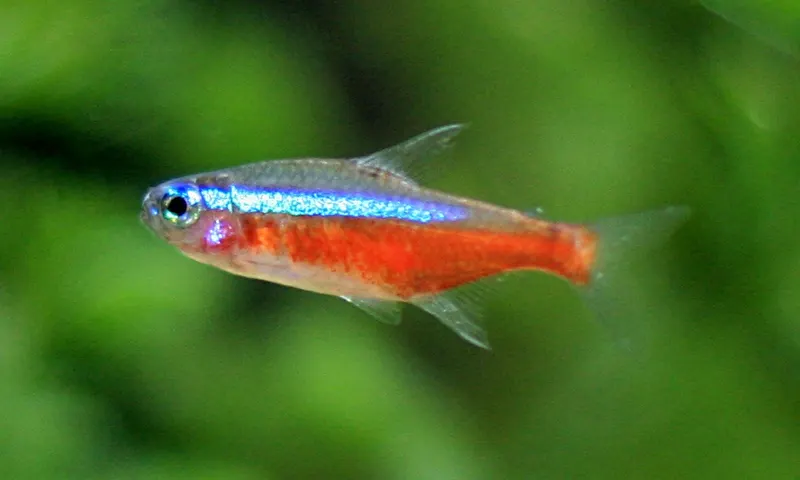
What they look like: iridescent blue line along the body with the lower body vivid red.
Native to: upper Orinoco and Negro Rivers in South America.
Edited by Marin Hale · last reviewed November 14, 2026 · How we check facts
Cardinal tetra size, lifespan and how many per tank
How big do cardinal tetras get?
Cardinal tetra size: adults reach 1.5–1.8 inches (3.8–4.6 cm).
How long do cardinal tetras live?
4–8 years with good care.
Do cardinal tetras need hard or soft water?
Cardinal tetras take a hardness (GH) of 1–12 dGH, about 18–210 ppm: soft to very hard water. Compare it with the hardness on your water report, which is given in ppm or mg/L.
How hard is your tap water? Austin · Denver · New York City · all cities
Bands from the US Geological Survey (soft up to 60 ppm, moderately hard up to 120, hard up to 180, very hard above); 1 dGH is about 17.9 ppm (Aquariadise).
How many cardinal tetras can you keep in a 5, 10 or 20-gallon tank?
| 5 gallons | Too small. Cardinal tetras need at least 15 gallons. |
|---|---|
| 10 gallons | Too small. Cardinal tetras need at least 15 gallons. |
| 20 gallons | Up to about 14 (keep at least 8) |
A cautious estimate from our crowding model, based on the minimum tank and group size rather than a published stocking list. With strong filtration, plants and weekly water changes, many keepers stock more. With other fish in the same part of the tank, fewer fit. How it works · Check a mixed tank
Sizes and lifespans are cross-checked across our sources: see where each value comes from.
Cardinal tetra care guide
Tank setup
| Heater | Yes. Set an adjustable heater to 75–82°F (24–28°C); cardinal tetras tolerate 73–84°F, and most rooms are cooler than that. |
|---|---|
| New tanks | Add only to an established, cycled tank. Not for a brand-new setup. |
Water for cardinal tetras: temperature, pH and hardness
Cardinal tetra temperature: keep them at 75–82°F (24–28°C); they tolerate 73–84°F (23–29°C).
Measure pH with the test kit. For hardness, a GH test or your water supplier’s report tells you what comes out of your tap.
Cardinal tetra behaviour and tank decor
Peaceful; best in a group of 8-10 with other schooling fishes for security.
- Plants and hiding places: heavily planted or natural-style set-up with sandy substrate, driftwood roots and branches, dried leaf litter, floating plants.
- Lighting: fairly dim lighting.
- Filter flow: gentle; sponge filter or slow canister outflow.
Signs of stress: colour duller with violet stripe at night; wild fish intolerant of deteriorating water conditions; colours fade when stressed; hides and fades when kept in groups of two or three; stops eating.
What do cardinal tetras eat?
Cardinal tetra diseases and health problems
- Dropsy. Signs: lopsided swelling, scales stick out, stops eating.
- White Spot Disease. Signs: small white spots on body and fins, like grains of salt.
- Wild-caught fish often have damaged fins, which helps tell them from bred fish.
- Shop fish are often half grown, around an inch long.
- Newly bought wild fish may refuse flakes for a few days; frozen brine shrimp or daphnia tempt them.
- Add only to a mature tank and acclimate slowly over 30 to 60 minutes.
Male vs female cardinal tetras, and breeding
How to tell male and female cardinal tetras apart: females are rounder-bodied and a little larger than males.
Breeding: Egg scatterer. Adults eat eggs; needs dim dedicated tank to raise fry.
How breeders do it (16 points from our sources)
- Mimic the natural setup: fine-leaved plants, very little light
- Dedicated, very dimly lit tank with fine-leaved plants, java moss or spawning mops, or mesh over the base
- Soft acidic water pH 5.5-6.5, gH 1-5, 26.5-29 °C
- Gentle air-powered sponge filter
- Condition with small live foods; spawn in a group (six of each sex) or in pairs
- Keep tank in complete darkness; remove adults at first sign of eggs
- Eggs hatch in 24-36 hours; fry free swimming 3-4 days later, feed infusoria then microworm or brine shrimp nauplii
- Keep eggs and fry in darkness, they are light sensitive
- 5- or 10-gallon breeding tank, acidic pH below 6.0, low GH, 27-29°C
- Catappa leaves, java fern or spawning mop on the bottom, with plastic craft mesh on top so eggs fall through
- Condition adults on live baby brine shrimp and tubifex; pick a full female and the best male, or use a group of at least 6
- Eggs hatch in 1-3 days; fry free swimming in 3-4 days, feed infusoria, vinegar eels, then baby brine shrimp
- Breeding water: 25-27°C, pH 5.5-6.5, GH 0-1, KH 0-1
- Very soft water, pH 5.5-6.0
- Egg scatterers; remove parents after spawning or they eat the eggs
- Eggs hatch after one day; raise fry on infusoria
- Wild fish are less tolerant of deteriorating water conditions than commercially-produced ones
- Can be shy if you suddenly walk in front of the tank
- Young angelfish and discus may eat small cardinals; use full-grown cardinals
- Most losses happen in the first weeks after purchase
- Wild-caught fish do better in genuinely soft, acidic waterSoft water / hardness: How many minerals are dissolved in the water (measured as GH). Your water supplier or a GH test can tell you.pH: How acidic or alkaline the water is; 7 is neutral, lower is more acidic.
- Can be shy around larger tank mates
Care tips
- Add cardinals only to a mature tank, since they are much less forgiving of ammonia and pH swings than hardy fish.Ammonia and nitrite: Poisons that build up from fish waste until the tank is cycled. A test kit measures them.
- Use drip acclimation when you bring them home, because they are sensitive to changes in water composition.Drip method: Letting tank water drip slowly into the fish's bag or bucket, so it adjusts to your water gradually.
- Keep them in a group of at least 8 in a tank of at least 15 gallons, with sandy substrate, driftwood and leaf litter, and fairly dim lighting.
- Keep the water between 75 and 82°F, the range where they do best, and watch for white spot disease, which they are relatively susceptible to.
Cardinal tetra tank mates
What can live with a cardinal tetra?
Verdicts against every species in our database, from our compatibility rules. How verdicts work
Easy picks for a 15-gallon tank: betta fish, celestial pearl danio, chili rasbora, ember tetra. Use the stocking calculator to check how many of each fit.
| Verdict | Species | Why | Smallest tank * |
|---|---|---|---|
| Good match | Betta fish | Both are comfortable at 75–82°F, pH 6.0–7.5. Peaceful together, and neither can eat the other. They share the tank well: bettas swim near the top, cardinal tetras mid-water. | 15 gal+ |
| Good match | Bristlenose pleco | Both are comfortable at 73–79°F, pH 5.8–7.5. Peaceful together, and neither can eat the other. They share the tank well: bristlenose plecos swim near the bottom, cardinal tetras mid-water. | 30 gal+ |
| Good match | Bronze corydoras | Both are comfortable at 73–82°F, pH 6.0–7.5. Peaceful together, and neither can eat the other. They share the tank well: bronze corydoras swim near the bottom, cardinal tetras mid-water. | 20 gal+ |
| Good match | Another cardinal tetra | Water needs overlap. Peaceful together, and neither can eat the other. | 15 gal+ |
| Good match | Celestial pearl danio | Both are comfortable at 73–79°F, pH 6.5–7.5. Peaceful together, and neither can eat the other. Both swim mid-water. | 15 gal+ |
| Good match | Chili rasbora | Both are comfortable at 73–82°F, pH 5.0–7.0. Peaceful together, and neither can eat the other. Both swim mid-water. | 15 gal+ |
| Good match | Ember tetra | Both are comfortable at 73–82°F, pH 5.0–7.0. Peaceful together, and neither can eat the other. Both swim mid-water. | 15 gal+ |
| Good match | Guppy | Both are comfortable at 73–82°F, pH 7.0–7.5. Peaceful together, and neither can eat the other. Both swim mid-water. | 15 gal+ |
| Good match | Harlequin rasbora | Both are comfortable at 73–82°F, pH 6.0–7.5. Peaceful together, and neither can eat the other. Both swim mid-water. | 15 gal+ |
| Good match | Honey gourami | Both are comfortable at 73–82°F, pH 6.0–7.5. Peaceful together, and neither can eat the other. Both swim mid-water. | 15 gal+ |
| Good match | Kuhli loach | Both are comfortable at 74–81°F, pH 5.5–7.0. Peaceful together, and neither can eat the other. They share the tank well: kuhli loaches swim near the bottom, cardinal tetras mid-water. | 20 gal+ |
| Good match | Neon tetra | Both are comfortable at 73–77°F, pH 6.0–7.0. Peaceful together, and neither can eat the other. Both swim mid-water. | 15 gal+ |
| Good match | Panda corydoras | Both are comfortable at 73–77°F, pH 6.0–7.5. Peaceful together, and neither can eat the other. They share the tank well: panda corydoras swim near the bottom, cardinal tetras mid-water. | 15 gal+ |
| Good match | Pygmy corydoras | Both are comfortable at 73–79°F, pH 6.2–7.4. Peaceful together, and neither can eat the other. Both swim mid-water. | 15 gal+ |
| Good match | Tiger barb | Both are comfortable at 73–80°F, pH 6.0–7.5. Peaceful together, and neither can eat the other. | 30 gal+ |
| Good match | Zebra danio | Both are comfortable at 73–77°F, pH 6.0–7.5. Peaceful together, and neither can eat the other. | 20 gal+ |
| Maybe | Amano shrimp | Cardinal tetras may pick off small or freshly molted Amano shrimp. Plants and hiding places help. | 15 gal+ |
| Maybe | Angelfish | Adult angelfish may eat small cardinal tetras. | 30 gal+ |
| Maybe | Cherry shrimp | Cardinal tetras eat baby shrimp and may pick off adults. Dense plants and moss help a colony survive. | 15 gal+ |
| Maybe | Molly | Cardinal tetras prefer softer water (1–12 dGH) than mollies (12–25 dGH). | 20 gal+ |
| Maybe | Platy | Cardinal tetras prefer softer water (1–12 dGH) than platies (10–20 dGH). | 20 gal+ |
| Maybe | Zebra nerite snail | pH ranges overlap only at pH 7.2–7.5, so one of them will be outside its comfort zone if your water drifts. | 15 gal+ |
| Avoid | Common goldfish | Common goldfish need cool water; cardinal tetras need tropical water. | — |
| Avoid | Fancy goldfish | Fancy goldfish need cool water; cardinal tetras need tropical water. | — |
| Avoid | White cloud minnow | White cloud minnows need cool water; cardinal tetras need tropical water. | — |
* Smallest tank: the larger of the two species’ own minimum tanks. It is not a stocking plan: a full group of each may need more room. Check exact numbers in the stocking calculator.
Questions
Do cardinal tetras need a heater?
They tolerate 73–84°F and do best at 75–82°F, so your tank needs to stay in that range. If your room can't hold it steadily, a heater is the usual way to do that.
What do cardinal tetras eat?
They are omnivores. Feed dried foods, plus live or frozen treats such as chironomid larvae, mosquito larvae, Daphnia and Moina.
What fish can live with cardinal tetras?
Our checks found no problems with neon tetras, ember tetras, harlequin rasboras, zebra danios, guppies, tiger barbs, bettas, bristlenose plecos, and bronze, panda and pygmy corydoras. Angelfish and cherry shrimp call for caution, because adult angelfish may eat small cardinals and cardinals eat baby shrimp. Mollies, platies and nerite snails prefer harder water than cardinals do. Common goldfish, fancy goldfish and white cloud minnows are a no, because they need cool water.
How many cardinal tetras should I keep together?
Keep at least 8. They reach 1.5–1.8 inches, and females are rounder-bodied and a little larger than males. A bigger group also helps if they are shy around larger tank mates.
Are cardinal tetras hard to keep?
Their care level is moderate. They do best in genuinely soft, acidic water, and wild-caught fish are less tolerant of deteriorating water conditions than commercially produced ones. Get the water stable before you buy them and acclimate them slowly.
Sources
(5 references, 27 facts with quotes)
Each value is cross-checked across the references below. Where they disagreed, an editor chose a value and recorded why.
- Cardinal tetra (en.wikipedia.org)
- Paracheirodon axelrodi (Seriously Fish) (www.seriouslyfish.com)
- Care Guide for Cardinal Tetras — Gorgeous Cousin of the ... (www.aquariumcoop.com)
- Cardinal Tetra (Paracheirodon axelrodi) (tropicalfishandaquariums.com)
- Paracheirodon axelrodi – Cardinal Tetra (aquainfo.nl)
- GBIF taxonomy record
- Wikidata entry
Where each value comes from (27 facts)
| Fact | What each source says |
|---|---|
| Adult size | en.wikipedia.org: “Growing to about 3 cm (1.2 in) in total length” seriouslyfish.com: “Max size 35mm SL1.4in SL” aquariumcoop.com: “grows up to 1.75 inches (4 cm) long in captivity” tropicalfishandaquariums.com: “Adult cardinal tetras measure 1.5–1.8 in (4–4.5 cm) in total length” aquainfo.nl: “These fish average around 4 to 4.5 centimeters in length (total length including the tail), although some females can grow up to 5 centimeters.” |
| Native to | en.wikipedia.org: “It is native to the upper Orinoco and Negro Rivers in South America.” seriouslyfish.com: “a small characid from the rio Negro and Orinoco drainages of Brazil, Colombia and Venezuela” aquariumcoop.com: “This species comes from the northern rivers of South America in countries like Brazil, Venezuela, and Columbia.” tropicalfishandaquariums.com: “Upper Rio Negro and upper Orinoco basins: northwestern Brazil, southern Venezuela and eastern Colombia” aquainfo.nl: “It occurs in countries such as Venezuela, Colombia, and Brazil.” |
| Water type | en.wikipedia.org: “is a species of freshwater fish of the family Acestrorhamphidae” seriouslyfish.com: “The water is typically acidic, of negligible carbonate hardness and conductivity” aquariumcoop.com: “Their native habitats include both blackwater streams ... and clearwater streams” tropicalfishandaquariums.com: “Keep the water at 75–82°F (24–28°C) with a pH of 5.0–6.5” aquainfo.nl: “These fish mainly live in small, shaded streams with clear water or in so-called blackwater rivers.” |
| Diet editor decision | en.wikipedia.org: “It is predominantly predatory, feeding on tiny animals found on underwater plants, roots, and leaf litter.” seriouslyfish.com: “Likely to be omnivorous feeding on small invertebrates, crustacea, filamentous algae, fallen fruit and suchlike in nature.” aquariumcoop.com: “In the wild, these micropredators feed on tiny crustaceans, insect larvae, little worms, and zooplankton.” tropicalfishandaquariums.com: “Diet Omnivore (micropredator)” aquainfo.nl: “The Cardinal Tetra is an omnivore, meaning it eats both plant and animal matter.” |
| Breeding type | en.wikipedia.org: “the pair release eggs and sperm.” seriouslyfish.com: “give the fish somewhere to deposit their eggs” aquariumcoop.com: “This egg scatterer likes to breed during the rainy season” tropicalfishandaquariums.com: “cardinals lay eggs, and a swollen female is simply full of eggs” aquainfo.nl: “Cardinal Tetras are egg scatterers; remove the parents after spawning, otherwise they will eat the eggs.” |
| Temperature | seriouslyfish.com: “Temperature: 23 – 29 °C73 – 84 °F” aquariumcoop.com: “pH levels of 4.0–7.5, soft to moderate hardness, and 73–84°F (23–29°C)” tropicalfishandaquariums.com: “Keep the water at 75–82°F (24–28°C) with a pH of 5.0–6.5, general hardness of 1–6 dGH and carbonate hardness of 1–3 dKH.” aquainfo.nl: “The water temperature should be between 23 and 29 degrees Celsius.” |
| pH editor decision | seriouslyfish.com: “pH: 3.5 – 7.5 although wild specimens do best in more acidic conditions.” aquariumcoop.com: “pH levels of 4.0–7.5, soft to moderate hardness, and 73–84°F (23–29°C)” tropicalfishandaquariums.com: “Keep the water at 75–82°F (24–28°C) with a pH of 5.0–6.5, general hardness of 1–6 dGH and carbonate hardness of 1–3 dKH.” aquainfo.nl: “A pH between 4.0 and 6.5 is suitable for this species.” |
| Smallest tank editor decision | seriouslyfish.com: “Volume ~54litres~14US gal” aquariumcoop.com: “at least 8–10 cardinal tetras for a 15- to 20-gallon aquarium or larger” tropicalfishandaquariums.com: “The minimum is 20 gallons (76 L) for a school of 6 to ten cardinals.” aquainfo.nl: “An aquarium at least 60 centimeters long (about 60 liters) is recommended for a school of 8 to 10 Cardinal Tetras.” |
| Group size | seriouslyfish.com: “Try to buy a mixed-sex group of at least 8-10 specimens” aquariumcoop.com: “we like to recommend getting at least 8–10 cardinal tetras for a 15- to 20-gallon aquarium or larger” tropicalfishandaquariums.com: “needs a group of 6 or more in a tank of at least 20 gallons (76 L)” aquainfo.nl: “look their best in a group of at least 8” |
| Temperament | seriouslyfish.com: “Generally peaceful making it an ideal resident of the well-researched community aquarium.” aquariumcoop.com: “As a very peaceful midwater schooling fish” tropicalfishandaquariums.com: “Cardinal tetras are peaceful and never bother other fish.” aquainfo.nl: “The Cardinal Tetra is a peaceful, gentle fish, making it very suitable for a community aquarium.” |
| Hardness (GH) | seriouslyfish.com: “Hardness: 1 – 12 dGH; towards the lower end of this range for wild fish or breeding.” tropicalfishandaquariums.com: “general hardness of 1–6 dGH and carbonate hardness of 1–3 dKH” aquainfo.nl: “The water hardness (dH) can range from 5 to 12.” |
| Telling males from females | seriouslyfish.com: “Sexually mature females are noticeably rounder-bodied and a little larger than males.” aquariumcoop.com: “Males are slimmer, while females are larger and rounder.” tropicalfishandaquariums.com: “adult females have a rounder, deeper belly and the blue stripe looks slightly bent where the body swells. Males are slimmer” aquainfo.nl: “Sometimes the male has a small hook on the anal fin, but this is not always the case.” |
| Care level editor decision | seriouslyfish.com: “Difficulty 6 of 8 measures Easy” tropicalfishandaquariums.com: “Care level Easy to moderate (in a mature, soft-water tank)” aquainfo.nl: “This species is sensitive to changes in water composition and water quality.” |
| Feeding | seriouslyfish.com: “does best when offered a varied menu which in this case should also contain live and frozen chironomid larvae (bloodworm), mosquito larvae, Daphnia, Moina, etc.” aquariumcoop.com: “Our favorite prepared foods include crushed flakes, nano pellets, freeze-dried tubifex worms, and Easy Fry and Small Fish Food.” tropicalfishandaquariums.com: “Feed 1–2 times a day, only what the school eats in about 2 minutes.” aquainfo.nl: “A varied menu of flake food is a good foundation. This can be supplemented with small live or frozen foods, such as Daphnia (water fleas) and newly hatched Artemia” |
| Breeding | seriouslyfish.com: “the adults will eat the eggs given the chance and should be removed as soon as eggs are noticed.” aquariumcoop.com: “Since adults will snack on their own offspring, we must be more creative about “hiding” the eggs when breeding them in captivity.” aquainfo.nl: “Breeding Cardinal Tetras is very difficult. Only reports of occasional successful breeding attempts can be found.” |
| Warnings | seriouslyfish.com: “wild specimens which are more intolerant of deteriorating water conditions than commercially-produced fish.” aquariumcoop.com: “make sure to get full-grown cardinal tetras for the discus and angelfish so that they won’t become an expensive snack” tropicalfishandaquariums.com: “They are much less forgiving of ammonia and pH swings than hardy fish, and most losses happen in the first weeks after purchase.” aquainfo.nl: “Paracheirodon axelrodi is a popular aquarium fish, but it is known to be relatively susceptible to certain diseases and changes in its environment.” |
| Substrate | seriouslyfish.com: “heavily-planted set-up or natural-style arrangement comprising a sandy substrate plus some driftwood roots and branches.” aquainfo.nl: “A dark substrate of sand or fine gravel, optionally supplemented with a layer of dried leaves (such as Catappa leaves), mimics the bottom of their natural blackwater biotope.” |
| Swims editor decision | aquariumcoop.com: “As a very peaceful midwater schooling fish” tropicalfishandaquariums.com: “Swimming level Middle to lower” aquainfo.nl: “They mainly swim in the middle levels of the aquarium” |
| Eats shrimp/snails editor decision | aquariumcoop.com: “they will opportunistically eat baby shrimp” tropicalfishandaquariums.com: “Adult amano shrimp and cherry shrimp are safe; some baby shrimp get eaten.” |
| Carbonate hardness (KH) editor decision | tropicalfishandaquariums.com: “general hardness of 1–6 dGH and carbonate hardness of 1–3 dKH” |
| Lifespan editor decision | tropicalfishandaquariums.com: “Lifespan 4–6 years (up to about 10)” aquainfo.nl: “In a well-maintained aquarium, however, they can live considerably longer, often 5 to 8 years, and sometimes even reach 10 years of age.” |
| Needs an established tank editor decision | tropicalfishandaquariums.com: “Add cardinals only to a mature tank that has run for at least a couple of months after cycling.” |
| Fin-nipper editor decision | tropicalfishandaquariums.com: “Cardinal tetras are peaceful and never bother other fish.” |
| Varieties | en.wikipedia.org: “A "gold" and "silver-blonde" form exists in the Rio Negro drainage that has less blue in the longitudinal stripe.” seriouslyfish.com: “selectively-produced ornamental strains including 'gold' and albino.” tropicalfishandaquariums.com: “Gold or leucistic cardinals have a pale body with a soft stripe, and albino cardinals have pink eyes and very little red.” aquainfo.nl: “"Platinum" or "golden" variants are also occasionally found in the wild” |
| Looks | en.wikipedia.org: “the striking iridescent blue line characteristic of the genus Paracheirodon laterally bisecting the fish, with the body below this line being vivid red in color” aquariumcoop.com: “has a full red stripe that stretches from the eye to tail.” tropicalfishandaquariums.com: “slim, torpedo-shaped body with an iridescent blue-green stripe that runs from the eye to the base of the adipose fin.” aquainfo.nl: “The Cardinal Tetra has an elongated, slender body.” |
| How often to feed | tropicalfishandaquariums.com: “Feed 1–2 times a day, only what the school eats in about 2 minutes.” |
| Diseases and signs | tropicalfishandaquariums.com: “If the swelling is lopsided, the scales stick out or the fish stops eating, check our guide to dropsy instead.” aquainfo.nl: “appears as small white spots on the fish's body and fins, resembling grains of salt.” |
Editor decisions (10)
- Seriously Fish, TFA and AquaInfo say omnivore; Wikipedia and Aquarium Co-op stress it is a micropredator. Both describe the same small-food diet; any non-herbivore diet is treated the same by the compatibility rules (only grazers are exempt from the predation check).
- Seriously Fish 3.5–7.5 and Aquarium Co-op 4.0–7.5; Tropical Fish & Aquariums and AquaInfo give 4.0–6.5 for wild fish. 5.0–7.5 suits the tank-raised fish most stores sell.
- Aquarium Co-op says 15–20 gallons for 8–10, Seriously Fish about 14 and AquaInfo about 16 (60 litres); TFA says 20.
- Seriously Fish and TFA say easy to moderate, but they need soft, acidic, stable water and a mature tank (TFA, AquaInfo), so not a first fish.
- Aquarium Co-op and AquaInfo: a midwater schooling fish; TFA's "middle to lower" is within that.
- Aquarium Co-op and TFA agree adults leave grown shrimp alone and may eat baby shrimp.
- TFA gives 1–3 dKH; Seriously Fish describes its home waters as having negligible carbonate hardness, which agrees.
- The 1-year figures (Wikipedia, Seriously Fish, Aquarium Co-op) describe wild fish, and each adds that they live much longer in aquariums. For aquarium fish: TFA 4–6 years, AquaInfo 5–8.
- TFA: add cardinals only to a tank that has run for at least a couple of months after cycling (an established tank, not just a cycled one).
- TFA: peaceful, never bother other fish; no source mentions nipping.
Cite this page
“Cardinal tetra care.” Fish Tank Atlas, last reviewed November 14, 2026. https://fishtankatlas.com/fish/cardinal-tetra/