Bristlenose pleco
Ancistrus cirrhosus · family Loricariidae
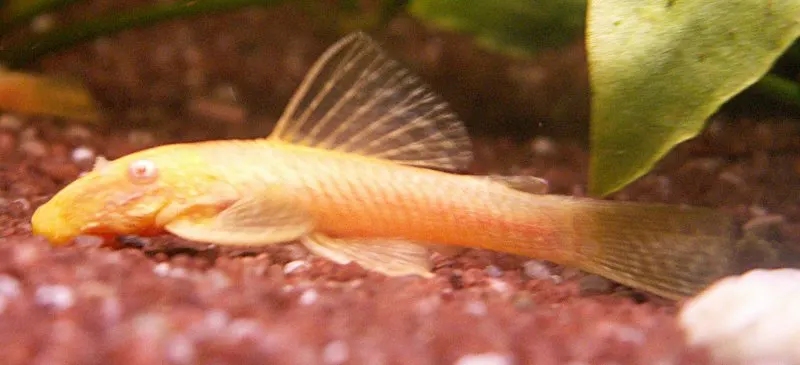
- Ideal temperature
- 73–77°F
- Smallest tank
- 30 gallons
- Keep at least
- 1
Bristlenose plecos in the aquarium trade are usually Ancistrus of uncertain species, often hybrids; this page covers the common brown bristlenose and its color forms.
The bristlenose pleco is a peaceful, bottom-dwelling catfish that grows to 4–5 inches and is rated easy to care for. It does best in a mature tank of at least 30 gallons with plenty of hiding places and bogwood or driftwood to graze on. The most important thing to know is that it can't live on algae alone, so it needs a mainly vegetable-based diet and a piece of wood in the tank.
Native to: Argentina, southern Brazil, Paraguay and Uruguay (Paraná-Paraguay and Uruguay river basins).
Edited by Marin Hale · last reviewed November 14, 2026 · How we check facts
Bristlenose pleco size, lifespan and how many per tank
How big do bristlenose plecos get?
Bristlenose pleco size: adults reach 4–5 inches (10.2–12.7 cm).
How long do bristlenose plecos live?
4–5 years with good care.
Do bristlenose plecos need hard or soft water?
Bristlenose plecos take a hardness (GH) of 3–19 dGH, about 54–340 ppm: soft to very hard water. Compare it with the hardness on your water report, which is given in ppm or mg/L.
How hard is your tap water? Austin · Denver · New York City · all cities
Bands from the US Geological Survey (soft up to 60 ppm, moderately hard up to 120, hard up to 180, very hard above); 1 dGH is about 17.9 ppm (Aquariadise).
How many bristlenose plecos can you keep in a 5, 10 or 20-gallon tank?
| 5 gallons | Too small. Bristlenose plecos need at least 30 gallons. |
|---|---|
| 10 gallons | Too small. Bristlenose plecos need at least 30 gallons. |
| 20 gallons | Too small. Bristlenose plecos need at least 30 gallons. |
| 30 gallons (its minimum) | Up to about 1 |
A cautious estimate from our crowding model, based on the minimum tank and group size rather than a published stocking list. With strong filtration, plants and weekly water changes, many keepers stock more. With other fish in the same part of the tank, fewer fit. How it works · Check a mixed tank
Sizes and lifespans are cross-checked across our sources: see where each value comes from.
Legal note, Hawaii: Bristlenose plecos (Ancistrus) are probably prohibited in Hawaii: we didn’t find them on any of Hawaii’s animal import lists, and Hawaii’s Department of Agriculture says any animal not on its lists is considered prohibited. Check with the department before bringing any to Hawaii. (Hawaii Department of Agriculture; checked November 18, 2026)
Bristlenose pleco care guide
Tank setup
| Heater | Yes. Set an adjustable heater to 73–77°F (23–25°C); bristlenose plecos tolerate 72–79°F, and most rooms are cooler than that. |
|---|---|
| New tanks | Add only to an established, cycled tank. Not for a brand-new setup. |
Water for bristlenose plecos: temperature, pH and hardness
Bristlenose pleco temperature: keep them at 73–77°F (23–25°C); they tolerate 72–79°F (22–26°C).
Measure pH with the test kit. For hardness, a GH test or your water supplier’s report tells you what comes out of your tap.
Bristlenose pleco behaviour and tank decor
Found in streams with a fast current and rocky substrate in the wild.
- Plants and hiding places: numerous hiding places including plenty of bogwood to graze on; plants are safe.
- Lighting: no special requirements for adults; dim lighting for breeding.
- Filter flow: strong current with plenty of oxygenation.
Signs of stress: older fish become less active and hide more.
What do bristlenose plecos eat?
Male vs female bristlenose plecos, and breeding
How to tell male and female bristlenose plecos apart: males have better developed snout tentacles than females.
Breeding: Cave spawner. Can breed in community tank but few fry survive; spawns up to every 6 weeks.
How breeders do it (11 points from our sources)
- Separate softwater spawning tank
- Small cave-like structures such as bogwood, rock and slate piles, clean new flowerpots
- Lighting not too bright
- Protect filter intakes with sponges to safeguard fry
- Male guards and fans the eggs
- Provide caves such as broken terra cotta pots so the male picks one to spawn in
- Move the male and eggs to a breeder net or separate 10 gallon tank
- Move fry to a seasoned grow-out tank and return the father to the main tank
- Remove father and eggs as soon as possible so the fry survive
- Male guards and fans the eggs until hatching in about 4-5 days
- Feed fry newly hatched brine shrimp and finely crushed flakes
- Needs bogwood to graze on (lignin)
- Needs many hiding places
- Algae alone is not enough, must be supplemented
- Needs driftwood
- Two mature males in a small tank can fight, causing injury or death
Care tips
- Add bogwood or driftwood and plenty of hiding spots, since this nocturnal fish grazes on the wood and hides during the day.
- Feed algae wafers, catfish pellets and vegetables like cucumber, lettuce or peas, and remove any leftover food, because bristlenose plecos are prone to obesity.
- Use soft gravel or sand to protect their barbels, and give them strong current with plenty of oxygenation.Soft water / hardness: How many minerals are dissolved in the water (measured as GH). Your water supplier or a GH test can tell you.
- Plan on more frequent water changes, as this fish has a high bioload, and add it only to a mature tank.
Bristlenose pleco tank mates
What can live with a bristlenose pleco?
Verdicts against every species in our database, from our compatibility rules. How verdicts work
Easy picks for a 30-gallon tank: amano shrimp, angelfish, betta fish, bronze corydoras. Use the stocking calculator to check how many of each fit.
| Verdict | Species | Why | Smallest tank * |
|---|---|---|---|
| Good match | Amano shrimp | Both are comfortable at 72–79°F, pH 6.0–7.6. Peaceful together, and neither can eat the other. Both swim near the bottom. | 30 gal+ |
| Good match | Angelfish | Both are comfortable at 75–79°F, pH 6.0–7.5. Peaceful together, and neither can eat the other. | 30 gal+ |
| Good match | Betta fish | Both are comfortable at 75–79°F, pH 6.0–7.5. Peaceful together, and neither can eat the other. They share the tank well: bettas swim near the top, bristlenose plecos near the bottom. | 30 gal+ |
| Good match | Bronze corydoras | Both are comfortable at 72–79°F, pH 6.0–8.0. Peaceful together, and neither can eat the other. Both swim near the bottom. | 30 gal+ |
| Good match | Cardinal tetra | Both are comfortable at 73–79°F, pH 5.8–7.5. Peaceful together, and neither can eat the other. They share the tank well: cardinal tetras swim mid-water, bristlenose plecos near the bottom. | 30 gal+ |
| Good match | Celestial pearl danio | Both are comfortable at 72–79°F, pH 6.5–8.0. Peaceful together, and neither can eat the other. They share the tank well: celestial pearl danios swim mid-water, bristlenose plecos near the bottom. | 30 gal+ |
| Good match | Cherry shrimp | Both are comfortable at 72–79°F, pH 6.5–8.0. Peaceful together, and neither can eat the other. | 30 gal+ |
| Good match | Chili rasbora | Both are comfortable at 72–79°F, pH 5.8–7.0. Peaceful together, and neither can eat the other. They share the tank well: chili rasboras swim near the top and mid-water, bristlenose plecos near the bottom. | 30 gal+ |
| Good match | Ember tetra | Both are comfortable at 73–79°F, pH 5.8–7.0. Peaceful together, and neither can eat the other. Both swim near the bottom. | 30 gal+ |
| Good match | Guppy | Both are comfortable at 72–79°F, pH 7.0–8.0. Peaceful together, and neither can eat the other. They share the tank well: guppies swim near the top and mid-water, bristlenose plecos near the bottom. | 30 gal+ |
| Good match | Harlequin rasbora | Both are comfortable at 72–79°F, pH 6.0–7.5. Peaceful together, and neither can eat the other. They share the tank well: harlequin rasboras swim near the top and mid-water, bristlenose plecos near the bottom. | 30 gal+ |
| Good match | Honey gourami | Both are comfortable at 72–79°F, pH 6.0–7.5. Peaceful together, and neither can eat the other. They share the tank well: honey gouramis swim near the top and mid-water, bristlenose plecos near the bottom. | 30 gal+ |
| Good match | Kuhli loach | Both are comfortable at 74–79°F, pH 5.8–7.0. Peaceful together, and neither can eat the other. Both swim near the bottom. | 30 gal+ |
| Good match | Molly | Both are comfortable at 72–79°F, pH 7.0–8.0. Peaceful together, and neither can eat the other. They share the tank well: mollies swim near the top and mid-water, bristlenose plecos near the bottom. | 30 gal+ |
| Good match | Neon tetra | Both are comfortable at 72–77°F, pH 6.0–7.0. Peaceful together, and neither can eat the other. They share the tank well: neon tetras swim mid-water, bristlenose plecos near the bottom. | 30 gal+ |
| Good match | Panda corydoras | Both are comfortable at 72–77°F, pH 6.0–7.7. Peaceful together, and neither can eat the other. Both swim near the bottom. | 30 gal+ |
| Good match | Platy | Both are comfortable at 72–79°F, pH 7.0–8.0. Peaceful together, and neither can eat the other. They share the tank well: platies swim near the top and mid-water, bristlenose plecos near the bottom. | 30 gal+ |
| Good match | Pygmy corydoras | Both are comfortable at 72–79°F, pH 6.2–7.4. Peaceful together, and neither can eat the other. Both swim near the bottom. | 30 gal+ |
| Good match | Tiger barb | Both are comfortable at 72–79°F, pH 6.0–8.0. Peaceful together, and neither can eat the other. | 30 gal+ |
| Good match | Zebra danio | Both are comfortable at 72–77°F, pH 6.0–8.0. Peaceful together, and neither can eat the other. | 30 gal+ |
| Good match | Zebra nerite snail | Both are comfortable at 72–79°F, pH 7.2–8.0. Peaceful together, and neither can eat the other. | 30 gal+ |
| Maybe | Another bristlenose pleco | Male bristlenose plecos claim a cave and a patch of the bottom as territory. One is simplest; for more than one, give each its own cave and plenty of floor space. | 30 gal+ |
| Avoid | Common goldfish | Common goldfish need cool water; bristlenose plecos need tropical water. | — |
| Avoid | Fancy goldfish | Fancy goldfish need cool water; bristlenose plecos need tropical water. | — |
| Avoid | White cloud minnow | White cloud minnows need cool water; bristlenose plecos need tropical water. | — |
* Smallest tank: the larger of the two species’ own minimum tanks. It is not a stocking plan: a full group of each may need more room. Check exact numbers in the stocking calculator.
Questions
Do bristlenose plecos need a heater?
They are tropical fish that tolerate 72–79°F, with an ideal range of 73–77°F. If your room doesn't stay in that range, a heater will keep the water steady.
What do bristlenose plecos eat?
They are herbivores that eat mainly vegetable-based foods such as algae wafers, catfish pellets, cucumber, lettuce and peas, with meaty foods only occasionally. Algae alone isn't enough, and they also need bogwood to graze on. Don't overfeed, since they gain weight easily.
What fish can live with bristlenose plecos?
They are peaceful and our checks found no problems with angelfish, bettas, bronze, panda and pygmy corydoras, cardinal and neon tetras, ember tetras, guppies, harlequin rasboras, mollies, platies, tiger barbs, zebra danios, cherry shrimp and zebra nerite snails. Common and fancy goldfish and white cloud minnows are not a match, because they need cooler water than bristlenose plecos do.
Can you keep more than one bristlenose pleco together?
Our checks found no problems keeping them with others of their own kind, but two mature males in a small tank can fight and cause injury or death. Males have better developed snout tentacles than females, which is how you can tell them apart.
Can bristlenose plecos breed in a home aquarium?
Yes, they are cave spawners and can spawn up to every 6 weeks. They can breed in a community tank, but few fry survive.
Sources
(4 references, 22 facts with quotes)
Each value is cross-checked across the references below. Where they disagreed, an editor chose a value and recorded why.
- Ancistrus cirrhosus (en.wikipedia.org)
- Bristlenose Catfish-Ancistrus (www.fishkeeper.co.uk)
- Bristlenose Pleco Care (Ancistrus spp) (www.fishlore.com)
- Bristlenose Catfish (Ancistrus cirrhosus) - Care, Feeding, ... (en.aqua-fish.net)
- GBIF taxonomy record
- Wikidata entry
Where each value comes from (22 facts)
| Fact | What each source says |
|---|---|
| Adult size editor decision | en.wikipedia.org: “Ancistrus cirrhosus reaches a standard length of 9.1 cm (3.6 in).” fishkeeper.co.uk: “Maximum Size 12cm (4.72")” fishlore.com: “Size : generally up to 6 inches (15 cm).” en.aqua-fish.net: “Usual size in fish tanks: 11 - 15 cm (4.33 - 5.91 inch)” |
| Native to | en.wikipedia.org: “it occurs in Argentina, southern Brazil, Paraguay and Uruguay in the Paraná-Paraguay and Uruguay river basins” fishkeeper.co.uk: “South American rivers. Many specimens offered for sale in the trade are tank-bred.” fishlore.com: “Origin / Habitat : South America, Amazon River basin and tributaries” en.aqua-fish.net: “Where the species comes from: South America” |
| Telling males from females | en.wikipedia.org: “these are better developed in the males than they are in females.” fishkeeper.co.uk: “Older males develop bushy-like growths on the head.” fishlore.com: “Males may have more and longer bristles near the mouth than females.” en.aqua-fish.net: “Males are typically larger and develop more pronounced bristles around their heads.” |
| Temperature editor decision | fishkeeper.co.uk: “Temperature 23-27°C” fishlore.com: “Temperature : 68°F - 77°F (20°C - 25°C)” en.aqua-fish.net: “Recommended temperature range: 22 - 26 °C (71.6 - 78.8°F)” |
| pH | fishkeeper.co.uk: “pH: 5.5-8.0, dH: up to 20 degrees.” fishlore.com: “pH 6 - 8” en.aqua-fish.net: “Recommended pH range: 5.8 - 7.6” |
| Diet editor decision | fishkeeper.co.uk: “Ancistrus sp. are primarily vegetarian” en.aqua-fish.net: “In the wild, their diet consists of plant matter, small invertebrates, and organic debris.” |
| Safe with plants editor decision | fishkeeper.co.uk: “Plants may be safely kept with Bristlenose Catfish” |
| Needs an established tank editor decision | fishkeeper.co.uk: “Bristlenose Catfish must only be added to mature aquariums.” en.aqua-fish.net: “Always ensure the tank is properly cycled before introducing the fish.” |
| Breeding type | fishkeeper.co.uk: “Bristlenose are secretive cave spawners” fishlore.com: “I break a lot of terra cotta pots to make caves.” en.aqua-fish.net: “They are cave spawners, so provide a variety of caves or tubes” |
| Feeding | fishkeeper.co.uk: “it is important to ensure that these fish receive a diet that is mainly vegetable based.” fishlore.com: “Eats algae and will appreciate fresh veggies like cucumber and zucchinni.” en.aqua-fish.net: “Feed your Bristlenose once or twice daily, but be mindful not to overfeed, as they are prone to obesity.” |
| Breeding | fishkeeper.co.uk: “can be bred in the community aquarium, although high numbers of fry are unlikely to survive under such circumstances.” en.aqua-fish.net: “Breeding Ancistrus cirrhosus is straightforward and can be accomplished in most home aquariums.” |
| Warnings | fishkeeper.co.uk: “Bristlenose catfish prefer a strong water current with plenty of oxygenation.” fishlore.com: “They do have a high bioload, so you have to prepared to do more frequent water changes.” en.aqua-fish.net: “Bristlenose catfish cannot survive on algae alone.” |
| Lifespan | fishlore.com: “Lifespan : 3 to 4 years” en.aqua-fish.net: “Bristlenose catfish can live for 4-6 years in captivity with proper care.” |
| Smallest tank editor decision | fishlore.com: “Aquarium Size : 30 gallons (115 liters)” en.aqua-fish.net: “a minimum tank size of 20 gallons (75 liters) is suitable” |
| Temperament | fishlore.com: “Peaceful but may be territorial with conspecifics” en.aqua-fish.net: “Temperament toward other fish species: peaceful” |
| Swims editor decision | fishlore.com: “Tank Region : All over” en.aqua-fish.net: “Usual place in the tank: Bottom levels” |
| Care level editor decision | fishlore.com: “Care Level : Easy” |
| Hardness (GH) | fishlore.com: “Water Hardness : 2° to 20° dH” en.aqua-fish.net: “Recommended water hardness: 4 - 18°N (71.43 - 321.43ppm)” |
| Substrate | en.aqua-fish.net: “The substrate should be soft gravel or sand to prevent damage to their sensitive barbels” |
| How often to feed | fishkeeper.co.uk: “Algae wafers and tablets are ideal, with the occasional addition of some vegetable matter such as cucumber, lettuce, or peeled steamed peas.” fishlore.com: “Fresh veggies should be in the tank for 24/7. Leave 24 hours and replace with a fresh piece.” en.aqua-fish.net: “Feed your Bristlenose once or twice daily, but be mindful not to overfeed, as they are prone to obesity.” |
| Varieties | fishkeeper.co.uk: “Albino, mottled, orange, snow white and long-finned varieties are available.” fishlore.com: “There are albino varieties as well.” |
| Group size editor decision | fishlore.com: “Peaceful but may be territorial with conspecifics” |
Editor decisions (9)
- Maidenhead gives 4.7 in and Aqua-Fish 4.3–5.9 in for aquarium fish; FishLore says up to 6 in. Wikipedia's 3.6 in is standard length (without the tail) for wild A. cirrhosus.
- Maidenhead 73–81°F, Aqua-Fish 72–79°F and FishLore 68–77°F; 72–79°F is comfortable across them.
- Maidenhead: Ancistrus are primarily vegetarian (algae, vegetables); Aqua-Fish notes they also pick at small invertebrates and debris. A grazer, not a hunter.
- Fishkeeper: plants may be safely kept with bristlenose; Aqua-Fish gives planted-tank advice for them. They graze algae off leaves rather than eat the plants.
- Maidenhead: bristlenose catfish must only be added to mature aquariums (they graze the algae and biofilm of an established tank). Aqua-Fish's "cycle first" alone wouldn't count.
- FishLore says 30 gallons and Aqua-Fish 20; one bristlenose produces a lot of waste for its size, so we use the larger figure.
- Aqua-Fish: bottom levels. FishLore's "all over" reflects it grazing the glass and decor; it rests and feeds on the bottom.
- FishLore rates it easy; the other sources describe a hardy, peaceful fish without special needs.
- No source asks for a group. FishLore: peaceful but may be territorial with its own kind, so one is the usual choice.
Cite this page
“Bristlenose pleco care.” Fish Tank Atlas, last reviewed November 14, 2026. https://fishtankatlas.com/fish/bristlenose-pleco/