Molly
Poecilia sphenops · family Poeciliidae
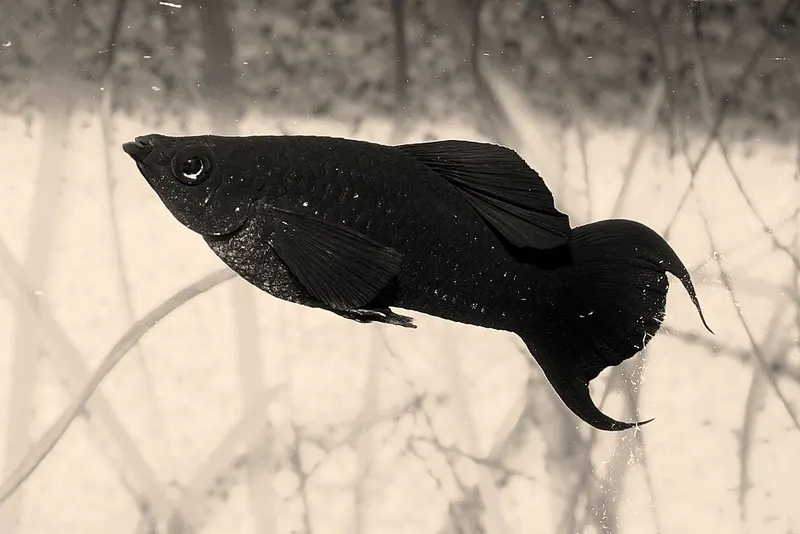
- Ideal temperature
- 75–79°F
- Smallest tank
- 20 gallons
- Keep at least
- 3 together
Mollies in stores are mostly hybrids of the common, sailfin and Yucatan mollies (Poecilia sphenops, P. latipinna, P. velifera); this page covers the common aquarium molly, including balloon and dalmatian forms.
The molly (Poecilia sphenops) is a peaceful, easy-care livebearer from Mexico, Guatemala, and Honduras. It stays about 4–5 inches long, lives roughly 3–5 years, and does best in a tank of at least 20 gallons. The most important thing to know is that mollies want moderately hard to hard, basic water (pH 7–8.5, 12–25 dGH) and do best in slightly brackish conditions. They weaken in soft or acidic water.
What they look like: more streamlined body than platies, with flat mouths.
Native to: Mexico, Guatemala, and Honduras.
Edited by Marin Hale · last reviewed November 14, 2026 · How we check facts
Molly size, lifespan and how many per tank
How big do mollies get?
Molly size: adults reach 4–5 inches (10.2–12.7 cm).
How long do mollies live?
3–5 years with good care.
Are mollies hard water fish?
Yes. Mollies need a hardness (GH) of 12–25 dGH, about 210–450 ppm: very hard water. Tap water softer than about 210 ppm is below their range.
How hard is your tap water? Austin · Denver · New York City · all cities
Bands from the US Geological Survey (soft up to 60 ppm, moderately hard up to 120, hard up to 180, very hard above); 1 dGH is about 17.9 ppm (Aquariadise).
How many mollies can you keep in a 5, 10 or 20-gallon tank?
| 5 gallons | Too small. Mollies need at least 20 gallons. |
|---|---|
| 10 gallons | Too small. Mollies need at least 20 gallons. |
| 20 gallons | Up to about 4 (keep at least 3) |
A cautious estimate from our crowding model, based on the minimum tank and group size rather than a published stocking list. With strong filtration, plants and weekly water changes, many keepers stock more. With other fish in the same part of the tank, fewer fit. How it works · Check a mixed tank
Sizes and lifespans are cross-checked across our sources: see where each value comes from.
Molly care guide
Tank setup
| Heater | Yes. Set an adjustable heater to 75–79°F (24–26°C); mollies tolerate 70–82°F, and most rooms are cooler than that. |
|---|
Water for mollies: temperature, pH and hardness
Molly temperature: keep them at 75–79°F (24–26°C); they tolerate 70–82°F (21–28°C).
Measure pH with the test kit. For hardness, a GH test or your water supplier’s report tells you what comes out of your tap.
Molly behaviour and tank decor
Browses on green algae in the aquarium and readily accepts dried food.
- Plants and hiding places: planted tank preferable.
- Lighting: no special requirements.
- Filter flow: moderate water flow.
Signs of stress: shimmying; fungus; clamped fins.
What do mollies eat?
Molly diseases and health problems
- Weakness and disease in soft or acidic water. Signs: shimmying, fungus, clamped fins.
- Swimbladder and digestive problems. Signs: body malformed and rounded, may bring premature death.
- Ich Fungus, and livebearer disease; add minerals.
- Livebearer disease Add minerals.
At the shop: don’t buy from a tank where any of them show these signs.
Male vs female mollies, and breeding
How to tell male and female mollies apart: females are larger; males are more intensely colored.
Several females to every male.
Breeding: Livebearer. Livebearer, up to 150 young after about a month; breeds through much of the year.
How breeders do it (11 points from our sources)
- At least two to three females for every male
- Areas of dense planting help
- Remove the gravid female to a separate tank to give birth, then return her to the main aquarium
- Do not use breeding nets or traps
- Fry accept brine shrimp nauplii or powdered flake from birth
- Wait 30 to 60 days for fry
- Adults eat their young, so provide dense plants as hiding spots
- Keep at least 2 females to every male
- Gestation about 28 days, 20 to 150 free-swimming young
- Gestation about 4-6 weeks, 20-50 fry
- Well-planted tank or breeding box protects fry from adults
- Needs moderately hard or harder, basic water; weakens in soft or acidic waterSoft water / hardness: How many minerals are dissolved in the water (measured as GH). Your water supplier or a GH test can tell you.pH: How acidic or alkaline the water is; 7 is neutral, lower is more acidic.
- Many morphs are weak and prone to disease from inbreeding
- Fish-farm brackish-bred mollies can suffer kidney failure when moved to fresh water
- Prefer higher pH, KH, and GH
- Sailfin hybrid forms need salt and high carbonate hardness
Care tips
- Keep the water between 70–82°F, ideally 75–79°F, with a heater if your room needs one to hold that range.
- Aim for pH 7–8.5 and 12–25 dGH, and add minerals if your tap water is soft, because soft water can lead to ich, fungus, and livebearer disease.
- Do regular water changes and keep conditions steady, since mollies are sensitive to poor water quality.
- Feed a varied omnivore diet with plenty of vegetable matter, such as blanched spinach or vegetable flake.
Molly tank mates
What can live with a molly?
Verdicts against every species in our database, from our compatibility rules. How verdicts work
Easy picks for a 20-gallon tank: betta fish, bronze corydoras, guppy, honey gourami. Use the stocking calculator to check how many of each fit.
| Verdict | Species | Why | Smallest tank * |
|---|---|---|---|
| Good match | Angelfish | Both are comfortable at 75–82°F, pH 7.0–7.5. Peaceful together, and neither can eat the other. | 30 gal+ |
| Good match | Betta fish | Both are comfortable at 75–82°F, pH 7.0–7.5. Peaceful together, and neither can eat the other. Both swim near the top. | 20 gal+ |
| Good match | Bristlenose pleco | Both are comfortable at 72–79°F, pH 7.0–8.0. Peaceful together, and neither can eat the other. They share the tank well: bristlenose plecos swim near the bottom, mollies near the top and mid-water. | 30 gal+ |
| Good match | Bronze corydoras | Both are comfortable at 70–82°F, pH 7.0–8.0. Peaceful together, and neither can eat the other. They share the tank well: bronze corydoras swim near the bottom, mollies near the top and mid-water. | 20 gal+ |
| Good match | Guppy | Both are comfortable at 72–82°F, pH 7.0–8.0. Peaceful together, and neither can eat the other. Both swim near the top and mid-water. | 20 gal+ |
| Good match | Honey gourami | Both are comfortable at 72–82°F, pH 7.0–7.5. Peaceful together, and neither can eat the other. Both swim near the top and mid-water. | 20 gal+ |
| Good match | Another molly | Water needs overlap. Peaceful together, and neither can eat the other. | 20 gal+ |
| Good match | Platy | Both are comfortable at 70–80°F, pH 7.0–8.1. Peaceful together, and neither can eat the other. Both swim near the top and mid-water. | 20 gal+ |
| Good match | Tiger barb | Both are comfortable at 72–80°F, pH 7.0–8.0. Peaceful together, and neither can eat the other. | 30 gal+ |
| Good match | Zebra danio | Both are comfortable at 70–77°F, pH 7.0–8.0. Peaceful together, and neither can eat the other. | 20 gal+ |
| Good match | Zebra nerite snail | Both are comfortable at 70–82°F, pH 7.2–8.4. Peaceful together, and neither can eat the other. | 20 gal+ |
| Maybe | Amano shrimp | Amano shrimp prefer softer water (6–14 dGH) than mollies (12–25 dGH). | 20 gal+ |
| Maybe | Cardinal tetra | Cardinal tetras prefer softer water (1–12 dGH) than mollies (12–25 dGH). | 20 gal+ |
| Maybe | Celestial pearl danio | Adult mollies may eat small celestial pearl danios. | 20 gal+ |
| Maybe | Ember tetra | pH ranges overlap only at pH 7.0, so one of them will be outside its comfort zone if your water drifts. | 20 gal+ |
| Maybe | Harlequin rasbora | Harlequin rasboras prefer softer water (1–12 dGH) than mollies (12–25 dGH). | 20 gal+ |
| Maybe | Kuhli loach | pH ranges overlap only at pH 7.0, so one of them will be outside its comfort zone if your water drifts. | 20 gal+ |
| Maybe | Neon tetra | pH ranges overlap only at pH 7.0, so one of them will be outside its comfort zone if your water drifts. | 20 gal+ |
| Maybe | Panda corydoras | Panda corydoras prefer softer water (2–12 dGH) than mollies (12–25 dGH). | 20 gal+ |
| Maybe | Pygmy corydoras | pH ranges overlap only at pH 7.0–7.4, so one of them will be outside its comfort zone if your water drifts. | 20 gal+ |
| Avoid | Cherry shrimp | Cherry shrimp prefer softer water (4–8 dGH) than mollies (12–25 dGH). | — |
| Avoid | Chili rasbora | pH ranges overlap only at pH 7.0, so one of them will be outside its comfort zone if your water drifts. | — |
| Avoid | Common goldfish | Common goldfish need cool water; mollies need tropical water. | — |
| Avoid | Fancy goldfish | Fancy goldfish need cool water; mollies need tropical water. | — |
| Avoid | White cloud minnow | White cloud minnows need cool water; mollies need tropical water. | — |
* Smallest tank: the larger of the two species’ own minimum tanks. It is not a stocking plan: a full group of each may need more room. Check exact numbers in the stocking calculator.
Questions
Do mollies need a heater?
Mollies are tropical fish that tolerate 70–82°F, and they do best at 75–79°F. A heater is the simplest way to hold the tank in that range and keep it steady.
What do mollies eat?
Mollies are omnivores, and a good share of their diet should be vegetable matter such as blanched spinach or vegetable flake.
What fish can live with mollies?
Peaceful tank mates with no problems found include guppies, platies, angelfish, betta fish, bristlenose plecos, bronze corydoras, zebra danios, tiger barbs, and zebra nerite snails. Neon tetras, cardinal tetras, ember tetras, harlequin rasboras, panda corydoras, and pygmy corydoras come with a caution, mostly because they prefer softer water than mollies. Adult mollies may also eat small neon tetras, ember tetras, and pygmy corydoras. Avoid cherry shrimp, which mollies will hunt and eat. Also avoid goldfish and white cloud minnows, which need cooler water than mollies do.
How many mollies should I keep together?
Keep several females to every male. Females are larger, and males are more intensely colored, so they are easy to tell apart.
How do mollies breed?
Mollies are livebearers. A female can have up to 150 young after about a month, and they breed through much of the year.
Sources
(5 references, 23 facts with quotes)
Each value is cross-checked across the references below. Where they disagreed, an editor chose a value and recorded why.
- Poecilia sphenops (en.wikipedia.org)
- Poecilia sphenops (Seriously Fish) (www.seriouslyfish.com)
- Care Guide for Mollies – Feeding, Breeding, and Tank Mates (www.aquariumcoop.com)
- Sphenops Molly (www.fishkeeper.co.uk)
- Short-Finned Molly (Poecilia sphenops) Care Guide (en.aqua-fish.net)
- GBIF taxonomy record
- Wikidata entry
Where each value comes from (23 facts)
| Fact | What each source says |
|---|---|
| Adult size editor decision | en.wikipedia.org: “P. sphenops can grow to 8.4 cm (3.3 in) standard length or 10 cm (3.9 in) total length, but is usually smaller.” seriouslyfish.com: “Max size 80mm SL3.1in SL” aquariumcoop.com: “can reach up to 4-5 inches (10-13 cm) in length” fishkeeper.co.uk: “Maximum Size 10cm (4")” en.aqua-fish.net: “Usual size in fish tanks: 12 - 15 cm (4.72 - 5.91 inch)” |
| Breeding type | en.wikipedia.org: “P. sphenops is a livebearer, producing up to 150 young after a month-long gestation.” seriouslyfish.com: “Reproduces in standard livebearer fashion.” aquariumcoop.com: “This prolific livebearer” fishkeeper.co.uk: “Mollies are livebearers, and after 28 days gestation” en.aqua-fish.net: “The way how these fish reproduce: Pseudo-Livebearer” |
| Native to | en.wikipedia.org: “P. sphenops itself as being native to Mexico, Guatemala, and Honduras.” seriouslyfish.com: “native range runs north from Venezuela and Colombia to Mexico” fishkeeper.co.uk: “Central and South America: Mexico to Colombia.” en.aqua-fish.net: “Where the species comes from: Central America” |
| Telling males from females | en.wikipedia.org: “females growing around 1 cm (0.39 in) larger than males. Males, which are the more intensely colored sex” seriouslyfish.com: “The male is smaller, more colourful and possesses a gonopodium.” aquariumcoop.com: “A male can be identified by his stick-shaped anal fin called a gonopodium, whereas a female has a fan-shaped anal fin.” fishkeeper.co.uk: “Males are generally smaller and possess a gonopodium.” en.aqua-fish.net: “Mature females tend to be larger than males and have a more rounded belly” |
| Breeding | en.wikipedia.org: “producing up to 150 young after a month-long gestation.” seriouslyfish.com: “The adult fish will predate on the young” aquariumcoop.com: “The adult mollies will predate on their own young” fishkeeper.co.uk: “the female will release between 20 and 150 free-swimming young.” en.aqua-fish.net: “After a gestation period of about 4-6 weeks, the female will give birth to a batch of fry, numbering between 20-50.” |
| Temperature editor decision | seriouslyfish.com: “Temperature: 21 – 28 °C70 – 82 °F” aquariumcoop.com: “raise the temperature to 75-80°F (24-27°C)” fishkeeper.co.uk: “Temperature 18-28°C” en.aqua-fish.net: “Recommended temperature range: 21 - 26 °C (69.8 - 78.8°F)” |
| pH | seriouslyfish.com: “pH: 7.0-8.5” fishkeeper.co.uk: “pH: 7.5-8.5, dH: 8-25 degrees.” en.aqua-fish.net: “Recommended pH range: 7 - 8.5” |
| Smallest tank editor decision | seriouslyfish.com: “Volume ~81litres~21US gal” aquariumcoop.com: “we recommend getting an aquarium that holds at least 20 gallons of water” |
| Temperament | seriouslyfish.com: “Peaceful but should only be kept with fish that can tolerate the same water conditions.” aquariumcoop.com: “Generally speaking, mollies are peaceful fish.” en.aqua-fish.net: “Temperament toward other fish species: peaceful” |
| Care level | seriouslyfish.com: “Difficulty5 of 8 measures Easy” aquariumcoop.com: “While molly fish are fairly easy to care for” |
| Diet | seriouslyfish.com: “Omnivorous by nature, feeding on a variety of zoobenthos and detritus in the wild.” aquariumcoop.com: “Because they are omnivores, provide a good mix of proteins and vegetables” en.aqua-fish.net: “is an omnivorous species with a strong preference for plant-based foods” |
| Hardness (GH) editor decision | seriouslyfish.com: “Hardness: 15-30 dH” fishkeeper.co.uk: “pH: 7.5-8.5, dH: 8-25 degrees.” en.aqua-fish.net: “Recommended water hardness: 12 - 18°N (214.29 - 321.43ppm)” |
| Male:female ratio | seriouslyfish.com: “we recommend that several females should be kept to every male in order to dissipate this.” aquariumcoop.com: “we recommend getting at least two to three females for every male.” fishkeeper.co.uk: “Try to keep at least 2 females to every male” |
| Feeding | seriouslyfish.com: “a good proportion of the diet should be composed of vegetable matter such as blanched spinach or vegetable flake.” aquariumcoop.com: “provide a good mix of proteins and vegetables in the form of high-quality flakes, pellets, frozen foods, and Repashy Soilent Green gel food.” fishkeeper.co.uk: “A good quality flake food should be alternated with a green vegetable flake food and frozen foods” en.aqua-fish.net: “Feeding should be done in small portions twice daily to prevent overfeeding and maintain water quality.” |
| Warnings | seriouslyfish.com: “When kept in soft or acidic water, the fish weakens fairly rapidly, frequently indicated by shimmying, fungus, and/or clamped fins.” aquariumcoop.com: “the change in water parameters can cause their kidneys to shut down.” fishkeeper.co.uk: “Does best in slightly brackish water.” en.aqua-fish.net: “Mollies are particularly sensitive to poor water conditions, so maintaining stable water parameters is key to their health.” |
| Eats shrimp/snails editor decision | aquariumcoop.com: “Avoid putting larger mollies with smaller animals like cherry shrimp because they will most likely get eaten.” |
| Lifespan editor decision | en.aqua-fish.net: “typically lives up to 3 years in captivity... some Mollies have been reported to live up to 5 years.” |
| Swims editor decision | en.aqua-fish.net: “Usual place in the tank: Top levels” |
| Varieties | en.wikipedia.org: “The black molly is commonly defined in aquarium literature as a black breeding form of P. sphenops” seriouslyfish.com: “There are also Gold, Green, Lyretail, Silver and Dalmation varieties.” aquariumcoop.com: “black, dalmatian, lyretail, balloon, gold dust, marble, platinum, creamsicle, and other variations.” fishkeeper.co.uk: “Black and orange-tailed marble forms are well established, with gold forms being more recently produced. All can be found as lyretail forms.” |
| Diseases and signs | seriouslyfish.com: “When kept in soft or acidic water, the fish weakens fairly rapidly, frequently indicated by shimmying, fungus, and/or clamped fins.” aquariumcoop.com: “they may develop diseases like ich (white spot disease), fungus, and livebearer disease.” |
| Looks | aquariumcoop.com: “They have a more streamlined body compared to platies” fishkeeper.co.uk: “as their name suggests, the males do not possess a high dorsal fin” |
| How often to feed | en.aqua-fish.net: “Feeding should be done in small portions twice daily to prevent overfeeding and maintain water quality.” |
| Group size editor decision | aquariumcoop.com: “we recommend getting at least two to three females for every male” fishkeeper.co.uk: “These livebearing fish are best kept in groups, to reduce harassment keep several females to each male.” |
Editor decisions (8)
- Aquarium Co-op says 4–5 in, Maidenhead 4 in and Aqua-Fish 4.7–5.9 in for aquarium mollies; Seriously Fish's 3.1 in is standard length for wild P. sphenops.
- Seriously Fish 70–82°F and Maidenhead 64–82°F; Aquarium Co-op recommends 75–80°F as the ideal.
- Aquarium Co-op says at least 20 gallons and Seriously Fish about 21 (81 litres).
- Mollies need hard water: Seriously Fish 15–30, Maidenhead 8–25, Aqua-Fish 12–18 dGH; 12–25 covers what most sources recommend.
- Aquarium Co-op: larger mollies will most likely eat small animals like cherry shrimp.
- Single source: Aqua-Fish says typically up to 3 years, some reported to 5.
- Aqua-Fish: top levels. Mollies, like the other livebearers (guppy, platy), use the upper and middle water; top-only would put them in the betta's surface zone.
- Aquarium Co-op: at least two to three females for every male; Fishkeeper: best kept in groups with more females than males. One male and two females is the smallest group that fits.
Cite this page
“Molly care.” Fish Tank Atlas, last reviewed November 14, 2026. https://fishtankatlas.com/fish/molly/