Celestial pearl danio
Danio margaritatus · family Cyprinidae
- Ideal temperature
- 73–78°F
- Smallest tank
- 10 gallons
- Keep at least
- 6 together
Also sold as galaxy rasbora; it's a danio, not a rasbora.
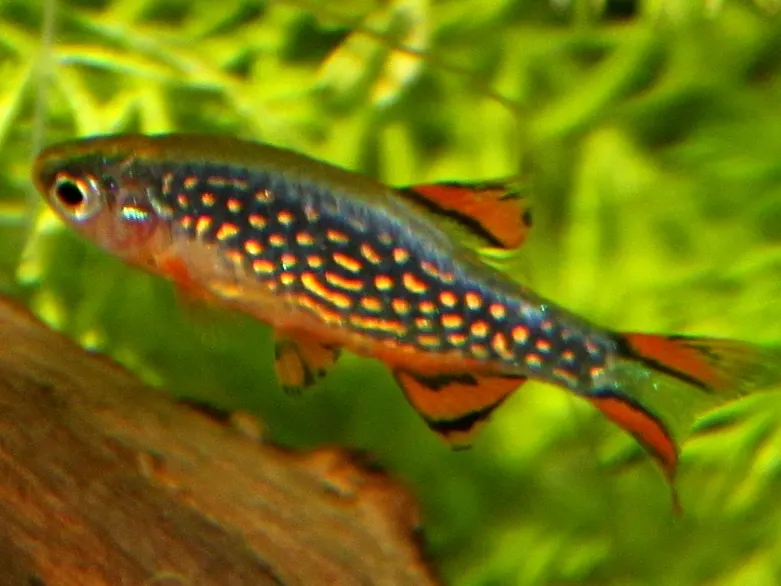
The celestial pearl danio (Danio margaritatus) is a tiny, peaceful freshwater fish from Myanmar and Northern Thailand. It is sometimes sold as the galaxy rasbora, but it is a danio, not a rasbora. It is easy to care for and needs a 10-gallon tank, a group of at least 6, and a mature, planted tank, because newly set-up tanks and poor water quality are hard on it.
What they look like: spotted pattern giving a miniature trout-like look.
Native to: Myanmar and Northern Thailand (Salween basin).
Edited by Marin Hale · last reviewed November 20, 2026 · How we check facts
Celestial pearl danio size, lifespan and how many per tank
How big do celestial pearl danios get?
Celestial pearl danio size: adults reach about 1 inch (2.5 cm).
How long do celestial pearl danios live?
3–5 years with good care.
Do celestial pearl danios need hard or soft water?
Celestial pearl danios take a hardness (GH) of 5–15 dGH, about 90–270 ppm: moderately hard to very hard water. Compare it with the hardness on your water report, which is given in ppm or mg/L.
How hard is your tap water? Austin · Denver · New York City · all cities
Bands from the US Geological Survey (soft up to 60 ppm, moderately hard up to 120, hard up to 180, very hard above); 1 dGH is about 17.9 ppm (Aquariadise).
How many celestial pearl danios can you keep in a 5, 10 or 20-gallon tank?
| 5 gallons | Too small. Celestial pearl danios need at least 10 gallons. |
|---|---|
| 10 gallons | Up to about 8 (keep at least 6) |
| 20 gallons | Up to about 16 (keep at least 6) |
A cautious estimate from our crowding model, based on the minimum tank and group size rather than a published stocking list. With strong filtration, plants and weekly water changes, many keepers stock more. With other fish in the same part of the tank, fewer fit. How it works · Check a mixed tank
Sizes and lifespans are cross-checked across our sources: see where each value comes from.
Celestial pearl danio care guide
Tank setup
| Heater | Yes. Set an adjustable heater to 73–78°F (23–26°C); celestial pearl danios tolerate 72–79°F, and most rooms are cooler than that. |
|---|---|
| Substrate | Dark substrate |
| New tanks | Add only to an established, cycled tank. Not for a brand-new setup. |
Water for celestial pearl danios: temperature, pH and hardness
Celestial pearl danio temperature: keep them at 73–78°F (23–26°C); they tolerate 72–79°F (22–26°C).
Measure pH with the test kit. For hardness, a GH test or your water supplier’s report tells you what comes out of your tap.
Celestial pearl danio behaviour and tank decor
Not very active, rather stationary, hovers in favorite spots; not a true shoaling fish.
- Plants and hiding places: well-planted with abundant water weed, stones and wood for hiding spots, spawning mop or dense plants.
- Lighting: direct daylight may be favorable; well lit.
- Filter flow: gentle filtration, air-powered sponge filter.
Signs of stress: skittish without broken lines of sight; less bold and poorer colour in small groups; rapid breathing; clamped fins; severe hiding.
What do celestial pearl danios eat?
Celestial pearl danio diseases and health problems
- Fin rot. Signs: fin edges become discoloured and frail, parts may fall off.
- Morphological deformities and spotted fins from intensive breeding. Signs: spots or blotches instead of stripes in the pelvic and anal fins.
- Dropsy. Signs: raised, sticking-out scales (pineconing).
- Stress. Signs: from aggression, poor water quality, overcrowding or unsuitable temperatures.
- Buy from reputable breeder or reliable store.
- Clear eyes, intact fins, active and alert.
- Bright colours, strong appetite, relaxed breathing.
- Avoid rapid breathing, clamped fins, emaciation, white spots, hiding, lethargy.
Male vs female celestial pearl danios, and breeding
How to tell male and female celestial pearl danios apart: males bright blue with brighter fins and a small black pad on the lower jaw; females dull blue-green with a black anal spot.
At least as many females as males.
Breeding: Egg scatterer, hides eggs in dense vegetation. Spawns almost every day, about 30 eggs per spawning; prolific.
How breeders do it (16 points from our sources)
- Provide a spawning mop or dense plants such as java moss
- Dense plant tangle harbors protists that fry feed on initially
- Set up 10-15 litre containers with aged water
- Fill with fine wool mops, Taxiphyllum or fine-leaved plants
- Add a single pair or one or two males with several females
- Remove adults after spawning, they eat eggs
- Feed fry Paramecium or 5-50 micron dry food, then Artemia nauplii
- At least six fish so both sexes present
- Move spawning media to separate tank to protect eggs
- Fry food under 50 µm such as infusoria, green water, vinegar eels, then baby brine shrimp
- Feed nutritious foods and keep tank clean
- Use sponge filter or inlet cover
- Fry eat infusoria first, then microfoods
- No specific breeding season
- Feed good supply of live food to trigger breeding
- Females lay in low-flow spots around plants
- Cannot be kept with large or bully fish
- Comes from slightly alkaline water in the wild, but does well anywhere in its pH range; keeping the pH stable matters more than the exact valuepH: How acidic or alkaline the water is; 7 is neutral, lower is more acidic.
- Newly imported fish often in poor condition and hard to acclimatiseSoft water / hardness: How many minerals are dissolved in the water (measured as GH). Your water supplier or a GH test can tell you.
- Avoid driftwood and leaf litter; tannins not in natural water
- Inbred stock often has deformities or spotted fins
- Can hybridise with Danio erythromicron
Care tips
- Add them only to a mature tank, and keep the water clean and stable, since they are sensitive to poor water quality and stress.
- Keep at least 6 together, with at least as many females as males, so the males don't fight over the females.
- Give them dense plants, a dark substrate and a securely fitting lid, and keep the current gentle because they struggle in strong flow.
- Feed small foods, such as small dried foods plus daily Daphnia or Artemia, and fill filter inlets with sponge so these tiny fish can't get sucked in.
Celestial pearl danio tank mates
What can live with a celestial pearl danio?
Verdicts against every species in our database, from our compatibility rules. How verdicts work
Easy picks for a 10-gallon tank: amano shrimp, cherry shrimp, chili rasbora, ember tetra. Use the stocking calculator to check how many of each fit.
| Verdict | Species | Why | Smallest tank * |
|---|---|---|---|
| Good match | Amano shrimp | Both are comfortable at 72–79°F, pH 6.5–7.6. Peaceful together, and neither can eat the other. Both swim mid-water. | 10 gal+ |
| Good match | Bristlenose pleco | Both are comfortable at 72–79°F, pH 6.5–8.0. Peaceful together, and neither can eat the other. They share the tank well: bristlenose plecos swim near the bottom, celestial pearl danios mid-water. | 30 gal+ |
| Good match | Bronze corydoras | Both are comfortable at 72–79°F, pH 6.5–8.0. Peaceful together, and neither can eat the other. They share the tank well: bronze corydoras swim near the bottom, celestial pearl danios mid-water. | 20 gal+ |
| Good match | Cardinal tetra | Both are comfortable at 73–79°F, pH 6.5–7.5. Peaceful together, and neither can eat the other. Both swim mid-water. | 15 gal+ |
| Good match | Another celestial pearl danio | Water needs overlap. Peaceful together, and neither can eat the other. | 10 gal+ |
| Good match | Cherry shrimp | Both are comfortable at 72–79°F, pH 6.5–8.0. Peaceful together, and neither can eat the other. | 10 gal+ |
| Good match | Chili rasbora | Both are comfortable at 72–79°F, pH 6.5–7.0. Peaceful together, and neither can eat the other. Both swim mid-water. | 10 gal+ |
| Good match | Ember tetra | Both are comfortable at 73–79°F, pH 6.5–7.0. Peaceful together, and neither can eat the other. Both swim mid-water. | 10 gal+ |
| Good match | Harlequin rasbora | Both are comfortable at 72–79°F, pH 6.5–7.5. Peaceful together, and neither can eat the other. Both swim mid-water. | 15 gal+ |
| Good match | Honey gourami | Both are comfortable at 72–79°F, pH 6.5–7.5. Peaceful together, and neither can eat the other. Both swim mid-water. | 10 gal+ |
| Good match | Kuhli loach | Kuhli loaches reach about 4 inches but are eel-thin with tiny mouths, and they feed on small sinking foods, not on tank mates; small fish like celestial pearl danios are safe with them. | 20 gal+ |
| Good match | Neon tetra | Both are comfortable at 72–77°F, pH 6.5–7.0. Peaceful together, and neither can eat the other. Both swim mid-water. | 10 gal+ |
| Good match | Panda corydoras | Both are comfortable at 72–77°F, pH 6.5–7.7. Peaceful together, and neither can eat the other. They share the tank well: panda corydoras swim near the bottom, celestial pearl danios mid-water. | 10 gal+ |
| Good match | Platy | Both are comfortable at 72–79°F, pH 7.0–8.0. Peaceful together, and neither can eat the other. Both swim mid-water. | 20 gal+ |
| Good match | Pygmy corydoras | Both are comfortable at 72–79°F, pH 6.5–7.4. Peaceful together, and neither can eat the other. Both swim mid-water. | 10 gal+ |
| Good match | Zebra nerite snail | Both are comfortable at 72–79°F, pH 7.2–8.0. Peaceful together, and neither can eat the other. | 10 gal+ |
| Maybe | Betta fish | Celestial pearl danios mostly nip each other, but they may also go after a betta's long fins. Keep a full group in a planted tank, watch the betta's fins, and be ready to separate them. | 10 gal+ |
| Maybe | Guppy | Celestial pearl danios mostly nip each other, but they may also go after male guppies' long tails. Watch the guppies' fins and be ready to separate them. | 10 gal+ |
| Maybe | Molly | Adult mollies may eat small celestial pearl danios. | 20 gal+ |
| Maybe | Tiger barb | Tiger barbs can harass much smaller, peaceful celestial pearl danios. | 30 gal+ |
| Maybe | Zebra danio | Zebra danios can harass much smaller, peaceful celestial pearl danios. | 20 gal+ |
| Avoid | Angelfish | Celestial pearl danios are small enough for adult angelfish to eat. | — |
| Avoid | Common goldfish | Common goldfish need cool water; celestial pearl danios need tropical water. | — |
| Avoid | Fancy goldfish | Fancy goldfish need cool water; celestial pearl danios need tropical water. | — |
| Avoid | White cloud minnow | White cloud minnows need cool water; celestial pearl danios need tropical water. | — |
* Smallest tank: the larger of the two species’ own minimum tanks. It is not a stocking plan: a full group of each may need more room. Check exact numbers in the stocking calculator.
Questions
Do celestial pearl danios need a heater?
They are tropical fish that tolerate 72–79°F, and they do best at 73–78°F. A heater is the simplest way to keep the water in that range.
What do celestial pearl danios eat?
They are omnivores with tiny mouths, so they need small foods. Offer small dried foods plus small live or frozen foods such as Daphnia and Artemia every day. Don't feed them dried food alone.
What fish can live with celestial pearl danios?
Good tank mates include Amano shrimp, cherry shrimp, kuhli loaches, cardinal tetras, ember tetras, chili rasbora, harlequin rasbora, honey gouramis, platies and corydoras, such as bronze, panda and pygmy. Use caution with bettas, guppies, mollies, tiger barbs and zebra danios. Avoid angelfish, goldfish and white cloud minnows. They also can't be kept with large or bully fish.
How big do celestial pearl danios get, and how many should I keep?
Adults reach about 1 inch and live 3 to 5 years. Keep a group of at least 6 in a tank of 10 gallons or more. The tank should be at least 45 x 30 cm, because the males spar.
How can I tell male and female celestial pearl danios apart?
Males are bright blue with brighter fins and a small black pad on the lower jaw. Females are a duller blue-green with a black anal spot. Keep at least as many females as males, because too many males can lead to injury or death.
Sources
(6 references, 28 facts with quotes)
Each value is cross-checked across the references below. Where they disagreed, an editor chose a value and recorded why.
- Danio margaritatus (en.wikipedia.org)
- Danio margaritatus (Seriously Fish) (www.seriouslyfish.com)
- Care Guide for Celestial Pearl Danios – Miniature Trout for Aquascapes (www.aquariumcoop.com)
- Celestial Pearl Danio Care: Tank Size, Diet and More | Chewy (www.chewy.com)
- Galaxy Rasbora Care & Info | Danio margaritatus - The Shrimp Farm (www.theshrimpfarm.com)
- Celestial Pearl Danio Care Guide (aka Galaxy Rasbora) (www.aquariumsource.com)
- GBIF taxonomy record
- Wikidata entry
Where each value comes from (28 facts)
| Fact | What each source says |
|---|---|
| Adult size | en.wikipedia.org: “measuring 2–2.5 cm standard length, a few individuals are able to reach 3 cm” seriouslyfish.com: “Max size 21mm SL0.8in SL” aquariumcoop.com: “They grow up to 1 inch (2.5 cm) long” chewy.com: “Celestial pearl danios grow to about 1 inch long.” aquariumsource.com: “The average Celestial Pearl Danio size is about one inch in length when fully grown.” |
| Group size editor decision | en.wikipedia.org: “a group of six individuals—half males, half females—will do well and exhibit natural behavior” seriouslyfish.com: “Buy as many as possible, ideally 20 or more” aquariumcoop.com: “we strongly suggest buying 10–15 CPDs since they can be a bit timid” chewy.com: “Keep at least six celestial pearl danios together” theshrimpfarm.com: “get a group of at least 10!” aquariumsource.com: “We recommend keeping 6 to 7 fish in the same tank.” |
| Temperament | en.wikipedia.org: “The celestial pearl danio seems overall quite peaceful, though some fin-nipping occurs.” aquariumcoop.com: “No, CPDs are peaceful nano fish that do well with other community fish.” chewy.com: “Celestial pearl danios are peaceful, beginner-friendly freshwater fish.” theshrimpfarm.com: “Galaxy rasboras make a great choice for a peaceful community aquarium.” aquariumsource.com: “For the most part, Celestial Pearl Danios are peaceful fish.” |
| Fin-nipper editor decision | en.wikipedia.org: “The celestial pearl danio seems overall quite peaceful, though some fin-nipping occurs.” seriouslyfish.com: “It's not uncommon to see nipped fins within a group though this behaviour does not normally extend to tankmates.” aquariumcoop.com: “they may do some fin nipping amongst their own species, they rarely go after other tank mates” chewy.com: “males may become territorial and chase or occasionally nip one another, particularly during breeding” theshrimpfarm.com: “galaxy rasboras may nip at longer-finned fish. They're not the best tankmates for Bettas or guppies.” |
| Water type | en.wikipedia.org: “is a small freshwater ray-finned fish belonging to the family Danionidae” seriouslyfish.com: “a miniature cyprinid from the Salween drainage in Shan State” aquariumcoop.com: “Celestial pearl danios are cold water fish? While they can live up to 78°F” chewy.com: “are freshwater fish that have quickly become favorites” theshrimpfarm.com: “small and colorful schooling fish to add some life to your shrimp aquarium” aquariumsource.com: “are a beautiful freshwater species that we recommend all the time” |
| Breeding type | en.wikipedia.org: “they are hidden away in vegetation as a loose batch” seriouslyfish.com: “this species is an egg-scattering spawner that shows no parental care.” aquariumcoop.com: “They are egg layers that prefer to spawn in media, so provide dense plants like java moss or a DIY yarn spawning mop.” theshrimpfarm.com: “Galaxy rasboras are egg scatterers” aquariumsource.com: “Celestial Pearl Danios are egg layers.” |
| Native to | en.wikipedia.org: “This fish is from Myanmar and Northern Thailand (in Salween basin).” seriouslyfish.com: “It's since been found in waters associated with the Salween (aka Thanlwin) River throughout southern Shan and even across the border in northern Thailand.” aquariumcoop.com: “they come from Southeast Asia and live in shallow waters with dense vegetation” chewy.com: “These nano fish are native to Myanmar in Southeast Asia” theshrimpfarm.com: “Galaxy rasboras are naturally found in the Asian countries of Myanmar and Thailand.” aquariumsource.com: “They were originally found occupying small ponds in Myanmar.” |
| Telling males from females | en.wikipedia.org: “males have a bright-blue background color (dull blue-green in females), and their fins are more brightly colored.” seriouslyfish.com: “Females have a blue-green base body colouration and less prominent, weakly red to orange colour patches in the fins” aquariumcoop.com: “Male celestial pearl danios (above) are more brightly colored, while females are rounder in shape.” chewy.com: “males are often more intensely blue, while females are generally rounder and less brightly colored” theshrimpfarm.com: “Females are a little bit duller. Their bellies lack the orange coloration and are generally off-white in color, without dots.” aquariumsource.com: “Generally, males are more slender than females.” |
| Male:female ratio editor decision | en.wikipedia.org: “a group of six individuals—half males, half females—will do well” aquariumsource.com: “we recommend keeping more females in the tank.” |
| Safe with plants | en.wikipedia.org: “Tanks for the celestial pearl danio should be well-planted” aquariumsource.com: “The plants help to keep the water in good condition while also giving the fish plenty of things to snack on or hide in.” |
| Breeding | en.wikipedia.org: “The celestial pearl danio is prolific, spawning "almost every day"” seriouslyfish.com: “If the fish are in good condition they will spawn often and in a densely-planted, mature aquarium it's possible that small numbers of fry may start to appear without intervention.” aquariumcoop.com: “once the females start developing large bellies full of eggs, they will likely spawn almost every day” theshrimpfarm.com: “The species doesn't have a specific breeding season, so they're usually in the mood year-round.” aquariumsource.com: “She can lay upwards of 30 eggs at once time.” |
| Warnings editor decision | en.wikipedia.org: “Consequently, it cannot be kept with large or "bully" fish.” seriouslyfish.com: “Newly-imported specimens are often in poor condition and can be difficult to acclimatise to aquarium life” aquariumcoop.com: “since CPDs sometimes like to hide, consider adding some dither fish” chewy.com: “They prefer gentle water flow and may struggle in tanks with strong currents.” theshrimpfarm.com: “The tiny fry can easily get sucked into a regular filter.” aquariumsource.com: “Males will fight over females constantly. This can lead to serious injury or even death.” |
| Looks | chewy.com: “Their spotted patterns give them a miniature trout-like appearance.” en.wikipedia.org: “small, plump danionin with a markedly blunt snout” seriouslyfish.com: “Males have a steel-to-deep blue body colouration extending over the majority of the flanks and intense red and black striping in all fins except the pectorals.” aquariumcoop.com: “striking golden spots scattered on their dark bodies” theshrimpfarm.com: “they sport a beautiful pattern of shimmering dots on a dark body. Their fins feature dashes of bright orange.” aquariumsource.com: “The base coloration of these fish is deep blue. However, their bodies are covered in pearl-like spots.” |
| Temperature editor decision | seriouslyfish.com: “Temperature 20–26°C68–79°F” aquariumcoop.com: “While they can live up to 78°F (26°C), they thrive in lower temperatures from 72–76°F (22–24°C).” chewy.com: “Temperature: 72–78 F; however, 72–76 F is ideal, as they prefer slightly lower temperatures” theshrimpfarm.com: “Temperature: 70-80 °F” aquariumsource.com: “Water Temperature: 73°F to 79°F” |
| pH | seriouslyfish.com: “pH: 6.5 – 7.5; a value of 7.3 was recorded at the type locality.” aquariumcoop.com: “They can handle a fairly wide range of pH from 6.6–8.0” chewy.com: “pH: 6.6–8.0” theshrimpfarm.com: “pH: 6.5-8” aquariumsource.com: “pH Levels: 6.5 to 7.5” |
| Hardness (GH) editor decision | seriouslyfish.com: “Hardness: 5 – 15 dGH” chewy.com: “Hardness level: Soft to moderate (5 to 15 dGH)” theshrimpfarm.com: “Hardness: 1-5 dGH” |
| Smallest tank editor decision | seriouslyfish.com: “we wouldn't keep a group of these in anything with base dimensions measuring less than 45 ∗ 30 cm” aquariumcoop.com: “if you purchase a bigger school of 10–15 fish as recommended, go for a 20-gallon aquarium or larger” chewy.com: “A 10-gallon aquarium can house a small group of celestial pearl danios” theshrimpfarm.com: “A 10-gallon long aquarium would be alright, but it's probably best to go for 15+ gallons.” aquariumsource.com: “the minimum tank size for Celestial Pearl Danios is 10 gallons.” |
| Care level | seriouslyfish.com: “Difficulty5 of 8 measures Easy” chewy.com: “Celestial pearl danios are peaceful, beginner-friendly freshwater fish.” theshrimpfarm.com: “Difficulty level Easy” aquariumsource.com: “Celestial Pearl Danio care isn’t difficult. They’re relatively hardy” |
| Swims editor decision | seriouslyfish.com: “as it rarely rises to the surface there's little point in offering floating products” aquariumcoop.com: “Since they like to swim in the middle of the tank” aquariumsource.com: “Galaxy Rasboras spend most of their time at the bottom half of the fish tank” |
| Diet | seriouslyfish.com: “Likely to feed on small invertebrates, algae and other zooplankton in nature.” aquariumcoop.com: “Their favorite meals include baby brine shrimp, frozen cyclops and daphnia, and micro worms.” chewy.com: “Celestial pearl danios are omnivores.” theshrimpfarm.com: “Wild galaxy rasboras are omnivorous.” aquariumsource.com: “Celestial Pearl Danios are omnivores.” |
| Substrate | seriouslyfish.com: “This timid species should ideally be kept in a heavily-planted set-up, preferably with a dark substrate.” chewy.com: “Small gravel, sand, or aquatic plant substrate” theshrimpfarm.com: “the galaxy rasbora probably prefers a dark substrate” aquariumsource.com: “Dark fine sand is a good choice due to its versatility.” |
| Feeding | seriouslyfish.com: “Daily meals of small live and frozen fare such as Daphnia, Artemia and suchlike will not only result in the best colouration” aquariumcoop.com: “try feeding tiny, slow-sinking foods in the water column” chewy.com: “Micro pellets Crushed flakes Baby brine shrimp Daphnia” theshrimpfarm.com: “You can consider a staple diet of very fine flakes or pellets meant for microfish.” aquariumsource.com: “In captivity, the fish will do just fine on commercially available flakes or pellets.” |
| How often to feed | seriouslyfish.com: “Daily meals of small live and frozen fare such as Daphnia, Artemia and suchlike” chewy.com: “Feed younger fish smaller foods two to three times a day and adults once a day.” |
| Diseases and signs | seriouslyfish.com: “specimens with spots or blotches instead of stripes in the pelvic and anal fins or morphological deformities are now common in the ornamental trade” chewy.com: “Dropsy: Sometimes called pineconing because scales are raised and stick out” aquariumsource.com: “Fin rot, in particular, is known to affect Celestial Pearl Danios.” |
| Eats shrimp/snails editor decision | aquariumcoop.com: “expect the CPDs to predate on any baby shrimp they find” chewy.com: “Celestial pearl danios can live with adult cherry shrimp, but they may eat baby shrimp.” theshrimpfarm.com: “They might eat newly hatched shrimp fry” |
| Lifespan | chewy.com: “Celestial pearl danios can live for 3–5 years.” aquariumsource.com: “the average Celestial Pearl Danio lifespan is between 3 and 5 years in captivity” |
| Needs an established tank editor decision | chewy.com: “can be good beginner fish when kept in a mature, cycled aquarium with stable water parameters” theshrimpfarm.com: “it does require a clean and fully cycled aquarium to thrive” |
| Carbonate hardness (KH) editor decision | aquariumsource.com: “Water Hardness: 2 – 10 dKH” |
Editor decisions (11)
- Wikipedia ('a group of six'), Chewy ('at least six') and Aquarium Source (6–7) state six as the minimum. Aquarium Co-op suggests 10–15, The Shrimp Farm 'at least 10' and Seriously Fish 'ideally 20' because they're timid: the page can say bigger groups are bolder.
- The nipping the sources describe is within their own group: Seriously Fish ('does not normally extend to tankmates'), Aquarium Co-op ('rarely go after other tank mates'), Chewy (males nip one another). Only The Shrimp Farm warns about long-finned fish ('not the best tankmates for Bettas or guppies'); that is handled as a caution override on those pairs rather than the general fin-nipper rule, which would wrongly fail them with shrimp.
- Wikipedia: a group of six, half males and half females, does well; Aquarium Source recommends more females than males because males fight over females. Both fit 'at least as many females as males'.
- Wikipedia's warning that the high pH of the Inle basin 'seems a necessary condition' is hedged; Seriously Fish (6.5–7.5), Aquarium Co-op and Chewy (6.6–8.0) and The Shrimp Farm ('do well in a pH of anywhere between 6.5-8. Stability is more important') all keep them across a range. The warning now says so; the other warnings are unchanged.
- Aquarium Co-op and Chewy 72–78°F (both: 72–76 ideal), Aquarium Source 73–79, Seriously Fish 68–79, The Shrimp Farm 70–80. 72–79°F is the shared range; they prefer the cooler half.
- Seriously Fish and Chewy both give 5–15 dGH; The Shrimp Farm's 1–5 is the only soft-water outlier.
- Chewy and Aquarium Source: 10 gallons for a small group; Seriously Fish's 45 × 30 cm footprint is about the same; The Shrimp Farm: a 10-gallon long 'would be alright', 15+ better. Aquarium Co-op's 20 is for a school of 10–15. With a group of six, 10 gallons rather than the rounded median of 11.
- Seriously Fish and Aquarium Co-op place them in the middle of the tank; only Aquarium Source adds the bottom. Middle, so the crowding model doesn't count them against bottom dwellers such as corydoras.
- All three sources mean baby shrimp only: Chewy ('can live with adult cherry shrimp, but they may eat baby shrimp'), Aquarium Co-op and The Shrimp Farm (newly hatched fry). Same rule as ember tetra, harlequin rasbora and white cloud minnow.
- Chewy: good beginner fish 'when kept in a mature, cycled aquarium with stable water parameters'; The Shrimp Farm: 'requires a clean and fully cycled aquarium to thrive'. Both ask for stable, cycled water, so the established-tank note applies (as for chili rasbora).
- Aquarium Source: 2–10 dKH, the only source with a KH figure; it fits Seriously Fish's and Chewy's 5–15 dGH general hardness.
Cite this page
“Celestial pearl danio care.” Fish Tank Atlas, last reviewed November 20, 2026. https://fishtankatlas.com/fish/celestial-pearl-danio/