Honey gourami
Trichogaster chuna · family Osphronemidae
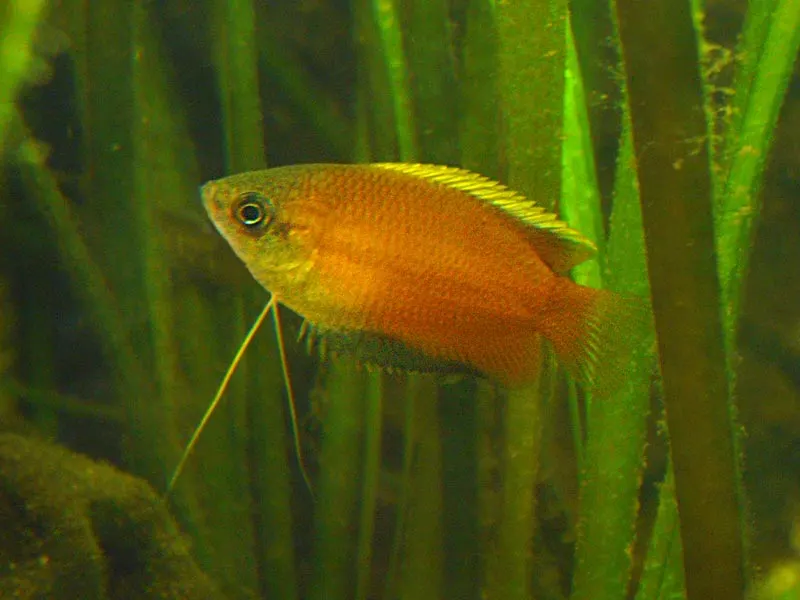
- Ideal temperature
- 74–81°F
- Smallest tank
- 10 gallons
- Keep at least
- 1
The honey gourami is a small, peaceful freshwater fish from India and Bangladesh that stays around 2 inches and lives 4 to 6 years. It's easy to care for, needs a tank of at least 10 gallons with warm water, gentle filtration and a tight lid. The most important thing to know is that it's shy and easily outcompeted, so it does best with calm tank mates and a quiet, gently flowing, well-kept tank.
What they look like: wild type: orange males with dark chest during courtship, duller females; red/gold: deep reddish-orange males, pale orange females; gold: bright yellow males, pale-yellow females.
Native to: India and Bangladesh.
Edited by Marin Hale · last reviewed November 17, 2026 · How we check facts
Honey gourami size, lifespan and how many per tank
How big do honey gouramis get?
Honey gourami size: adults reach about 2 inches (5.1 cm).
How long do honey gouramis live?
4–6 years with good care.
Do honey gouramis need hard or soft water?
Honey gouramis take a hardness (GH) of 3–15 dGH, about 54–270 ppm: soft to very hard water. Compare it with the hardness on your water report, which is given in ppm or mg/L.
How hard is your tap water? Austin · Denver · New York City · all cities
Bands from the US Geological Survey (soft up to 60 ppm, moderately hard up to 120, hard up to 180, very hard above); 1 dGH is about 17.9 ppm (Aquariadise).
How many honey gouramis can you keep in a 5, 10 or 20-gallon tank?
| 5 gallons | Too small. Honey gouramis need at least 10 gallons. |
|---|---|
| 10 gallons | Up to about 1 |
| 20 gallons | Up to about 2 |
A cautious estimate from our crowding model, based on the minimum tank and group size rather than a published stocking list. With strong filtration, plants and weekly water changes, many keepers stock more. With other fish in the same part of the tank, fewer fit. How it works · Check a mixed tank
Sizes and lifespans are cross-checked across our sources: see where each value comes from.
Honey gourami care guide
Tank setup
| Heater | Yes. Set an adjustable heater to 74–81°F (23–27°C); honey gouramis tolerate 72–82°F, and most rooms are cooler than that. |
|---|---|
| Substrate | Dark fine gravel or sand |
Water for honey gouramis: temperature, pH and hardness
Honey gourami temperature: keep them at 74–81°F (23–27°C); they tolerate 72–82°F (22–28°C).
Measure pH with the test kit. For hardness, a GH test or your water supplier’s report tells you what comes out of your tap.
Honey gourami behaviour and tank decor
Peaceful community fish, prefers top and middle levels; males may be territorially aggressive toward each other in confined tanks; relatively timid.
- Plants and hiding places: dense vegetation and structural features that provide cover.
- Lighting: shady.
- Filter flow: gentle; air-powered sponge filter turning over gently.
Signs of stress: intimidated or outcompeted for food by larger or vigorous tankmates; becomes shy and hides all the time when a semi-aggressive tank boss is present; poor water quality, inappropriate tank mates, overcrowding or unsuitable environment cause stress and illness vulnerability; retreats to planted hiding spots when another fish gets in their face; shy and nervous when kept with large aggressive fish.
What do honey gouramis eat?
Honey gourami diseases and health problems
- Ich. Signs: small white spots on body and fins, rubbing or scratching against objects.
- Fin rot or damage. Signs: torn, frayed, or deteriorating fins.
- Clear eyes without swelling or cloudiness.
- Intact fins.
- Healthy appetite.
- Active, normal swimming.
- Many are sold as juveniles and may still grow.
Male vs female honey gouramis, and breeding
How to tell male and female honey gouramis apart: males are more colourful, with orange throat and longer fins with pointed dorsal.
Breeding: Bubble nester.
How breeders do it (22 points from our sources; they differ on temperature)
- Male builds floating bubble nest, often incorporating plant material
- Male embraces female beneath nest; male collects eggs and places them in nest
- Remove female after spawning as male guards nest aggressively
- Eggs hatch in about two days; larvae free-swimming several days later
- Early life stages feed first on microscopic food
- Floating and/or stem plants reaching the surface
- Gentle air-powered sponge filter so nest and fry are not disturbed
- Tightest-fitting cover so fry get warm humid air for labyrinth development
- Condition pair with frozen and live foods like baby brine shrimp
- Remove female after spawning as male guards the clutch fiercely
- Male tends nest until hatching in about 24-36 hours, then can be removed
- Fry free swimming 24-48 hours later; feed infusoria or liquid fry food first week, then brine shrimp nauplii or microworm
- Fry sensitive to water chemistry and temperature changes; take care with water changes
- 10-gallon tank with 6-8 inches of water, heater at 82°F, gentle sponge filter with minimal surface agitation
- Seal lid with plastic wrap to raise humidity for labyrinth development in fry
- Eggs hatch in 24-36 hours; fry free swimming 1-2 days later; remove father then
- Fry need infusoria, vinegar eels, powdered fry food, then baby brine shrimp around 2 weeks
- Small meals several times a day and daily small water changes for fry
- Separate breeding tank of about 15 gallons
- Raise temperature to 78-82°F
- Shallower water level can help
- Feed fry brine shrimp or artemia once free swimming
- Males may be territorial toward each other in confined tanks
- Can be relatively timid
- Keep filtration gentle
- Can become shy and hide if a semi-aggressive tank boss is present
- Squabbles among themselves, especially males defending territory during breeding
- Use slow-flow filter
Care tips
- Keep the water between 72 and 82°F (74 to 81°F is ideal) with a pH of 6.0 to 7.5, and keep it clean, since they can be sensitive to poor water quality.pH: How acidic or alkaline the water is; 7 is neutral, lower is more acidic.
- Use a slow-flow filter and keep the current gentle, because they are slow-moving fish.
- Use a tight-fitting lid, but don't fill the tank to the top and don't overplant the surface, as they need access to the humid air layer above the water.
- Choose calm tank mates and make sure the gouramis get their share of food, since larger or pushy fish spook them and they're easily outcompeted.
Honey gourami tank mates
What can live with a honey gourami?
Verdicts against every species in our database, from our compatibility rules. How verdicts work
Easy picks for a 10-gallon tank: celestial pearl danio, chili rasbora, ember tetra, guppy. Use the stocking calculator to check how many of each fit.
| Verdict | Species | Why | Smallest tank * |
|---|---|---|---|
| Good match | Angelfish | Both are comfortable at 75–82°F, pH 6.0–7.5. Peaceful together, and neither can eat the other. | 30 gal+ |
| Good match | Bristlenose pleco | Both are comfortable at 72–79°F, pH 6.0–7.5. Peaceful together, and neither can eat the other. They share the tank well: bristlenose plecos swim near the bottom, honey gouramis near the top and mid-water. | 30 gal+ |
| Good match | Bronze corydoras | Both are comfortable at 72–82°F, pH 6.0–7.5. Peaceful together, and neither can eat the other. They share the tank well: bronze corydoras swim near the bottom, honey gouramis near the top and mid-water. | 20 gal+ |
| Good match | Cardinal tetra | Both are comfortable at 73–82°F, pH 6.0–7.5. Peaceful together, and neither can eat the other. Both swim mid-water. | 15 gal+ |
| Good match | Celestial pearl danio | Both are comfortable at 72–79°F, pH 6.5–7.5. Peaceful together, and neither can eat the other. Both swim mid-water. | 10 gal+ |
| Good match | Chili rasbora | Both are comfortable at 72–82°F, pH 6.0–7.0. Peaceful together, and neither can eat the other. Both swim near the top and mid-water. | 10 gal+ |
| Good match | Ember tetra | Both are comfortable at 73–82°F, pH 6.0–7.0. Peaceful together, and neither can eat the other. Both swim near the top and mid-water. | 10 gal+ |
| Good match | Guppy | Both are comfortable at 72–82°F, pH 7.0–7.5. Peaceful together, and neither can eat the other. Both swim near the top and mid-water. | 10 gal+ |
| Good match | Harlequin rasbora | Both are comfortable at 72–82°F, pH 6.0–7.5. Peaceful together, and neither can eat the other. Both swim near the top and mid-water. | 15 gal+ |
| Good match | Another honey gourami | Water needs overlap. Peaceful together, and neither can eat the other. | 10 gal+ |
| Good match | Kuhli loach | Both are comfortable at 74–81°F, pH 6.0–7.0. Peaceful together, and neither can eat the other. They share the tank well: kuhli loaches swim near the bottom, honey gouramis near the top and mid-water. | 20 gal+ |
| Good match | Molly | Both are comfortable at 72–82°F, pH 7.0–7.5. Peaceful together, and neither can eat the other. Both swim near the top and mid-water. | 20 gal+ |
| Good match | Neon tetra | Both are comfortable at 72–77°F, pH 6.0–7.0. Peaceful together, and neither can eat the other. Both swim mid-water. | 10 gal+ |
| Good match | Panda corydoras | Both are comfortable at 72–77°F, pH 6.0–7.5. Peaceful together, and neither can eat the other. They share the tank well: panda corydoras swim near the bottom, honey gouramis near the top and mid-water. | 10 gal+ |
| Good match | Platy | Both are comfortable at 72–80°F, pH 7.0–7.5. Peaceful together, and neither can eat the other. Both swim near the top and mid-water. | 20 gal+ |
| Good match | Pygmy corydoras | Both are comfortable at 72–79°F, pH 6.2–7.4. Peaceful together, and neither can eat the other. Both swim mid-water. | 10 gal+ |
| Good match | Zebra danio | Both are comfortable at 72–77°F, pH 6.0–7.5. Peaceful together, and neither can eat the other. | 20 gal+ |
| Maybe | Amano shrimp | Honey gouramis may pick off small or freshly molted Amano shrimp. Plants and hiding places help. | 10 gal+ |
| Maybe | Betta fish | Both are labyrinth fish (they gulp air at the surface) that build bubble nests (floating foam nests for eggs), and a betta may treat a honey gourami as a rival. It can work with a calm betta in a planted 20+ gallon tank; be ready to separate them. | 20 gal+ |
| Maybe | Cherry shrimp | Honey gouramis eat baby shrimp and may pick off adults. Dense plants and moss help a colony survive. | 10 gal+ |
| Maybe | Zebra nerite snail | pH ranges overlap only at pH 7.2–7.5, so one of them will be outside its comfort zone if your water drifts. | 10 gal+ |
| Avoid | Common goldfish | Common goldfish need cool water; honey gouramis need tropical water. | — |
| Avoid | Fancy goldfish | Fancy goldfish need cool water; honey gouramis need tropical water. | — |
| Avoid | Tiger barb | Tiger barbs nip fins, and honey gouramis are slow, peaceful fish best kept only with non-fin-nipping barbs and tetras. | — |
| Avoid | White cloud minnow | White cloud minnows need cool water; honey gouramis need tropical water. | — |
* Smallest tank: the larger of the two species’ own minimum tanks. It is not a stocking plan: a full group of each may need more room. Check exact numbers in the stocking calculator.
Questions
Do honey gouramis need a heater?
They're tropical fish that tolerate 72 to 82°F, with 74 to 81°F being ideal, so a heater is the way to keep the water in that range if your room is cooler. A large gap between room and water temperature may also harm their labyrinth organ, which is another reason to keep the water steady.
What do honey gouramis eat?
They're omnivores that do well on dried foods plus plenty of small live or frozen foods such as Daphnia, Artemia and bloodworm. Because they're slow-moving and easily outcompeted, make sure they're getting their share at feeding time.
What fish can live with honey gouramis?
Our checks found no problems with angelfish, bristlenose plecos, bronze, panda and pygmy corydoras, cardinal, ember and neon tetras, chili and harlequin rasbora, guppies, mollies, platies, zebra danios and other honey gouramis. Avoid tiger barbs, which nip fins, and common goldfish, fancy goldfish and white cloud minnows, which need cool water rather than tropical water. Betta fish and cherry shrimp call for caution, and a zebra nerite snail is only comfortable where pH overlaps at 7.2 to 7.5.
Can you keep more than one male honey gourami together?
It's risky. Males can be territorial toward each other in confined tanks and squabble, especially when defending territory during breeding, so the safest choice is one male per tank. Males are the more colourful ones, with an orange throat and longer fins with a pointed dorsal.
How big do honey gouramis get and how long do they live?
Honey gouramis reach about 2 inches as adults and live around 4 to 6 years. A tank of at least 10 gallons suits them, and they breed as bubble nesters.
Sources
(5 references, 24 facts with quotes)
Each value is cross-checked across the references below. Where they disagreed, an editor chose a value and recorded why.
- Honey gourami (en.wikipedia.org)
- Trichogaster chuna (Seriously Fish) (www.seriouslyfish.com)
- Care Guide for Honey Gouramis – Our Favorite Peaceful Gourami (www.aquariumcoop.com)
- Honey Gourami Care Guide: Tank Size, Diet & Tank Mates (www.chewy.com)
- Honey Gourami (aka Sunset): Care, Size & Tank Mates! (www.aquariumsource.com)
- GBIF taxonomy record
- Wikidata entry
Where each value comes from (24 facts)
| Fact | What each source says |
|---|---|
| Temperature | en.wikipedia.org: “They are commonly maintained at temperatures between 22–28 °C (72–82 °F).” seriouslyfish.com: “Temp 22–27°C72–81°F” aquariumcoop.com: “temperatures between 74–82°F (23–28°C)” chewy.com: “Temperature: 74–82 F” aquariumsource.com: “Water temperature: 72°F to 82°F” |
| Adult size | en.wikipedia.org: “This species can reach a length of 5.5 centimetres (2.2 in) TL.” seriouslyfish.com: “Max size 55mm SL2.2in SL” aquariumcoop.com: “the honey gourami is smaller in size and stays around 2 inches (5 cm).” chewy.com: “Adults typically reach about 2 inches long” aquariumsource.com: “The average honey gourami size is around 2 inches in length.” |
| Temperament | en.wikipedia.org: “The honey gourami is widely regarded as a peaceful community fish” aquariumcoop.com: “they are considered to be peaceful community fish that get along with everyone.” chewy.com: “Honey gouramis are generally peaceful and non-aggressive” aquariumsource.com: “The honey gourami is a peaceful yet active community fish.” |
| Swims editor decision | en.wikipedia.org: “This fish prefers the top and middle levels of the water.” aquariumcoop.com: “we find that our honey gouramis swim all over the tank and readily eat both floating and sinking foods.” chewy.com: “Honey gouramis typically swim in the middle and upper areas of the water column.” aquariumsource.com: “For the most part, these fish will stick to the top half of the aquarium.” |
| Breeding type | en.wikipedia.org: “Honey gouramis reproduce by means of bubble-nest spawning” seriouslyfish.com: “This species is a bubblenester which forms temporary pair bonds.” aquariumcoop.com: “make bubble nests to house their eggs” chewy.com: “Males may also build bubble nests at the water’s surface” aquariumsource.com: “Since honey gouramis are bubble nesters you’ll need to have plants in the tank as well.” |
| Native to | en.wikipedia.org: “a species of gourami native to India and Bangladesh.” seriouslyfish.com: “a labyrinth fish from the Ganges and Brahmaputra systems of India and Bangladesh, with records from Nepal.” aquariumcoop.com: “Trichogaster chuna comes from India and Bangladesh” chewy.com: “Honey gouramis are small freshwater fish native to India.” aquariumsource.com: “These fish originate from Bangladesh and India” |
| Water type | en.wikipedia.org: “commonly kept in small freshwater aquaria” aquariumcoop.com: “slow-moving ponds full of vegetation” chewy.com: “small, colorful, peaceful freshwater fish” aquariumsource.com: “popular fixture in the freshwater aquarium community” |
| Telling males from females | en.wikipedia.org: “Male specimens of this fish, typical of many gouramis, are generally more colourful than their female counterparts.” seriouslyfish.com: “Adult females are brownish in colour, noticeably larger than males and possess a broad, brownish midlateral stripe” aquariumcoop.com: “the male is usually more vibrant in coloration than the female, and his throat turns dark blue-black during courtship.” chewy.com: “Males are generally more brightly colored than females.” |
| Warnings | en.wikipedia.org: “males may display territorial aggression toward one another, particularly in confined conditions.” seriouslyfish.com: “Needs a tight-fitting lid as this species is known to jump” aquariumcoop.com: “if you have a semi-aggressive fish that establishes itself as the “tank boss,” the honey gourami can become quite shy and start hiding all the time.” chewy.com: “Use a secure lid to help maintain warm, humid air above the water and prevent fish from jumping.” aquariumsource.com: “Too many males packed in closely can lead to aggression and potential fights.” |
| pH | seriouslyfish.com: “pH 6.0–7.5” aquariumcoop.com: “pH of 6.0–8.0” aquariumsource.com: “pH levels: 6 to 7.5” |
| Hardness (GH) | seriouslyfish.com: “Hardness 2–15dGH” chewy.com: “Hardness level: 4–15 (dGH)” |
| Smallest tank editor decision | seriouslyfish.com: “Volume ~54litres~14US gal” aquariumcoop.com: “A single honey gourami can live in a 5- or 10-gallon tank, but a group of three gouramis would do better in a 20-gallon aquarium.” chewy.com: “Minimum tank size: A single honey gourami or small group needs a 5- to 10-gallon tank.” aquariumsource.com: “The recommended tank size for the honey gouramis is 10 gallons for one fish.” |
| Group size editor decision | seriouslyfish.com: “meaning the purchase of no less than 4-6 specimens is recommended.” aquariumcoop.com: “Both sexes are equally good-natured and can live alone or in a group.” chewy.com: “Yes. Honey gouramis can live alone, although they can also be kept with compatible tank mates or in appropriately sized groups.” aquariumsource.com: “They enjoy the company and will feel safer and more enriched in a group of four or more.” |
| Care level | seriouslyfish.com: “a good subject for those new to the hobby given its peaceable nature and relative adaptability in terms of water chemistry.” aquariumcoop.com: “making it a hardy pet that is great for beginners.” chewy.com: “relatively easy to care for, making them a good choice for beginner aquarists.” aquariumsource.com: “Honey gourami care is really quite easy.” |
| Feeding | seriouslyfish.com: “should also be offered plenty of small live or frozen foods such as Daphnia, Artemia, or bloodworm regularly” aquariumcoop.com: “willingly eat an omnivore diet of flakes, nano pellets, Repashy gel food, freeze-dried foods, frozen foods, and live foods.” chewy.com: “Feed adults once a day and juveniles 2–3 times daily.” aquariumsource.com: “The general feeding schedule that most honey gourami owners tend to stick with is twice per day.” |
| Diet | aquariumcoop.com: “willingly eat an omnivore diet of flakes, nano pellets, Repashy gel food, freeze-dried foods, frozen foods, and live foods.” chewy.com: “Honey gouramis are omnivores that eat a varied diet.” aquariumsource.com: “Honey gouramis are omnivores and eat a lot of insects in their natural environment.” |
| Eats shrimp/snails | aquariumcoop.com: “they do not seem to go after adult amano or cherry shrimp but will opportunistically eat any babies they find.” chewy.com: “Honey gouramis may prey on very small shrimp, so use caution when housing them together.” |
| Lifespan | chewy.com: “Honey gouramis typically live about 2–5 years with proper care.” aquariumsource.com: “The average honey gourami lifespan is 5-8 years.” |
| Substrate | chewy.com: “Dark-colored fine gravel or sand can create a natural-looking environment and make the fish’s colors stand out.” |
| Carbonate hardness (KH) | aquariumsource.com: “Water hardness: 4-10 KH” |
| Looks | chewy.com: “Gold: Bright yellow males and pale-yellow females.” en.wikipedia.org: “They have orange-coloured bodies. Male specimens of this fish, typical of many gouramis, are generally more colourful than their female counterparts.” seriouslyfish.com: “Adult females are brownish in colour, noticeably larger than males and possess a broad, brownish midlateral stripe” aquariumcoop.com: “the honey gourami has a flat, oblong-shaped body with two modified ventral fins that act like long, trailing whiskers.” aquariumsource.com: “These fish are slim and streamlined with a slight upward tilt to their faces.” |
| Varieties | seriouslyfish.com: “ornamental strains such as 'red', 'sunset' and 'golden' exist.” aquariumcoop.com: “The most common kinds are wild type, yellow gold, and red. Sometimes the latter type is called “sunset honey gourami,”” chewy.com: “Wild type: Orange males with a dark chest, particularly during courtship; females are typically duller in color.” aquariumsource.com: “Other Names: Sunset Honey Gourami, Red Flame Gourami, and the Red Honey Gourami.” |
| How often to feed | chewy.com: “Feed adults once a day and juveniles 2–3 times daily.” aquariumsource.com: “The general feeding schedule that most honey gourami owners tend to stick with is twice per day.” |
| Diseases and signs | chewy.com: “Ich or white spot disease: May cause small white spots on the body and fins, along with rubbing or scratching against objects.” aquariumsource.com: “You don’t need to worry about any species-specific diseases with honey gouramis” |
Editor decisions (3)
- Wikipedia ('prefers the top and middle levels'), Chewy ('middle and upper areas') and Aquarium Source ('the top half') agree; Aquarium Co-op's 'swim all over the tank' is about where they feed, so bottom is left out.
- Sources range 5–14: Aquarium Co-op and Chewy put a single fish in 5–10 gallons, Aquarium Source recommends 10 for one fish, Seriously Fish gives ~14 for a group. 10 is the conservative single-fish figure; Aquarium Co-op notes a group of three does better in 20.
- Aquarium Co-op ('can live alone or in a group') and Chewy ('can live alone') say a single fish is fine; Seriously Fish (4–6) and Aquarium Source (4+) prefer groups, which the page can say, but keeping one is not wrong.
Cite this page
“Honey gourami care.” Fish Tank Atlas, last reviewed November 17, 2026. https://fishtankatlas.com/fish/honey-gourami/