Kuhli loach
Pangio kuhlii · family Cobitidae
- Ideal temperature
- 75–79°F
- Smallest tank
- 20 gallons
- Keep at least
- 5 together
Kuhli loaches in the aquarium trade are mostly Pangio semicincta and close relatives sold under the same name; this page covers the banded kuhli loach, which they all resemble in care.
The kuhli loach is a peaceful, eel-shaped bottom dweller that grows to about 4 inches and can live 10 to 14 years. It's an easy-care fish that does best in soft, slightly acidic to neutral water, in a mature tank with a sandy bottom and a group of at least 5. The most important thing to know is that kuhlis are escape artists and burrowers, so you need a tight-fitting lid and a filter inlet covered with fine mesh.
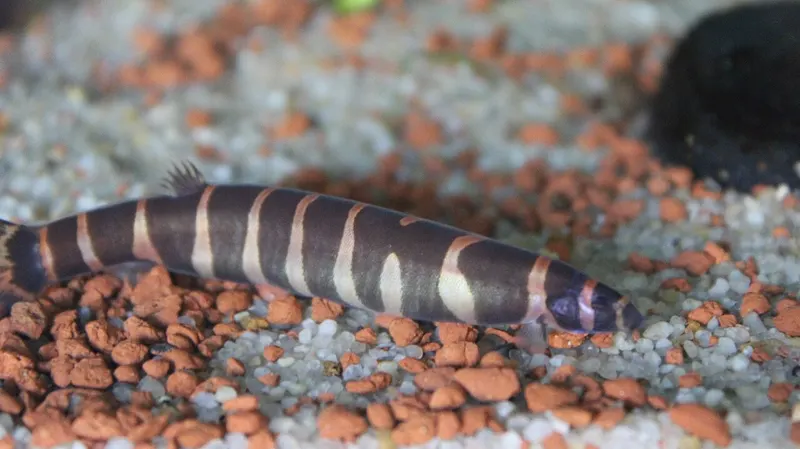
What they look like: P. semicincta: usually nine to 12 dark bars over an orangey background.
Native to: Java, Indonesia; also Malaysia, Sumatra.
Edited by Marin Hale · last reviewed November 20, 2026 · How we check facts
Kuhli loach size, lifespan and how many per tank
How big do kuhli loaches get?
Kuhli loach size: adults reach 3.9–4 inches (9.9–10.2 cm).
How long do kuhli loaches live?
10–14 years with good care.
Do kuhli loaches need hard or soft water?
Kuhli loaches take a hardness (GH) of 0–8 dGH, about 0–140 ppm: soft to hard water. Compare it with the hardness on your water report, which is given in ppm or mg/L.
How hard is your tap water? Austin · Denver · New York City · all cities
Bands from the US Geological Survey (soft up to 60 ppm, moderately hard up to 120, hard up to 180, very hard above); 1 dGH is about 17.9 ppm (Aquariadise).
How many kuhli loaches can you keep in a 5, 10 or 20-gallon tank?
| 5 gallons | Too small. Kuhli loaches need at least 20 gallons. |
|---|---|
| 10 gallons | Too small. Kuhli loaches need at least 20 gallons. |
| 20 gallons | Up to about 7 (keep at least 5) |
The most of this species on its own, from our crowding model; it matches Aquarium Co-op’s 10-gallon stocking (“4 kuhli loaches”). With other fish in the same part of the tank, fewer fit. How it works · Check a mixed tank
Sizes and lifespans are cross-checked across our sources: see where each value comes from.
Kuhli loach care guide
Tank setup
| Heater | Yes. Set an adjustable heater to 75–79°F (24–26°C); kuhli loaches tolerate 74–81°F, and most rooms are cooler than that. |
|---|---|
| New tanks | Add only to an established, cycled tank. Not for a brand-new setup. |
Water for kuhli loaches: temperature, pH and hardness
Kuhli loach temperature: keep them at 75–79°F (24–26°C); they tolerate 74–81°F (23–27°C).
Measure pH with the test kit. For hardness, a GH test or your water supplier’s report tells you what comes out of your tap.
Kuhli loach behaviour and tank decor
Nocturnal, shy, bottom-dwelling, burrows; more active with larger groups.
- Plants and hiding places: burrowing spaces, planted tank, driftwood and decor with small spaces.
- Lighting: avoids bright light.
- Filter flow: gentle filtration with a little surface agitation; avoid high flow.
What do kuhli loaches eat?
Kuhli loach diseases and health problems
- Ich. Signs: tiny white spots all over the body.
- Dropsy
- Fin rot
- Choose fish that are alert and eating well.
Male vs female kuhli loaches, and breeding
How to tell male and female kuhli loaches apart: males have a more muscular dorsal cross-section and larger, paddle-shaped, often pigmented pectoral fins; breeding females get larger with greenish ovaries visible.
Breeding: Egg layer, lays eggs among roots of floating plants. Difficult in captivity; most successes use hormone injections.
How breeders do it (11 points from our sources)
- Plenty of hiding spaces
- Consistent water quality
- Separate tank away from other species
- Feed plenty of live food
- Thick mass of java moss for fry hiding
- Fine rounded gravel area so eggs can fall to safety
- Breeding tank with a large group
- Lower water level and live floating plants
- Low light
- Slightly softer water and pH 6.5
- Remove eggs and fry as adults eat them
- May swim into unprotected filter inlets
- Can escape the tank
- Can burrow and stay hidden for long periods
- Has a spine below each eye that can harm predators
- Keep small specimens away from filter and powerhead intakes
- Sub-ocular spines can tangle in nets
Care tips
- Keep at least 5 kuhli loaches together in a tank of 20 gallons or more, and add them only to a mature, established tank.
- Use fine-grained sand and avoid sharp decor, so they can burrow without hurting themselves.
- Fit a tight-fitting lid and cover the filter inlet with fine mesh, because kuhlis jump and squeeze into tiny gaps.
- Make water changes small and gradual, and be careful with medications, since kuhlis are sensitive to both and are very susceptible to disease and parasites.
Kuhli loach tank mates
What can live with a kuhli loach?
Verdicts against every species in our database, from our compatibility rules. How verdicts work
Easy picks for a 20-gallon tank: betta fish, bronze corydoras, cardinal tetra, celestial pearl danio. Use the stocking calculator to check how many of each fit.
| Verdict | Species | Why | Smallest tank * |
|---|---|---|---|
| Good match | Betta fish | Both are comfortable at 75–81°F, pH 6.0–7.0. Peaceful together, and neither can eat the other. They share the tank well: bettas swim near the top, kuhli loaches near the bottom. | 20 gal+ |
| Good match | Bristlenose pleco | Both are comfortable at 74–79°F, pH 5.8–7.0. Peaceful together, and neither can eat the other. Both swim near the bottom. | 30 gal+ |
| Good match | Bronze corydoras | Both are comfortable at 74–81°F, pH 6.0–7.0. Peaceful together, and neither can eat the other. Both swim near the bottom. | 20 gal+ |
| Good match | Cardinal tetra | Both are comfortable at 74–81°F, pH 5.5–7.0. Peaceful together, and neither can eat the other. They share the tank well: cardinal tetras swim mid-water, kuhli loaches near the bottom. | 20 gal+ |
| Good match | Celestial pearl danio | Kuhli loaches reach about 4 inches but are eel-thin with tiny mouths, and they feed on small sinking foods, not on tank mates; small fish like celestial pearl danios are safe with them. | 20 gal+ |
| Good match | Cherry shrimp | Kuhli loaches reach about 4 inches but are eel-thin with tiny mouths, and they feed on small sinking foods, not on tank mates; adult shrimp are safe with them, though newborn shrimp may be eaten, as with most fish. | 20 gal+ |
| Good match | Chili rasbora | Kuhli loaches reach about 4 inches but are eel-thin with tiny mouths, and they feed on small sinking foods, not on tank mates; even tiny fish like chili rasboras are safe with them. | 20 gal+ |
| Good match | Ember tetra | Kuhli loaches reach about 4 inches but are eel-thin with tiny mouths, and they feed on small sinking foods, not on tank mates; small tetras like embers are safe with them. | 20 gal+ |
| Good match | Harlequin rasbora | Both are comfortable at 74–81°F, pH 6.0–7.0. Peaceful together, and neither can eat the other. They share the tank well: harlequin rasboras swim near the top and mid-water, kuhli loaches near the bottom. | 20 gal+ |
| Good match | Honey gourami | Both are comfortable at 74–81°F, pH 6.0–7.0. Peaceful together, and neither can eat the other. They share the tank well: honey gouramis swim near the top and mid-water, kuhli loaches near the bottom. | 20 gal+ |
| Good match | Another kuhli loach | Water needs overlap. Peaceful together, and neither can eat the other. | 20 gal+ |
| Good match | Neon tetra | Both are comfortable at 74–77°F, pH 6.0–7.0. Peaceful together, and neither can eat the other. They share the tank well: neon tetras swim mid-water, kuhli loaches near the bottom. | 20 gal+ |
| Good match | Panda corydoras | Both are comfortable at 74–77°F, pH 6.0–7.0. Peaceful together, and neither can eat the other. Both swim near the bottom. | 20 gal+ |
| Good match | Pygmy corydoras | Kuhli loaches reach about 4 inches but are eel-thin with tiny mouths, and they feed on small sinking foods, not on tank mates; they share the bottom peacefully with small corydoras. | 20 gal+ |
| Good match | Tiger barb | Both are comfortable at 74–80°F, pH 6.0–7.0. Peaceful together, and neither can eat the other. | 30 gal+ |
| Good match | Zebra danio | Both are comfortable at 74–77°F, pH 6.0–7.0. Peaceful together, and neither can eat the other. | 20 gal+ |
| Maybe | Amano shrimp | Kuhli loaches reach about 4 inches but are eel-thin with tiny mouths, and they feed on small sinking foods, not on tank mates; adult Amano shrimp are safe with them. | 20 gal+ |
| Maybe | Angelfish | Angelfish are cichlids that eat small, slender fish, and young kuhli loaches are at risk. Add full-grown kuhlis and give them plenty of hiding places on the bottom. | 30 gal+ |
| Maybe | Guppy | pH ranges overlap only at pH 7.0, so one of them will be outside its comfort zone if your water drifts. | 20 gal+ |
| Maybe | Molly | pH ranges overlap only at pH 7.0, so one of them will be outside its comfort zone if your water drifts. | 20 gal+ |
| Maybe | Platy | pH ranges overlap only at pH 7.0, so one of them will be outside its comfort zone if your water drifts. | 20 gal+ |
| Maybe | Zebra nerite snail | pH ranges don't overlap (5.5–7.0 vs 7.2–8.4). | 20 gal+ |
| Avoid | Common goldfish | Common goldfish need cool water; kuhli loaches need tropical water. | — |
| Avoid | Fancy goldfish | Fancy goldfish need cool water; kuhli loaches need tropical water. | — |
| Avoid | White cloud minnow | White cloud minnows need cool water; kuhli loaches need tropical water. | — |
* Smallest tank: the larger of the two species’ own minimum tanks. It is not a stocking plan: a full group of each may need more room. Check exact numbers in the stocking calculator.
Questions
Do kuhli loaches need a heater?
Kuhli loaches are tropical fish that tolerate 74–81°F, with an ideal range of 75–79°F. If your room can't keep the tank in that range, a heater is the simple fix.
What do kuhli loaches eat?
They're omnivores that eat sinking pellets, flakes, shrimp and bloodworms. They feed along the bottom, so make sure food actually reaches them. If tank mates take it all, try feeding at night.
What fish can live with kuhli loaches?
Kuhlis are peaceful and eel-thin with tiny mouths, so they feed on small sinking foods rather than on tank mates. They get along with neon, cardinal and ember tetras, chili and harlequin rasboras, celestial pearl danios, zebra danios, tiger barbs, honey gouramis, bettas, bronze, panda and pygmy corydoras, and bristlenose plecos. Guppies, mollies and platies need harder water than kuhlis like, and goldfish and white cloud minnows need cooler water. Angelfish can eat young kuhlis, so add full-grown kuhlis and give them plenty of hiding places.
How many kuhli loaches should I keep together?
Keep at least 5. They're social and spend a lot of time hidden, so a group in a 20-gallon or larger tank gives them company and security. Males tend to have larger, paddle-shaped, often pigmented pectoral fins, and breeding females get larger and may show greenish ovaries.
Why can't I find my kuhli loach?
Kuhlis burrow and can stay hidden for long periods, so a missing loach isn't always a worry. Check that the lid is secure and the filter inlet is covered, since they can escape the tank or swim into unprotected inlets. Also check that the group is eating, because they must be fed specifically so they don't go hungry.
Sources
(6 references, 26 facts with quotes)
Each value is cross-checked across the references below. Where they disagreed, an editor chose a value and recorded why.
- Kuhli loach (en.wikipedia.org)
- Pangio kuhlii (Seriously Fish) (www.seriouslyfish.com)
- Care Guide for Kuhli Loaches – The Coolest Oddball Fish for Beginners (www.aquariumcoop.com)
- Kuhli Loach-Pangio kuhlii (www.fishkeeper.co.uk)
- Keeping Kuhli and other Eel loaches in the aquarium - Practical Fishkeeping (www.practicalfishkeeping.co.uk)
- Kuhli Loach Care: The Secretive Eel-Like Fish You’ll Love (www.aquariumsource.com)
- GBIF taxonomy record
- Wikidata entry
Where each value comes from (26 facts)
| Fact | What each source says |
|---|---|
| Temperature editor decision | en.wikipedia.org: “a temperature range of 75–86 °F (24–30 °C)” seriouslyfish.com: “21–26°C70–79°F” aquariumcoop.com: “they enjoy temperatures between 74–80°F (23–27°C)” fishkeeper.co.uk: “Temperature 24-28°C” practicalfishkeeping.co.uk: “22-26°C/72-89°F” aquariumsource.com: “warmer temperatures between 73 and 86 degrees Fahrenheit are preferred” |
| pH editor decision | en.wikipedia.org: “prefer water with a 5.5 – 6.5 pH-but will tolerate 7.0 pH in aquaria” seriouslyfish.com: “pH 3.5–7.0” fishkeeper.co.uk: “pH: 6.0-7.0, dH: up to 12 degrees” practicalfishkeeping.co.uk: “aim for a pH between 6.0-7.0” aquariumsource.com: “A pH balance between 5.5 and 6.5 is best.” |
| Adult size | en.wikipedia.org: “have a maximum length of 4 inches (10 cm)” seriouslyfish.com: “Max size 100mm SL3.9in SL” aquariumcoop.com: “kuhli loaches only grow to three to four inches long” fishkeeper.co.uk: “Maximum Size 10cm (4")” practicalfishkeeping.co.uk: “It grows to 10cm/4” in length.” aquariumsource.com: “in captivity the average size of a Kuhli Loac is between 3 and 4 inches” |
| Lifespan editor decision | en.wikipedia.org: “can have nearly a 10-year lifespan, sometimes reaching as far as 14 years in captivity” aquariumsource.com: “The average Kuhli Loach lifespan is around 10 years.” |
| Smallest tank editor decision | en.wikipedia.org: “Kuhli loach groups of this size can be kept in 20-gallon aquariums” seriouslyfish.com: “Volume ~54litres~14US gal” aquariumcoop.com: “get a group of at least three to six for a 20-gallon aquarium (or larger)” aquariumsource.com: “the minimum Kuhli Loach tank size is only about 15 gallons” |
| Group size editor decision | en.wikipedia.org: “prefer to be in large groups of other kuhlis (typically 5 or more)” seriouslyfish.com: “a group of at least 5-6 specimens should be the minimum purchased” aquariumcoop.com: “get a group of at least three to six for a 20-gallon aquarium (or larger)” fishkeeper.co.uk: “five would be considered the absolute minimum number” practicalfishkeeping.co.uk: “Ten should be the absolute minimum together” |
| Temperament | en.wikipedia.org: “They are friendly with other tank mates (they will not attack nor eat them)” seriouslyfish.com: “Pangio spp. are peaceful both with one another and other fishes” aquariumcoop.com: “Given how peaceful they are, you can easily keep them with other community fish” fishkeeper.co.uk: “Kuhli Loaches are a peaceful species” aquariumsource.com: “They’re peaceful fish and get along with other creatures as long as they are left alone.” |
| Swims | en.wikipedia.org: “The kuhli loach is a bottom dweller that burrows into soft places.” aquariumcoop.com: “as they scavenge for food at the bottom of the aquarium” practicalfishkeeping.co.uk: “Serpentine bottom dwellers” aquariumsource.com: “They are bottom-dwellers, so you won’t find your Kuhli swimming up to the surface of the water very often.” |
| Safe with plants | en.wikipedia.org: “Planted aquariums allow kuhlis the opportunity to better hide themselves and feel more comfortable, and they will not consume any of the plants.” aquariumcoop.com: “kuhli loaches won’t consume algae or aquarium plants and safe to keep in a planted tank” |
| Water type | en.wikipedia.org: “is a small eel-like freshwater fish belonging to the loach family (Cobitidae)” fishkeeper.co.uk: “Freshwater” aquariumsource.com: “hails from freshwater streams in Southeast Asia” |
| Breeding type | en.wikipedia.org: “a few hundred greenish eggs are laid among the roots of floating plants” |
| Native to | en.wikipedia.org: “Kuhli loaches are from the island of Java, Indonesia, and additionally can be found in Malaysia, Sumatra.” seriouslyfish.com: “Pangio semicincta is a cobitid loach from Peninsular Malaysia, Sumatra and Borneo.” fishkeeper.co.uk: “Sumatra, Borneo and Java, Indonesia. Also Malaysia and Thailand.” aquariumsource.com: “hails from freshwater streams in Southeast Asia in areas like Malaysia, Thailand, and Borneo” |
| Hardness (GH) editor decision | en.wikipedia.org: “a water hardness of 5.0 dGH” seriouslyfish.com: “Hardness 0–8dGH” fishkeeper.co.uk: “Soft and slightly acidic is best long-term. pH: 6.0-7.0, dH: up to 12 degrees.” practicalfishkeeping.co.uk: “a general hardness of less than 12-15° (DH)” aquariumsource.com: “The water should also have a hardness rating of no more than 5.0 dGH.” |
| Telling males from females | en.wikipedia.org: “Males have a more muscular dorsal cross-section. Additionally, their pectoral fins tend to be larger and more paddle-shaped, often containing pigment.” seriouslyfish.com: “Adult females are typically heavier-bodied and a little larger then males, while in mature males the first pectoral-fin ray is branched and thickened.” fishkeeper.co.uk: “Females are noticeably plumper when filled with eggs.” practicalfishkeeping.co.uk: “in males — except P. alcoides, P. incognito and P. pulla — the second pectoral ray, and sometimes the third, is thickened” aquariumsource.com: “Some say that males have larger pectoral fins, but the difference is very minor.” |
| Substrate | en.wikipedia.org: “sharp decor and non-sand substrate are not recommended for this nocturnal species” seriouslyfish.com: “Use a soft, sandy substrate since this species likes to dig and tends to spend some of its time completely buried.” aquariumcoop.com: “they will appreciate any kind of smooth substrate that is safe to dig in” fishkeeper.co.uk: “has a sandy substrate in order to protect the delicate sensory barbel area” practicalfishkeeping.co.uk: “Furnish the bottom with a soft sand substrate” aquariumsource.com: “The best option is fine sand. Though, smooth pebbles can work too.” |
| Feeding | en.wikipedia.org: “They consume many different types of sinking pellets, flakes, and even shrimp/bloodworms.” seriouslyfish.com: “In the aquarium it will accept sinking dried foods but should also be offered regular meals of live and frozen Daphnia, Artemia, bloodworm, micro worm, grindal worm, etc.” aquariumcoop.com: “They prefer sinking foods such as community pellets, Repashy gel food, frozen bloodworms, and live blackworms.” fishkeeper.co.uk: “Sinking catfish pellets and small sized frozen foods such as mosquito larvae, brineshrimp, and daphnia.” practicalfishkeeping.co.uk: “Eel loaches love appropriately sized baby brineshrimp, mini bloodworm, Daphnia and Cyclops, plus sinking dried foods” aquariumsource.com: “Kuhli Loaches love protein-based fish foods.” |
| Breeding | en.wikipedia.org: “Most of the successful attempts at breeding this species in captivity are with the help of hormone injections to induce breeding.” seriouslyfish.com: “Several vague reports exist but none are supported by solid information or photographs.” aquariumcoop.com: “Kuhli loaches are not commonly bred in captivity” fishkeeper.co.uk: “the actual spawning, for a large part, still remains a bit of a mystery” practicalfishkeeping.co.uk: “only a couple of species have been successfully bred in home aquaria and these have been accidental” aquariumsource.com: “Breeding Kuhli Loaches in captivity is no easy task.” |
| Warnings | en.wikipedia.org: “They may also occasionally swim into unprotected filter inlets, possibly leading to their deaths.” seriouslyfish.com: “Needs a tight-fitting lid as this species is known to jump” aquariumcoop.com: “you must specifically feed them to make sure they don’t go hungry” fishkeeper.co.uk: “If housing smaller specimens, be sure to protect them from any filter or powerhead intakes” practicalfishkeeping.co.uk: “Ensure your Eel loaches cannot get into filters or powerheads, as they can squeeze into the tiniest gaps.” aquariumsource.com: “Also, make sure that you have a secure lid. These fish have been known to jump right out of the tanks” |
| How often to feed | en.wikipedia.org: “They usually feed at night, but can be taught to feed in the day in the home aquarium.” aquariumsource.com: “We recommend that you feed your Kuhli Loaches several times throughout the day.” |
| Diseases and signs | en.wikipedia.org: “kuhli loaches can succumb to various common aquaria diseases such as dropsy, ich, fin rot, and cottonmouth” aquariumsource.com: “Usually, the first signs of the disease are tiny white spots all over your fish’s body.” |
| Looks | practicalfishkeeping.co.uk: “this species usually has nine to 12 dark bars over an orangey background” en.wikipedia.org: “The body has 10 to 15 dark brown to black vertical bars, and the gaps between them are salmon pink to yellow with a light underside.” seriouslyfish.com: “most specimens exhibit the same basic pattern of dark saddle-like markings, usually wider at the dorsal surface, over a yellow/orange base colour” aquariumcoop.com: “unique eel-like bodies, beady black eyes, and bristly barbels or whiskers around their mouths” aquariumsource.com: “the fish have between 10 and 15 dark stripes” |
| Care level editor decision | seriouslyfish.com: “Difficulty5 of 8 measures Easy” aquariumcoop.com: “these little oddball fish are easy to keep” aquariumsource.com: “Care: Medium-Difficult” |
| Eats shrimp/snails editor decision | aquariumcoop.com: “unlike other members of the loach family, they are not known for eating snails or shrimp” |
| Varieties | aquariumcoop.com: “Black kuhli loaches (Pangio oblonga) and silver kuhli loaches (Pangio anguillaris) are other varieties found in the aquarium trade.” aquariumsource.com: “The name for this is the black Kuhli Loach.” |
| Needs an established tank | fishkeeper.co.uk: “It is very important that the aquarium is well matured and has a sandy substrate” practicalfishkeeping.co.uk: “Your tank should be mature and ideally at least 60cm/2’ long.” |
| Diet editor decision | aquariumsource.com: “They’re natural omnivores that can eat pretty much anything.” |
Editor decisions (9)
- Sources span 70–86°F: Aquarium Co-op 74–80, Maidenhead 24–28°C, Practical Fishkeeping 22–26°C, Seriously Fish 21–26°C, Wikipedia and Aquarium Source up to 86. The median 74–81°F keeps the range most sources share; the 86°F upper ends are outliers.
- Maidenhead and Practical Fishkeeping give 6.0–7.0, Wikipedia and Aquarium Source 5.5–6.5 (Wikipedia: 'will tolerate 7.0 pH in aquaria'). Seriously Fish's 3.5 low end describes wild blackwater, not an aquarium target.
- Wikipedia: 'nearly a 10-year lifespan, sometimes reaching as far as 14 years in captivity'; Aquarium Source: around 10 years. 10–14 shows both the typical figure and the long-lived upper end Wikipedia gives.
- Wikipedia and Aquarium Co-op (a group of three to six in 'a 20-gallon aquarium (or larger)') say 20; Aquarium Source 15 and Seriously Fish's footprint about 14. With a group of 5, the 20-gallon figure from two sources is used rather than the rounded median of 18.
- Wikipedia ('typically 5 or more'), Seriously Fish ('at least 5-6') and Maidenhead ('five would be considered the absolute minimum') agree on 5; Aquarium Co-op's 3 is the low end of its 3–6 for a 20-gallon, and Practical Fishkeeping's 10 is a preference.
- All sources ask for soft water: Seriously Fish 0–8 dGH, Aquarium Source no more than 5, Maidenhead and Practical Fishkeeping up to 12. 0–8 is the Seriously Fish range and sits inside the others.
- Seriously Fish ('Easy') and Aquarium Co-op ('easy to keep') against Aquarium Source's 'Medium-Difficult'. Easy, with the established-tank and secure-lid warnings the sources give.
- Aquarium Co-op: 'not known for eating snails or shrimp'. Wikipedia lists shrimp among good tank mates and Aquarium Source says red cherry shrimp 'do just fine' with them.
- Aquarium Source: 'natural omnivores'. The other sources agree in substance: Wikipedia ('eat anything that reaches the bottom'), Maidenhead and Practical Fishkeeping list sinking pellets, flake and small frozen foods.
Cite this page
“Kuhli loach care.” Fish Tank Atlas, last reviewed November 20, 2026. https://fishtankatlas.com/fish/kuhli-loach/