Zebra danio
Danio rerio · family Cyprinidae
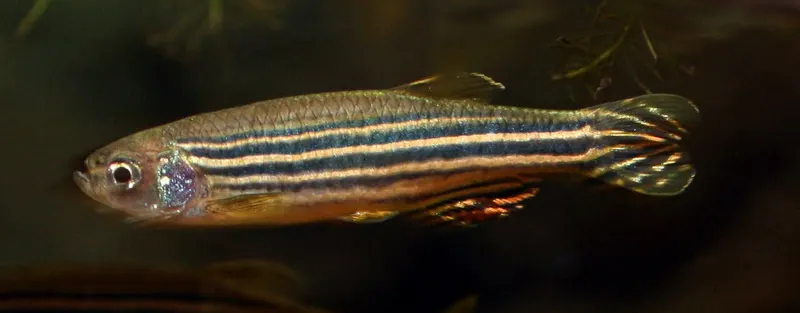
- Smallest tank
- 20 gallons
- Keep at least
- 6 together
The zebra danio (Danio rerio) is a hardy, peaceful 2-inch schooling fish from South Asia, and it's an easy choice for a first community tank. Keep at least 6 in a tank of 20 gallons or more, with a tight lid, because they jump. They also nip fins, so choose tank mates with care.
What they look like: males have gold stripes between blue stripes; females have silver stripes.
Native to: South Asia (India, Pakistan, Bangladesh, Nepal, Bhutan).
Edited by Marin Hale · last reviewed November 14, 2026 · How we check facts
Zebra danio size, lifespan and how many per tank
How big do zebra danios get?
Zebra danio size: adults reach about 2 inches (5.1 cm).
How long do zebra danios live?
3–5 years with good care.
Do zebra danios need hard or soft water?
Zebra danios take a hardness (GH) of 5–20 dGH, about 90–360 ppm: moderately hard to very hard water. Compare it with the hardness on your water report, which is given in ppm or mg/L.
How hard is your tap water? Austin · Denver · New York City · all cities
Bands from the US Geological Survey (soft up to 60 ppm, moderately hard up to 120, hard up to 180, very hard above); 1 dGH is about 17.9 ppm (Aquariadise).
How many zebra danios can you keep in a 5, 10 or 20-gallon tank?
| 5 gallons | Too small. Zebra danios need at least 20 gallons. |
|---|---|
| 10 gallons | Too small. Zebra danios need at least 20 gallons. |
| 20 gallons | Up to about 8 (keep at least 6) |
A cautious estimate from our crowding model, based on the minimum tank and group size rather than a published stocking list. With strong filtration, plants and weekly water changes, many keepers stock more. With other fish in the same part of the tank, fewer fit. How it works · Check a mixed tank
Sizes and lifespans are cross-checked across our sources: see where each value comes from.
Zebra danio care guide
Tank setup
| Heater | Usually no heater needed: zebra danios are fine from 64°F to 77°F, so most homes work. Add one if your room drops below 64°F. |
|---|---|
| Substrate | Soft sand or mud, darker substrate |
Water for zebra danios: temperature, pH and hardness
Zebra danio temperature: keep them at 64–77°F (18–25°C).
Measure pH with the test kit. For hardness, a GH test or your water supplier’s report tells you what comes out of your tap.
Zebra danio behaviour and tank decor
Playful; does well in schools or shoals of six or more and interacts well with other fish species.
- Plants and hiding places: decor not critical, but shows better colour in a heavily planted set-up with dark substrate; floating plants and driftwood roots or branches to diffuse light are appreciated.
- Lighting: diffused light, via floating plants and driftwood.
- Filter flow: does not need strong filtration but appreciates a degree of water movement.
Signs of stress: stressed when kept alone or in too small a group; stressed in a tank that is too brightly lit without enough cover.
What do zebra danios eat?
Zebra danio diseases and health problems
- Microsporidia. Signs: chronic emaciation and curvature of the spine.
- Mycobacterium infection. Signs: enlarged pores on the skin and missing fins.
- Neon tetra disease. Signs: restlessness, increased respiration, white patches on the skin, separating from the group.
- Flavobacterium columnare infection. Signs: symptoms similar to neon tetra disease.
- Bloat and obesity from overfeeding
- Quality stock can be hard to find because of heavy inbreeding and mass production.
- Wild specimens are sometimes carried by specialist retailers.
- Start with a small group of juveniles to ensure at least one male and female.
Male vs female zebra danios, and breeding
How to tell male and female zebra danios apart: males torpedo-shaped with gold stripes between blue stripes; females have larger whitish belly and silver stripes.
Breeding: Egg scatterer. Spawns frequently, even daily; adults eat hatchlings.
How breeders do it (14 points from our sources)
- Adults eat hatchlings, so separate the two groups with a net, breeding box or separate tank
- Presence of plants, even plastic plants, encourages spawning
- Spawn best in the morning
- Set up one or more smaller containers half-filled with water, very dimly lit
- Cover base with mesh that eggs fall through but adults cannot reach, or plastic grass matting, or fill with Java moss/fine-leaved plants
- Slightly acidic to neutral pH, temperature towards upper end of range
- Small power filter with flow directed down the length of the tank, later swapped for a sponge filter
- Introduce one or two well-conditioned pairs with females full of eggs
- Initiate spawning with small amounts of cool water added every few hours and small amounts of live and frozen foods
- Remove both parents after spawning as they eat eggs and fry
- Feed fry Paramecium or very fine dry food, then Artemia nauplii and microworm
- Move the rounded female and male to the breeding tank
- Eggs are not sticky and slip into gravel crevices; hatch in about 2 days
- Egg-scatterer producing around 100 eggs in a single spawning
- Inbreeding common, quality stock hard to findSoft water / hardness: How many minerals are dissolved in the water (measured as GH). Your water supplier or a GH test can tell you.
- Needs a secure lid, jumps
Care tips
- Keep a group of at least 6 zebra danios in a tank of 20 gallons or more.
- Use a secure lid, because zebra danios jump.
- Leave open swimming space and add some cover, since bright light with nowhere to hide stresses them.
- Feed small portions, because overfeeding leads to bloat.
Zebra danio tank mates
What can live with a zebra danio?
Verdicts against every species in our database, from our compatibility rules. How verdicts work
Easy picks for a 20-gallon tank: bronze corydoras, cardinal tetra, harlequin rasbora, honey gourami. Use the stocking calculator to check how many of each fit.
| Verdict | Species | Why | Smallest tank * |
|---|---|---|---|
| Good match | Bristlenose pleco | Both are comfortable at 72–77°F, pH 6.0–8.0. Peaceful together, and neither can eat the other. | 30 gal+ |
| Good match | Bronze corydoras | Both are comfortable at 68–77°F, pH 6.0–8.0. Peaceful together, and neither can eat the other. | 20 gal+ |
| Good match | Cardinal tetra | Both are comfortable at 73–77°F, pH 6.0–7.5. Peaceful together, and neither can eat the other. | 20 gal+ |
| Good match | Harlequin rasbora | Both are comfortable at 70–77°F, pH 6.0–7.5. Peaceful together, and neither can eat the other. | 20 gal+ |
| Good match | Honey gourami | Both are comfortable at 72–77°F, pH 6.0–7.5. Peaceful together, and neither can eat the other. | 20 gal+ |
| Good match | Kuhli loach | Both are comfortable at 74–77°F, pH 6.0–7.0. Peaceful together, and neither can eat the other. | 20 gal+ |
| Good match | Molly | Both are comfortable at 70–77°F, pH 7.0–8.0. Peaceful together, and neither can eat the other. | 20 gal+ |
| Good match | Neon tetra | Both are comfortable at 70–77°F, pH 6.0–7.0. Peaceful together, and neither can eat the other. | 20 gal+ |
| Good match | Panda corydoras | Both are comfortable at 68–77°F, pH 6.0–7.7. Peaceful together, and neither can eat the other. | 20 gal+ |
| Good match | Platy | Both are comfortable at 68–77°F, pH 7.0–8.0. Peaceful together, and neither can eat the other. | 20 gal+ |
| Good match | Tiger barb | Both are comfortable at 72–77°F, pH 6.0–8.0. Peaceful together, and neither can eat the other. | 30 gal+ |
| Good match | White cloud minnow | Both are comfortable at 64–72°F, pH 6.0–8.0. Peaceful together, and neither can eat the other. | 20 gal+ |
| Good match | Another zebra danio | Water needs overlap. Peaceful together, and neither can eat the other. | 20 gal+ |
| Good match | Zebra nerite snail | Both are comfortable at 65–77°F, pH 7.2–8.0. Peaceful together, and neither can eat the other. | 20 gal+ |
| Maybe | Amano shrimp | Zebra danios are too small to eat adult Amano shrimp but may harass them and take molting or young ones. | 20 gal+ |
| Maybe | Celestial pearl danio | Zebra danios can harass much smaller, peaceful celestial pearl danios. | 20 gal+ |
| Maybe | Chili rasbora | Zebra danios can harass much smaller, peaceful chili rasboras. | 20 gal+ |
| Maybe | Ember tetra | Zebra danios can harass much smaller, peaceful ember tetras. | 20 gal+ |
| Maybe | Pygmy corydoras | Zebra danios can harass much smaller, peaceful pygmy corydoras. | 20 gal+ |
| Avoid | Angelfish | Temperatures barely overlap (75–77°F), leaving no margin. | — |
| Avoid | Betta fish | Temperatures barely overlap (75–77°F), leaving no margin. | — |
| Avoid | Cherry shrimp | Zebra danios will hunt and eat cherry shrimp. | — |
| Avoid | Common goldfish | Zebra danios are small enough for adult common goldfish to eat. | — |
| Avoid | Fancy goldfish | Adult fancy goldfish may eat small zebra danios. | — |
| Avoid | Guppy | Zebra danios nip fins, and guppies have long fins. | — |
* Smallest tank: the larger of the two species’ own minimum tanks. It is not a stocking plan: a full group of each may need more room. Check exact numbers in the stocking calculator.
Questions
Do zebra danios need a heater?
They tolerate 64–77°F, which is a wide range. If your room keeps the tank water within that range, you may not need a heater. Use a thermometer to check.
What do zebra danios eat?
Zebra danios are omnivores and aren't fussy. Feed good quality dried foods plus small live and frozen foods, and don't overfeed, because that leads to bloat.
What fish can live with zebra danios?
Our checks found no problems with neon tetras, cardinal tetras, harlequin rasboras, white cloud minnows, tiger barbs, platies, mollies, bronze and panda corydoras, bristlenose plecos and zebra nerite snails. Avoid long-finned fish such as bettas, angelfish and guppies, because zebra danios nip fins. Also avoid cherry shrimp, which they will hunt and eat. Ember tetras and pygmy corydoras are a caution, since zebra danios can harass much smaller, peaceful fish.
How many zebra danios should I keep together?
Keep at least 6. They grow to about 2 inches, and a group needs a tank of 20 gallons or more with open swimming space. They live around 3 to 5 years.
How can I tell male and female zebra danios apart, and do they breed easily?
Males are torpedo-shaped with gold stripes between the blue ones. Females have a larger whitish belly and silver stripes. Zebra danios are egg scatterers that spawn frequently, even daily, but the adults eat the hatchlings.
Sources
(5 references, 25 facts with quotes)
Each value is cross-checked across the references below. Where they disagreed, an editor chose a value and recorded why.
- Zebrafish (en.wikipedia.org)
- Danio rerio (Seriously Fish) (www.seriouslyfish.com)
- Zebra Danio (Danio Rerio): Ultimate Care Guide (www.fishlaboratory.com)
- Care Needs for a Zebra Danio – Ideal Tank Conditions ... (www.allaquariumfish.com)
- Zebra Danio Information & Care (www.ratemyfishtank.com)
- GBIF taxonomy record
- Wikidata entry
Where each value comes from (25 facts)
| Fact | What each source says |
|---|---|
| Adult size | en.wikipedia.org: “The zebrafish can reach up to 4–5 cm (1.6–2.0 in) in length” seriouslyfish.com: “Max size 50mm SL2.0in SL” fishlaboratory.com: “At full maturity you can expect Zebra Danios to reach 2.5 to 3 inches long.” ratemyfishtank.com: “it grows to about 2 inches (6 cm) and lives for around 5 years” |
| Lifespan | en.wikipedia.org: “Its lifespan in captivity is around two to three years, although in ideal conditions, this may be extended to over five years.” fishlaboratory.com: “they can live anywhere from 3 to 5 years in captivity.” ratemyfishtank.com: “it grows to about 2 inches (6 cm) and lives for around 5 years” |
| Group size | en.wikipedia.org: “They also do well in schools or shoals of six or more, and interact well with other fish species in the aquarium.” seriouslyfish.com: “It is a schooling species by nature and should be maintained in a group of at least 8-10 specimens.” fishlaboratory.com: “You can keep up to 5 Zebra Danios in a 10 gallon tank.” allaquariumfish.com: “they'll be much happier and less stressed if they're kept in schools of five or more.” ratemyfishtank.com: “A schooling fish, it prefers to be in groups of 6 or more.” |
| Care level | en.wikipedia.org: “Zebrafish are hardy fish and considered good for beginner aquarists.” seriouslyfish.com: “Difficulty7 of 8 measures Easy” fishlaboratory.com: “Zebra Danios are easy fish to care for” allaquariumfish.com: “these fish are easy to care for, full of personality” |
| Water type | en.wikipedia.org: “The zebrafish is native to freshwater habitats in South Asia” seriouslyfish.com: “found mostly in slow or still pools and mature rice paddies” |
| Native to | en.wikipedia.org: “The zebrafish is native to freshwater habitats in South Asia where it is found in India, Pakistan, Bangladesh, Nepal and Bhutan.” seriouslyfish.com: “The zebra danio, Danio rerio, is a small cyprinid from India and Bangladesh, found mostly in slow or still pools and mature rice paddies.” ratemyfishtank.com: “Originating in Eastern India, it grows to about 2 inches (6 cm)” |
| Telling males from females | en.wikipedia.org: “The male is torpedo-shaped, with gold stripes between the blue stripes; the female has a larger, whitish belly and silver stripes instead of gold.” seriouslyfish.com: “Sexually mature females are usually rounder-bellied, slightly less colourful and a little larger than males.” fishlaboratory.com: “Adult male Zebra Danios are more slender and tend to be smaller than the females. Female Zebra Danios have more rounded and larger bellies.” ratemyfishtank.com: “Males have gold stripes between the blue stripes and females have silver stripes instead of gold.” |
| Long fins editor decision | en.wikipedia.org: “long-finned strains, have been obtained via selective breeding programs for the aquarium trade.” seriouslyfish.com: “a xanthistic 'golden' form and a long-finned variety.” fishlaboratory.com: “They are all captive bred for their longer flowy fins.” ratemyfishtank.com: “There are long-finned and other color forms of this danio.” |
| Breeding | en.wikipedia.org: “Given the opportunity, adults eat hatchlings, which may be protected by separating the two groups with a net, breeding box or separate tank.” seriouslyfish.com: “The adults will eat any eggs they find and are best removed after a couple of days” fishlaboratory.com: “Zebra Danios provide no parental care to their offspring and will eat their own fry.” |
| Warnings | en.wikipedia.org: “they are susceptible to Oodinium or velvet disease, microsporidia (Pseudoloma neurophilia), and Mycobacterium species.” seriouslyfish.com: “inbreeding has occurred on a large scale and quality stock can be hard to find.” fishlaboratory.com: “It is important to make sure that your Zebra Danio tank has a secure lid to prevent them from jumping out” allaquariumfish.com: “a tank that's too brightly lit without enough cover can stress them out.” ratemyfishtank.com: “Zebra Danio are susceptible to Oodinium, or Velvet disease.” |
| Temperature editor decision | seriouslyfish.com: “For general maintenance a value of 18 – 25 °C64 – 77 °F should suffice meaning a heater may not always be required.” fishlaboratory.com: “a warmer temperature that is maintained at a range of around 79F to 88F” allaquariumfish.com: “keep the water temperature between 21°C and 26°C (70°F to 78°F)” ratemyfishtank.com: “a temperature range of 64–74°F (18–24°C)” |
| pH editor decision | seriouslyfish.com: “pH: 6.0 – 8.0” fishlaboratory.com: “They require 6.5 to 7.0 pH” ratemyfishtank.com: “Zebra Danios prefer water with a 6.0–8.0 pH” |
| Hardness (GH) | seriouslyfish.com: “Hardness: 5 – 20 dGH” ratemyfishtank.com: “a water hardness of up to 5.0–19.0 dGH” |
| Smallest tank editor decision | seriouslyfish.com: “An active species so even a small group needs an aquarium with minimum base dimensions of 90 ∗ 30 cm36 ∗ 12 in.” fishlaboratory.com: “Zebra Danios require a tank of at least 10 gallons to house the recommended minimum sized school.” allaquariumfish.com: “A 10-gallon (40 liters) tank is the minimum size you should go for” |
| Temperament | seriouslyfish.com: “This species is very peaceful indeed and can be combined with many of the most popular fish in the hobby” fishlaboratory.com: “Zebra Danios are considered peaceful fish that do well in most community setups.” allaquariumfish.com: “Zebra danios are peaceful with the right companions” ratemyfishtank.com: “Like other danios it is omnivorous and a peaceful fish that gets along well with other fish in community tanks.” |
| Diet | seriouslyfish.com: “Offer a balanced diet comprising good quality dried products along with small live and frozen foods such as Daphnia, Artemia and bloodworm.” fishlaboratory.com: “Zebra Danios are omnivorous, opportunistic feeders that eat a variety of foods.” allaquariumfish.com: “Zebra danios are omnivores, which means they're not too picky when it comes to food.” ratemyfishtank.com: “Like other danios it is omnivorous and a peaceful fish” |
| Breeding type | seriouslyfish.com: “it is an egg-scattering spawner that exhibits no parental care.” fishlaboratory.com: “the female will lay her eggs scattered around.” ratemyfishtank.com: “An egg-scatterer, danios produce around 100 eggs in a single spawning.” |
| Feeding | seriouslyfish.com: “In the aquarium it is unfussy and will accept just about anything offered.” fishlaboratory.com: “It is recommended that Zebra Danio are fed small amounts of food 2 to 3 times per day.” allaquariumfish.com: “it's best to give them a varied diet.” |
| Fin-nipper editor decision | fishlaboratory.com: “Zebra Danios are quick moving, and are fin-nipping fish.” |
| Safe with plants editor decision | fishlaboratory.com: “there is a high chance that they will be caught snacking on your plants as they prefer plant matter in their diet.” |
| Substrate | fishlaboratory.com: “The best substrate to use for Zebra Danios is a soft, sand or mud substrate.” |
| Diseases and signs | en.wikipedia.org: “they are susceptible to Oodinium or velvet disease, microsporidia (Pseudoloma neurophilia), and Mycobacterium species.” seriouslyfish.com: “Symptoms include restlessness, increased respiration, white patches on the skin, and an individual separating itself from the group.” fishlaboratory.com: “Mycobacteriosis will show up as enlarged pores on the skin of the fish, and even missing fins.” ratemyfishtank.com: “Zebra Danio are susceptible to Oodinium, or Velvet disease.” |
| Varieties | en.wikipedia.org: “other cultivated varieties include "golden", "sandy", "longfin" and "leopard".” seriouslyfish.com: “There do exist several ornamental strains, however, including a xanthistic 'golden' form and a long-finned variety.” fishlaboratory.com: “Longfin Zebra Danios are not a naturally occurring type of Zebra Danio in the wild.” ratemyfishtank.com: “There are long-finned and other color forms of this danio.” |
| Looks | ratemyfishtank.com: “Males have gold stripes between the blue stripes and females have silver stripes instead of gold.” en.wikipedia.org: “five uniform, pigmented, horizontal, blue stripes on the side of the body, which are reminiscent of a zebra's stripes, and which extend to the end of the caudal fin.” fishlaboratory.com: “slender, silver bodies that have blueish-purple stripes that run horizontally along their length from gil to tail.” |
| How often to feed | fishlaboratory.com: “It is recommended that Zebra Danio are fed small amounts of food 2 to 3 times per day.” allaquariumfish.com: “it's best to give them a varied diet.” |
Editor decisions (6)
- The normal zebra danio is short-finned; long-finned zebras are a bred variety.
- Seriously Fish 64–77°F, RateMyFishTank 64–74°F and All Aquarium Fish 70–78°F; Fish Laboratory's 79–88°F is for breeding, not keeping.
- Seriously Fish and RateMyFishTank give 6.0–8.0; Fish Laboratory's 6.5–7.0 is a preference within that.
- Seriously Fish wants a tank at least 36 in long for this very active schooling fish; the 10-gallon figures come from smaller sites, so we use the cautious one.
- Fish Laboratory calls them fin-nipping fish; fast schooling danios may nip slow, long-finned fish, especially in small groups.
- Seriously Fish and All Aquarium Fish recommend planted tanks. Fish Laboratory's 'snacking on your plants' is an anecdote; zebra danios mainly eat insects, and no other source reports plant damage.
Cite this page
“Zebra danio care.” Fish Tank Atlas, last reviewed November 14, 2026. https://fishtankatlas.com/fish/zebra-danio/