Harlequin rasbora
Trigonostigma heteromorpha · family Cyprinidae
- Ideal temperature
- 73–79°F
- Smallest tank
- 15 gallons
- Keep at least
- 8 together
The harlequin rasbora (Trigonostigma heteromorpha) is a peaceful, easy-care schooling fish from the Malay Peninsula, Singapore, Sumatra and Borneo. It stays small at about 1.7–1.8 inches, lives 5–6 years, and does well in a tank of 15 gallons or more. The most important thing to know is that it's timid, so keep a group of at least 8 or it will turn skittish, stressed and prone to disease.
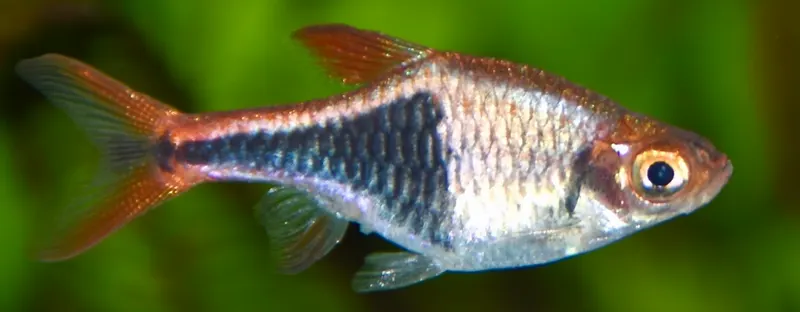
What they look like: coppery body and fins with a black triangle on the rear half of the body.
Native to: Malay Peninsula, Singapore, Sumatra and Borneo.
Edited by Marin Hale · last reviewed November 14, 2026 · How we check facts
Harlequin rasbora size, lifespan and how many per tank
How big do harlequin rasboras get?
Harlequin rasbora size: adults reach 1.7–1.8 inches (4.3–4.6 cm).
How long do harlequin rasboras live?
5–6 years with good care.
Do harlequin rasboras need hard or soft water?
Harlequin rasboras take a hardness (GH) of 1–12 dGH, about 18–210 ppm: soft to very hard water. Compare it with the hardness on your water report, which is given in ppm or mg/L.
How hard is your tap water? Austin · Denver · New York City · all cities
Bands from the US Geological Survey (soft up to 60 ppm, moderately hard up to 120, hard up to 180, very hard above); 1 dGH is about 17.9 ppm (Aquariadise).
How many harlequin rasboras can you keep in a 5, 10 or 20-gallon tank?
| 5 gallons | Too small. Harlequin rasboras need at least 15 gallons. |
|---|---|
| 10 gallons | Too small. Harlequin rasboras need at least 15 gallons. |
| 20 gallons | Up to about 14 (keep at least 8) |
A cautious estimate from our crowding model, based on the minimum tank and group size rather than a published stocking list. With strong filtration, plants and weekly water changes, many keepers stock more. With other fish in the same part of the tank, fewer fit. How it works · Check a mixed tank
Sizes and lifespans are cross-checked across our sources: see where each value comes from.
Harlequin rasbora care guide
Tank setup
| Heater | Yes. Set an adjustable heater to 73–79°F (23–26°C); harlequin rasboras tolerate 70–82°F, and most rooms are cooler than that. |
|---|
Water for harlequin rasboras: temperature, pH and hardness
Harlequin rasbora temperature: keep them at 73–79°F (23–26°C); they tolerate 70–82°F (21–28°C).
Measure pH with the test kit. For hardness, a GH test or your water supplier’s report tells you what comes out of your tap.
Harlequin rasbora behaviour and tank decor
Peaceful shoaling fish, active in the water; keep in a group of at least six.
- Plants and hiding places: live plants such as Cryptocoryne and Aponogeton with open areas for swimming.
- Lighting: subdued lighting.
- Filter flow: modest currents with enough filtration turnover to keep the tank clean.
Signs of stress: nervous when kept in small numbers; farmed fish lack much of the colour of wild ones; lone individuals quickly become stressed and prone to disease; skittish and secretive in small groups; colour improves after a few weeks destressing in the tank.
What do harlequin rasboras eat?
Male vs female harlequin rasboras, and breeding
How to tell male and female harlequin rasboras apart: males have slightly larger black body patch, more rounded near anal fin; ripe females fuller-bodied.
Breeding: Egg depositor on plant leaves (adhesive eggs). Parents may eat eggs; breeding needs soft, acidic water.
How breeders do it (13 points from our sources)
- Plants such as Cryptocoryne in the breeding tank; eggs are laid on leaf undersides
- Soft, acidic water, no higher than 4 dH, pH around 6.4
- Temperature 28 °C (82 °F)
- Condition parents heavily with live foods such as Daphnia and mosquito larvae
- Remove adults or eggs after spawning as adults eat eggs
- Separate, very dimly lit tank with bare base or mesh so eggs fall through
- PH 5.0-6.0, 1-5 dH, temperature at the upper end of the range
- Broad-leaved plant clump (Microsorium, Cryptocoryne) or artificial alternative
- Condition with small live and frozen foods 2 or 3 times a day for weeks beforehand
- Older fish (a year or more) spawn best
- Large cool water change (40-50%) before introducing one or two pairs in the evening
- Set up a separate spawning and rearing container to maximize survival
- Sticky eggs adhere to fine-leaved plants
- Does best under dim lighting
- Adult small size must be considered when choosing tankmates
- Timid; keep a large group so they feel at ease
- Discreet and hides near larger neighbours
- Skittish and secretive when kept alone or in small groups
Care tips
- Keep at least 8 together in a tank of 15 gallons or more, because lone fish become stressed and susceptible to disease.
- Use dim lighting and don't leave the tank bare, since they dislike bright light and bare tanks.
- A dark or soft sandy substrate with wood and leaf litter suits them, and plants are safe with them.Soft water / hardness: How many minerals are dissolved in the water (measured as GH). Your water supplier or a GH test can tell you.
- Keep the water between 70–82°F (ideally 73–79°F) with a pH of 6.0–7.5, and keep it cycled and stable.pH: How acidic or alkaline the water is; 7 is neutral, lower is more acidic.
Harlequin rasbora tank mates
What can live with a harlequin rasbora?
Verdicts against every species in our database, from our compatibility rules. How verdicts work
Easy picks for a 15-gallon tank: betta fish, cardinal tetra, celestial pearl danio, chili rasbora. Use the stocking calculator to check how many of each fit.
| Verdict | Species | Why | Smallest tank * |
|---|---|---|---|
| Good match | Betta fish | Both are comfortable at 75–82°F, pH 6.0–7.5. Peaceful together, and neither can eat the other. Both swim near the top. | 15 gal+ |
| Good match | Bristlenose pleco | Both are comfortable at 72–79°F, pH 6.0–7.5. Peaceful together, and neither can eat the other. They share the tank well: bristlenose plecos swim near the bottom, harlequin rasboras near the top and mid-water. | 30 gal+ |
| Good match | Bronze corydoras | Both are comfortable at 70–82°F, pH 6.0–7.5. Peaceful together, and neither can eat the other. They share the tank well: bronze corydoras swim near the bottom, harlequin rasboras near the top and mid-water. | 20 gal+ |
| Good match | Cardinal tetra | Both are comfortable at 73–82°F, pH 6.0–7.5. Peaceful together, and neither can eat the other. Both swim mid-water. | 15 gal+ |
| Good match | Celestial pearl danio | Both are comfortable at 72–79°F, pH 6.5–7.5. Peaceful together, and neither can eat the other. Both swim mid-water. | 15 gal+ |
| Good match | Chili rasbora | Both are comfortable at 70–82°F, pH 6.0–7.0. Peaceful together, and neither can eat the other. Both swim near the top and mid-water. | 15 gal+ |
| Good match | Ember tetra | Both are comfortable at 73–82°F, pH 6.0–7.0. Peaceful together, and neither can eat the other. Both swim near the top and mid-water. | 15 gal+ |
| Good match | Guppy | Both are comfortable at 72–82°F, pH 7.0–7.5. Peaceful together, and neither can eat the other. Both swim near the top and mid-water. | 15 gal+ |
| Good match | Another harlequin rasbora | Water needs overlap. Peaceful together, and neither can eat the other. | 15 gal+ |
| Good match | Honey gourami | Both are comfortable at 72–82°F, pH 6.0–7.5. Peaceful together, and neither can eat the other. Both swim near the top and mid-water. | 15 gal+ |
| Good match | Kuhli loach | Both are comfortable at 74–81°F, pH 6.0–7.0. Peaceful together, and neither can eat the other. They share the tank well: kuhli loaches swim near the bottom, harlequin rasboras near the top and mid-water. | 20 gal+ |
| Good match | Neon tetra | Both are comfortable at 70–77°F, pH 6.0–7.0. Peaceful together, and neither can eat the other. Both swim mid-water. | 15 gal+ |
| Good match | Panda corydoras | Both are comfortable at 70–77°F, pH 6.0–7.5. Peaceful together, and neither can eat the other. They share the tank well: panda corydoras swim near the bottom, harlequin rasboras near the top and mid-water. | 15 gal+ |
| Good match | Pygmy corydoras | Both are comfortable at 72–79°F, pH 6.2–7.4. Peaceful together, and neither can eat the other. Both swim mid-water. | 15 gal+ |
| Good match | Tiger barb | Both are comfortable at 72–80°F, pH 6.0–7.5. Peaceful together, and neither can eat the other. | 30 gal+ |
| Good match | Zebra danio | Both are comfortable at 70–77°F, pH 6.0–7.5. Peaceful together, and neither can eat the other. | 20 gal+ |
| Maybe | Amano shrimp | Harlequin rasboras may pick off small or freshly molted Amano shrimp. Plants and hiding places help. | 15 gal+ |
| Maybe | Angelfish | Adult angelfish may eat small harlequin rasboras. | 30 gal+ |
| Maybe | Cherry shrimp | Harlequin rasboras eat baby shrimp and may pick off adults. Dense plants and moss help a colony survive. | 15 gal+ |
| Maybe | Molly | Harlequin rasboras prefer softer water (1–12 dGH) than mollies (12–25 dGH). | 20 gal+ |
| Maybe | Platy | Harlequin rasboras prefer softer water (1–12 dGH) than platies (10–20 dGH). | 20 gal+ |
| Maybe | Zebra nerite snail | pH ranges overlap only at pH 7.2–7.5, so one of them will be outside its comfort zone if your water drifts. | 15 gal+ |
| Avoid | Common goldfish | Common goldfish need cool water; harlequin rasboras need tropical water. | — |
| Avoid | Fancy goldfish | Fancy goldfish need cool water; harlequin rasboras need tropical water. | — |
| Avoid | White cloud minnow | White cloud minnows need cool water; harlequin rasboras need tropical water. | — |
* Smallest tank: the larger of the two species’ own minimum tanks. It is not a stocking plan: a full group of each may need more room. Check exact numbers in the stocking calculator.
Questions
Do harlequin rasboras need a heater?
They tolerate 70–82°F, and 73–79°F is ideal. If your tank can't reliably stay within that range, a heater is the way to hold it there.
What do harlequin rasboras eat?
They are carnivores that do best on a varied diet of prepared foods. Mix in live foods such as Daphnia now and then.
What fish can live with harlequin rasboras?
Good matches include neon tetras, cardinal tetras, ember tetras, guppies, zebra danios, tiger barbs, bettas, bristlenose plecos, and bronze, panda and pygmy corydoras. Use caution with angelfish, which may eat them, and with cherry shrimp, which they may eat. Mollies, platies and zebra nerite snails prefer harder water than harlequins do. Avoid common goldfish, fancy goldfish and white cloud minnows, which need cool water, and goldfish can also eat them.
How many harlequin rasboras should I keep together?
Keep at least 8. They are timid, and a large group helps them feel at ease. In small groups or alone, they become skittish and secretive.
How can I tell male and female harlequin rasboras apart?
Males have a slightly larger black body patch that is more rounded near the anal fin. Ripe females are fuller-bodied. If you want to breed them, they lay adhesive eggs on plant leaves and need soft, acidic water. The parents may eat the eggs.
Sources
(5 references, 25 facts with quotes)
Each value is cross-checked across the references below. Where they disagreed, an editor chose a value and recorded why.
- Harlequin rasbora (en.wikipedia.org)
- Trigonostigma heteromorpha (Seriously Fish) (www.seriouslyfish.com)
- Harlequin Rasbora Trigonostigma heteromorpha (www.qualitymarine.com)
- Trigonostigma heteromorpha - harlequin rasbora (www.fishi-pedia.com)
- Harlequin Rasbora Care | The Best Schooling Nano Fish? (www.theshrimpfarm.com)
- GBIF taxonomy record
- Wikidata entry
Where each value comes from (25 facts)
| Fact | What each source says |
|---|---|
| Temperature | en.wikipedia.org: “the fish is capable of living in temperatures from 21 to 28 °C (70 to 82 °F)” seriouslyfish.com: “Temp 21–28°C70–82°F” fishi-pedia.com: “Temperature 23 - 26 °C” theshrimpfarm.com: “Temperature: 70–82.5°F” |
| pH editor decision | en.wikipedia.org: “The fish will live in an aquarium in waters ranging from a pH of 6.0 to 7.8” seriouslyfish.com: “pH 5.0–7.5” fishi-pedia.com: “pH (acidity) 6.8 - 7.2” theshrimpfarm.com: “pH: 5.0–7.5” |
| Adult size | en.wikipedia.org: “attains a standard length of 4 cm~4.5 cm, the maximum length can reach two inches (5.1 cm)” seriouslyfish.com: “Max size 45mm SL1.8in SL” fishi-pedia.com: “The harlequin rasbora measures between 3 and 4 cm.” theshrimpfarm.com: “Harlequin rasboras reach no more than 1.8" or so in length” |
| Lifespan | en.wikipedia.org: “individuals in the aquarium can be expected, with good care, to live for five to eight years” fishi-pedia.com: “Longevity 5 year” |
| Group size editor decision | en.wikipedia.org: “should be kept in a group comprising a minimum of six individuals” seriouslyfish.com: “should be kept in a group of at least 8-10 specimens” fishi-pedia.com: “at least 15 individuals in an aquarium of 60 liters minimum” theshrimpfarm.com: “a group of six or eight is okay, but twenty or even thirty fish will really stop anyone” |
| Temperament | en.wikipedia.org: “Being a peaceful species, the harlequin rasbora may be maintained in a community aquarium” seriouslyfish.com: “This species is very peaceful indeed making it an ideal resident of the well-maintained community tank” qualitymarine.com: “This attractive and peaceful schooling fish is perfectly at home in most any community aquarium” fishi-pedia.com: “The harlequin rasbora is a peaceful species that generally does not exhibit behavioral problems in a community aquarium.” theshrimpfarm.com: “Harlequin rasboras are ideal community fish.” |
| Safe with plants editor decision | en.wikipedia.org: “An aquarium intended to house harlequin rasboras should be planted with live plants” |
| Water type | en.wikipedia.org: “The fish will live in an aquarium in waters ranging from a pH of 6.0 to 7.8” seriouslyfish.com: “Such environments characteristically contain soft, weakly acidic to neutral water” fishi-pedia.com: “is a little fresh water fish from the Eurasia” theshrimpfarm.com: “Wild harlequin rasboras can be found in soft and lightly acidic waters” |
| Breeding type | en.wikipedia.org: “the harlequin rasbora deposits adhesive eggs on the underside of the leaves of plants such as Cryptocoryne and Aponogeton” seriouslyfish.com: “the eggs are attached to the underside of broad plant leaves or other objects rather than scattered randomly” theshrimpfarm.com: “the sticky eggs are adhered to fine-leaved plants and left to fend for themselves” |
| Native to | en.wikipedia.org: “The harlequin rasbora is a native of the Malay Peninsula, Singapore, Sumatra and Borneo.” seriouslyfish.com: “a small cyprinid from southern Thailand, Peninsular Malaysia, Singapore and Sumatra” qualitymarine.com: “populations well-documented from peninsular Malaysia and Thailand (and perhaps nearby Sumatra)” fishi-pedia.com: “Countries Indonesia Malaisie Thaïlande islands Riau Archipelago Borneo Sumatra” theshrimpfarm.com: “Origin Malay Peninsula, Indonesia” |
| Hardness (GH) | en.wikipedia.org: “hardness ranges from zero to 15°dH” seriouslyfish.com: “Hardness 1–12dGH” fishi-pedia.com: “gh (hardness) 6 - 10” |
| Telling males from females | en.wikipedia.org: “Males are cited as possessing a slightly larger black body patch than females” seriouslyfish.com: “Mature females are usually rounder-bellied and often a little larger than the slimmer, more colourful males.” qualitymarine.com: “In mature specimens, females grow a bit larger and have a fuller belly.” fishi-pedia.com: “The females have a more rounded abdomen than the males, they are generally stockier.” |
| Feeding | en.wikipedia.org: “a variety of these should be given, preferably interspersed with feedings of live foods such as Daphnia” seriouslyfish.com: “regular meals of small live and frozen foods such as bloodworm, Daphnia, and Artemia, alongside good quality dried flakes and granules” qualitymarine.com: “will benefit from regular feedings of frozen worms and crustaceans” fishi-pedia.com: “This species can eat dry food (flakes, pellets), fresh food and frozen food.” theshrimpfarm.com: “You can feed a high-quality microfood (pellet or flake) as a staple” |
| Breeding | en.wikipedia.org: “the parent fishes should be removed from the breeding aquarium to prevent instances of egg eating” seriouslyfish.com: “in a densely-planted, mature aquarium it is possible that small numbers of young may start to appear without human intervention” qualitymarine.com: “It is even possible for young to successfully develop without assistance in a densely planted aquarium.” theshrimpfarm.com: “In the aquarium, they'll try to eat their own eggs and babies because they simply don't recognize them.” |
| Smallest tank | seriouslyfish.com: “Volume ~54litres~14US gal” fishi-pedia.com: “at least 15 individuals in an aquarium of 60 liters minimum” theshrimpfarm.com: “A 15-gallon (long) tank should be enough for a small to medium-sized group” |
| Care level | seriouslyfish.com: “Difficulty6 of 8 measures Easy” theshrimpfarm.com: “Difficulty level Easy” |
| Diet editor decision | seriouslyfish.com: “a micropredator feeding on small insects, worms, crustaceans and other zooplankton” qualitymarine.com: “This is a primarily carnivorous fish, which will benefit from regular feedings of frozen worms and crustaceans.” fishi-pedia.com: “The harlequin rasbora is carnivorous.” theshrimpfarm.com: “they're unfussy and will accept anything they can fit into their mouths” |
| Substrate | seriouslyfish.com: “A more natural-looking arrangement might consist of a soft, sandy substrate with wood roots and branches” theshrimpfarm.com: “covering a sandy substrate with a layer of leaf litter, sticks, and seed pods” |
| Warnings | seriouslyfish.com: “This species seems to do best under fairly dim lighting” qualitymarine.com: “Be sure to always keep a large group together, as this will also encourage these timid fishes to feel at ease” fishi-pedia.com: “Lonely individuals tend to quickly become stressed and become especially susceptible to disease.” theshrimpfarm.com: “When kept alone or in very small groups, on the other hand, they can become skittish and secretive.” |
| Swims editor decision | fishi-pedia.com: “naturally found mid-depth and near surface” |
| Long fins editor decision | theshrimpfarm.com: “aquaculturists have... managed to create long-finned harlequins, purple/blue and gold harlequins” |
| Eats shrimp/snails editor decision | theshrimpfarm.com: “harlequins are much too small to try to take on an adult shrimp, even if it's a tiny Neocaridina. Only newly hatched babies are at risk” |
| Looks | qualitymarine.com: “unmistakable black triangle present on the posterior half of the body, which contrasts against the cupreous hue of the body and fins” en.wikipedia.org: “approximately lozenge-shaped body, whose basal colour from the head to the caudal peduncle is an orange-pink” seriouslyfish.com: “The basic body colouration of T. heteromorpha is pinkish, it has the deepest body shape of the three and the characteristic body marking is broader, more triangular” theshrimpfarm.com: “starts out a muted orange-pink near the head and intensifies into a beautiful coppery orange near the tail” |
| Varieties | seriouslyfish.com: “Several selectively-bred ornamental strains have also become available including 'blue', 'black', and 'golden' (leucistic) forms” theshrimpfarm.com: “they've managed to create long-finned harlequins, purple/blue and gold harlequins, "blond" harlequins (which lack the triangle)” |
| How often to feed | fishi-pedia.com: “Meals should be eaten within 2–3 minutes, served in several small portions rather than a single large ration.” |
Editor decisions (7)
- Seriously Fish and The Shrimp Farm give 5.0–7.5, Wikipedia 6.0–7.8; 6.0–7.5 is comfortable across the sources for tank-bred fish.
- Seriously Fish says at least 8–10; Wikipedia and The Shrimp Farm say 6 or more. 8 keeps them schooling and confident.
- Wikipedia recommends a planted tank with Cryptocoryne and Aponogeton; no source reports harlequins eating plants.
- Seriously Fish, Quality Marine and Fishi-pedia: a micropredator of insects, worms and zooplankton; it still takes prepared foods (The Shrimp Farm); any non-herbivore diet is treated the same by the compatibility rules (only grazers are exempt from the predation check).
- Fishi-pedia: mid-depth and near the surface; a mid-water schooling fish in every source's description.
- The only mention (The Shrimp Farm) is of a bred long-finned variety; the normal harlequin is short-finned.
- The Shrimp Farm: much too small to take an adult shrimp; only newly hatched babies are at risk.
Cite this page
“Harlequin rasbora care.” Fish Tank Atlas, last reviewed November 14, 2026. https://fishtankatlas.com/fish/harlequin-rasbora/