Chili rasbora
Boraras brigittae · family Cyprinidae
- Ideal temperature
- 72–82°F
- Smallest tank
- 10 gallons
- Keep at least
- 8 together
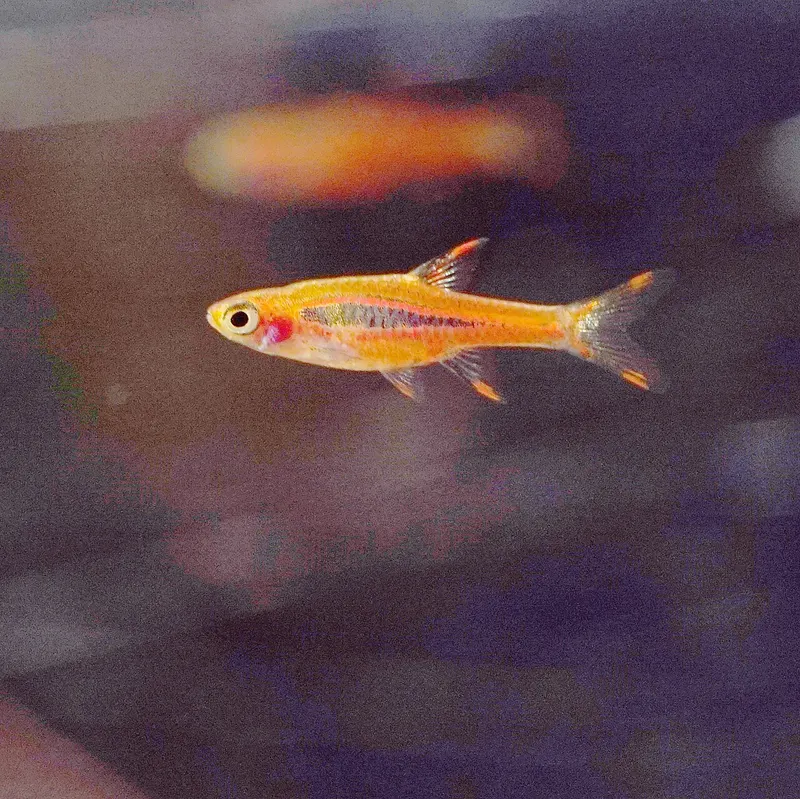
The chili rasbora (Boraras brigittae) is a tiny, peaceful fish from the swamps of South West Borneo, Indonesia. It reaches only 0.7–0.8 inches and does best in a group of at least 8, in a 10-gallon or larger tank with dense cover and dim lighting. The most important thing to know is that it's sensitive to water chemistry swings, so it's best added to a mature tank where soft, acidic water stays stable.
What they look like: slender body with pointed fins, deep cool-toned red with black horizontal stripe.
Native to: swamps of South West Borneo, Indonesia.
Edited by Marin Hale · last reviewed November 17, 2026 · How we check facts
Chili rasbora size, lifespan and how many per tank
How big do chili rasboras get?
Chili rasbora size: adults reach 0.7–0.8 inches (1.8–2 cm).
How long do chili rasboras live?
5–7 years with good care.
Do chili rasboras need hard or soft water?
Chili rasboras take a hardness (GH) of 1–10 dGH, about 18–180 ppm: soft to hard water. Compare it with the hardness on your water report, which is given in ppm or mg/L.†
How hard is your tap water? Austin · Denver · New York City · all cities
Bands from the US Geological Survey (soft up to 60 ppm, moderately hard up to 120, hard up to 180, very hard above); 1 dGH is about 17.9 ppm (Aquariadise).
How many chili rasboras can you keep in a 5, 10 or 20-gallon tank?
| 5 gallons | Too small. Chili rasboras need at least 10 gallons. |
|---|---|
| 10 gallons | Up to about 10 (keep at least 8) |
| 20 gallons | Up to about 21 (keep at least 8) |
A cautious estimate from our crowding model, based on the minimum tank and group size rather than a published stocking list. With strong filtration, plants and weekly water changes, many keepers stock more. With other fish in the same part of the tank, fewer fit. How it works · Check a mixed tank
Sizes and lifespans are cross-checked across our sources: see where each value comes from.
Legal note, Hawaii: Chili rasboras (Boraras brigittae) are probably prohibited in Hawaii: we didn’t find them on any of Hawaii’s animal import lists, and Hawaii’s Department of Agriculture says any animal not on its lists is considered prohibited. Check with the department before bringing any to Hawaii. (Hawaii Department of Agriculture; checked November 18, 2026)
Chili rasbora care guide
Tank setup
| Heater | Yes. Set an adjustable heater to 72–82°F (22–28°C); chili rasboras tolerate 68–82°F, and most rooms are cooler than that. |
|---|---|
| Substrate | Soft, sandy substrate |
| New tanks | Add only to an established, cycled tank. Not for a brand-new setup. |
Water for chili rasboras: temperature, pH and hardness
Chili rasbora temperature: keep them at 72–82°F (22–28°C); they tolerate 68–82°F (20–28°C).
Measure pH with the test kit. For hardness, a GH test or your water supplier’s report tells you what comes out of your tap.
Chili rasbora behaviour and tank decor
Very peaceful, timid schooling fish; keep in a group of at least 8-10; males compete for females and form temporary territories when spawning.
- Plants and hiding places: densely planted tank with floating plants, driftwood roots or branches, soft sandy substrate, shady spots and dried leaf litter.
- Lighting: fairly dim lighting.
- Filter flow: filtration does not need to be strong; may struggle in fast current.
Signs of stress: shy and hiding among plants when kept in small groups; susceptible to swings in water chemistry; colours fade or look pale; fade from poor or unstable water, slightly aggressive tank mate, or not enough cover; chronic stress leaves them vulnerable to disease.
What do chili rasboras eat?
Chili rasbora diseases and health problems
- Ich. Signs: tiny white spots on body, fins and gills; flashing against objects.
- Fungal infections. Signs: white fluffy or cottony growths on body, mouth and head.
- Bacterial infections. Signs: sores, ulcers or red patches, ragged bloody fins.
- Columnaris. Signs: lesions, discolored and shed scales, fuzzy patches.
- Flukes. Signs: external parasites visible attached to skin or gills.
At the shop: don’t buy from a tank where any of them show these signs.
Male vs female chili rasboras, and breeding
How to tell male and female chili rasboras apart: females have rounder bellies and lighter color; males smaller and more brightly colored.
Breeding: Egg scatterer, continuous spawner. Small numbers of fry may appear in a mature tank; adults eat eggs but don't actively hunt them.
How breeders do it (19 points from our sources)
- Continuous spawners laying eggs daily, scatter eggs, no parental care
- Set up 10-15 litre dimly lit containers with bare base or mesh so eggs fall through
- Water pH 5.0-6.5, 1-5°H, temperature at upper end of range
- Add Java moss or other fine-leaved plant filling about half the space
- Add two or three pairs of conditioned adults and remove them after a couple of days
- Fry need Paramecium or other microscopic food, then Artemia nauplii/microworm after a week to ten days
- Wait a week or two before small water changes
- Cover bottom with plastic craft mesh over java moss or spawning mop so eggs fall through
- Soft acidic water, pH below 6.5, temperature above 25°C (77°F)
- Condition pair or small group with live foods
- Feed fry infusoria and vinegar eels, then micro worms and baby brine shrimp after a couple of weeks
- Breed in a mature planted tank with catappa leaves and botanicals for fry to graze
- Acidic pH below 7.0 may improve hatch rate
- Keep a group of at least 6 to get both sexes
- Can breed in the main tank, no separate tank needed
- In a single-species tank fry hide among plants and can survive
- Dense planting may give eggs and fry cover
- Males can be territorial, so give ample space
- Keep 1 to 2 females per male
- Susceptible to swings in water chemistry
- May struggle in fast current
- Sensitive; poor or unstable water causes colour fade, stress and disease
- Colour takes many months to develop
- Pale for a couple of weeks after moving tanks
- Sensitive to water chemistry fluctuations
Care tips
- Keep at least 8 together, because chili rasboras get shy without a large group.
- Add them only to a mature tank, and keep the water soft and acidic (pH 4.0–7.0, 1–10 dGH) and stable, since they are very sensitive to ammonia and nitrates.Ammonia and nitrite: Poisons that build up from fish waste until the tank is cycled. A test kit measures them.Soft water / hardness: How many minerals are dissolved in the water (measured as GH). Your water supplier or a GH test can tell you.pH: How acidic or alkaline the water is; 7 is neutral, lower is more acidic.
- Use dim lighting, dense planting and a low-flow filter such as a sponge filter, and cover the filter intake so these small fish aren't pulled in or tired out by current.
- Feed small foods like pellets, flakes, frozen food or young brine shrimp, and watch that they get their share, because they are easily outcompeted at mealtimes.
Chili rasbora tank mates
What can live with a chili rasbora?
Verdicts against every species in our database, from our compatibility rules. How verdicts work
Easy picks for a 10-gallon tank: amano shrimp, betta fish, celestial pearl danio, cherry shrimp. Use the stocking calculator to check how many of each fit.
| Verdict | Species | Why | Smallest tank * |
|---|---|---|---|
| Good match | Amano shrimp | Both are comfortable at 68–81°F, pH 6.0–7.0. Peaceful together, and neither can eat the other. Both swim mid-water. | 10 gal+ |
| Good match | Betta fish | Both are comfortable at 75–82°F, pH 6.0–7.0. Peaceful together, and neither can eat the other. Both swim near the top. | 10 gal+ |
| Good match | Bristlenose pleco | Both are comfortable at 72–79°F, pH 5.8–7.0. Peaceful together, and neither can eat the other. They share the tank well: bristlenose plecos swim near the bottom, chili rasboras near the top and mid-water. | 30 gal+ |
| Good match | Bronze corydoras | Both are comfortable at 68–82°F, pH 6.0–7.0. Peaceful together, and neither can eat the other. They share the tank well: bronze corydoras swim near the bottom, chili rasboras near the top and mid-water. | 20 gal+ |
| Good match | Cardinal tetra | Both are comfortable at 73–82°F, pH 5.0–7.0. Peaceful together, and neither can eat the other. Both swim mid-water. | 15 gal+ |
| Good match | Celestial pearl danio | Both are comfortable at 72–79°F, pH 6.5–7.0. Peaceful together, and neither can eat the other. Both swim mid-water. | 10 gal+ |
| Good match | Cherry shrimp | Both are comfortable at 68–82°F, pH 6.5–7.0. Peaceful together, and neither can eat the other. | 10 gal+ |
| Good match | Another chili rasbora | Water needs overlap. Peaceful together, and neither can eat the other. | 10 gal+ |
| Good match | Ember tetra | Both are comfortable at 73–82°F, pH 5.0–7.0. Peaceful together, and neither can eat the other. Both swim near the top and mid-water. | 10 gal+ |
| Good match | Harlequin rasbora | Both are comfortable at 70–82°F, pH 6.0–7.0. Peaceful together, and neither can eat the other. Both swim near the top and mid-water. | 15 gal+ |
| Good match | Honey gourami | Both are comfortable at 72–82°F, pH 6.0–7.0. Peaceful together, and neither can eat the other. Both swim near the top and mid-water. | 10 gal+ |
| Good match | Kuhli loach | Kuhli loaches reach about 4 inches but are eel-thin with tiny mouths, and they feed on small sinking foods, not on tank mates; even tiny fish like chili rasboras are safe with them. | 20 gal+ |
| Good match | Neon tetra | Both are comfortable at 70–77°F, pH 6.0–7.0. Peaceful together, and neither can eat the other. Both swim mid-water. | 10 gal+ |
| Good match | Panda corydoras | Both are comfortable at 68–77°F, pH 6.0–7.0. Peaceful together, and neither can eat the other. They share the tank well: panda corydoras swim near the bottom, chili rasboras near the top and mid-water. | 10 gal+ |
| Good match | Pygmy corydoras | Both are comfortable at 72–79°F, pH 6.2–7.0. Peaceful together, and neither can eat the other. Both swim mid-water. | 10 gal+ |
| Good match | White cloud minnow | Both are comfortable at 68–72°F, pH 6.0–7.0. Peaceful together, and neither can eat the other. Both swim near the top and mid-water. | 10 gal+ |
| Maybe | Guppy | pH ranges overlap only at pH 7.0, so one of them will be outside its comfort zone if your water drifts. | 10 gal+ |
| Maybe | Platy | pH ranges overlap only at pH 7.0, so one of them will be outside its comfort zone if your water drifts. | 20 gal+ |
| Maybe | Tiger barb | Tiger barbs can harass much smaller, peaceful chili rasboras. | 30 gal+ |
| Maybe | Zebra danio | Zebra danios can harass much smaller, peaceful chili rasboras. | 20 gal+ |
| Maybe | Zebra nerite snail | pH ranges don't overlap (4.0–7.0 vs 7.2–8.4). | 10 gal+ |
| Avoid | Angelfish | Chili rasboras are small enough for adult angelfish to eat. | — |
| Avoid | Common goldfish | pH ranges overlap only at pH 7.0, so one of them will be outside its comfort zone if your water drifts. | — |
| Avoid | Fancy goldfish | pH ranges overlap only at pH 6.8–7.0, so one of them will be outside its comfort zone if your water drifts. | — |
| Avoid | Molly | pH ranges overlap only at pH 7.0, so one of them will be outside its comfort zone if your water drifts. | — |
* Smallest tank: the larger of the two species’ own minimum tanks. It is not a stocking plan: a full group of each may need more room. Check exact numbers in the stocking calculator.
Questions
Do chili rasboras need a heater?
Chili rasboras tolerate 68–82°F, and their ideal range is 72–82°F. Whether you need a heater depends on whether your room keeps the tank in that range. They are sensitive to temperature changes, so a steady temperature matters.
What do chili rasboras eat?
They are carnivores and eat pellets, flakes, frozen food, and young brine shrimp and worms. Because they are easily outcompeted at mealtimes, make sure they get their share if you keep them with faster eaters.
What fish can live with chili rasboras?
Peaceful tank mates with similar water needs work well, including neon tetras, cardinal tetras, ember tetras, harlequin rasboras, white cloud minnows, honey gouramis, bettas, pygmy, panda and bronze corydoras, bristlenose plecos and cherry shrimp. Avoid angelfish, goldfish and mollies, which can eat them or need different water. Be careful with guppies, platies, tiger barbs, zebra danios and nerite snails.
How many chili rasboras should I keep together?
Keep at least 8, in a tank of 10 gallons or more. Smaller groups tend to be shy and hide. They live about 5–7 years.
How can I tell male and female chili rasboras apart?
Males are smaller and more brightly colored, while females have rounder bellies and lighter color. A ratio of 1 male to 1–2 females works well. Their color can take many months to develop, and they may look pale for a couple of weeks after a move.
Sources
(6 references, 27 facts with quotes)
Each value is cross-checked across the references below. Where they disagreed, an editor chose a value and recorded why.
- Boraras brigittae (en.wikipedia.org)
- Boraras brigittae (Seriously Fish) (www.seriouslyfish.com)
- Chilli Rasbora Care Guide: Tank Size, Setup & Tips - Practical Fishkeeping (www.practicalfishkeeping.co.uk)
- Care Guide for Chili Rasboras — Spicy Red Nano Fish for Planted Tanks (aquariumcoop.com)
- Chili Rasbora - Size, Tank Mates And Care Guide (www.tankarium.com)
- Chili Rasbora Care Guide | Shrimpy Business (shrimpybusiness.com)
- GBIF taxonomy record
- Wikidata entry
Where each value comes from (27 facts)
| Fact | What each source says |
|---|---|
| Adult size | en.wikipedia.org: “Their sizes range between 10 and 20 mm (0.39–0.79 in)” seriouslyfish.com: “Max size 20mm SL0.8in SL” practicalfishkeeping.co.uk: “Size: up to 2cm (0.8”)” aquariumcoop.com: “They only grow to about ¾ inch (2 cm) long” tankarium.com: “Chili rasboras only grow to around half an inch long.” shrimpybusiness.com: “growing between 0.6 and 0.8 inches in length at maturity” |
| Diet editor decision | en.wikipedia.org: “micro-predators with a diet primarily consisting of small insects, worms, crustaceans, and other zooplankton” tankarium.com: “Chili rasboras are omnivores, eating different types of food, including plant matter and meaty protein.” shrimpybusiness.com: “they are classified as micropredators. These fish thrive on a varied diet of live, frozen, and freeze-dried carnivorous foods” |
| Native to | en.wikipedia.org: “It is endemic to the swamps of South West Borneo, Indonesia.” seriouslyfish.com: “appears to be endemic to southwestern Borneo” practicalfishkeeping.co.uk: “Origin: Found in the south of Borneo.” aquariumcoop.com: “Chili rasbora are found in the rainforests of Borneo and Indonesia” tankarium.com: “Origin Southern Borneo, Indonesia” shrimpybusiness.com: “Chili rasboras are native to Indonesia, specifically to southwestern Borneo.” |
| Telling males from females | en.wikipedia.org: “Females in this species have rounder bellies and lighter color than males. The males are smaller than females and more brightly colored” seriouslyfish.com: “Mature females are noticeably rounder-bellied and often a little larger than males.” aquariumcoop.com: “Females tend to be rounder and less colorful, while males are smaller and have the brightest reds.” shrimpybusiness.com: “Male chili rasboras also tend to be thinner and more streamlined than females – more bullet-shaped than rounded.” |
| Feeding | en.wikipedia.org: “They may be fed pellets, frozen food, flakes, young brine shrimp and worms.” seriouslyfish.com: “Daily meals of small live and frozen fare such as Daphnia, Artemia along with good quality flakes and granules” practicalfishkeeping.co.uk: “Prepared micro granules or crushed flakes, and small frozen and live foods like Cyclops and baby brine shrimp work well.” aquariumcoop.com: “so floating or slow-sinking foods should be offered” tankarium.com: “I recommend that you feed the rasboras twice daily” shrimpybusiness.com: “Feed in very small amounts – only as much as your fish can consume in a minute or two.” |
| Temperature | seriouslyfish.com: “20–28°C68–82°F” practicalfishkeeping.co.uk: “Temperature: 20-28°C (68-82°F)” aquariumcoop.com: “temperatures between 72–82°F (22–28°C)” tankarium.com: “Temperature Range Tropical 68° to 83° Fahrenheit” shrimpybusiness.com: “Temperature: 68°F to 82°F” |
| pH editor decision | seriouslyfish.com: “pH 4.0–7.0” aquariumcoop.com: “We have successfully kept them in pH levels of 6.0–8.0” tankarium.com: “pH Range 4.0 to 7.0” shrimpybusiness.com: “pH Level: 4.0 to 7.0” |
| Hardness (GH) | seriouslyfish.com: “Hardness 1–10dGH” |
| Smallest tank editor decision | seriouslyfish.com: “Volume ~41litres~11US gal” practicalfishkeeping.co.uk: “a shoal of 10 or more rasboras will be a squeeze in the 20 litre (4.4 gal) tank, but more suitable for a 45 litre (9.9 gal)” aquariumcoop.com: “we have successfully kept them in planted fish tanks as small as 3 gallons” tankarium.com: “you can keep a school of ten of these gorgeous little fish in a 5-gallon aquarium” shrimpybusiness.com: “chili rasboras can be kept in a tank as small as 10 gallons for a group of ten fish” |
| Group size | seriouslyfish.com: “should be kept in a group of at least 8-10 specimens” practicalfishkeeping.co.uk: “a shoal of 10 or more rasboras” aquariumcoop.com: “we like keeping a school of at least 8–12 together” tankarium.com: “Chili rasboras need to live in large groups of eight to ten individuals.” shrimpybusiness.com: “a tank as small as 10 gallons for a group of ten fish” |
| Temperament | seriouslyfish.com: “This species is very peaceful but does not make an ideal community fish” practicalfishkeeping.co.uk: “Their small size and peaceful nature mean they can be outcompeted in a busy tank” aquariumcoop.com: “Boraras brigittae is a very peaceful species” tankarium.com: “Chili rasboras are peaceful, timid fish” shrimpybusiness.com: “Chili rasboras are generally very peaceful” |
| Care level editor decision | seriouslyfish.com: “Rated moderate because it needs a well-established tank and stable water.” aquariumcoop.com: “chili rasboras are quite hardy and can handle a much wider range of water parameters” tankarium.com: “Care Level Moderate” shrimpybusiness.com: “generally considered an intermediate fish rather than a beginner fish” |
| Eats shrimp/snails | seriouslyfish.com: “in a planted set-up can be housed alongside freshwater shrimp of the genera Caridina and Neocaridina” practicalfishkeeping.co.uk: “alongside Neocaridina shrimp, as they are fairly shrimp safe” aquariumcoop.com: “chili rasboras won’t bother the adult shrimp” tankarium.com: “the rasboras are too small to eat adult and baby shrimp” shrimpybusiness.com: “They aren’t big enough to feed on most shrimp” |
| Breeding type | seriouslyfish.com: “an egg-scattering, continuous spawner that exhibits zero parental care” practicalfishkeeping.co.uk: “continuous spawners, laying eggs daily once they are mature. These eggs are scattered amongst the plants” aquariumcoop.com: “To prevent the adults from predating on their own eggs, cover the bottom of the tank with plastic craft mesh” tankarium.com: “Easy to breed in captivity. Egg layer” shrimpybusiness.com: “Female chili rasboras are egg scatterers and neither sex cares for the eggs at all” |
| Needs an established tank editor decision | seriouslyfish.com: “Do not introduce any Boraras sp. to a biologically-immature aquarium as they can be susceptible to swings in water chemistry.” |
| Substrate | seriouslyfish.com: “A soft, sandy substrate is probably the best choice” tankarium.com: “Fine gravel or sand is a close match to the rasboras’ natural river bottom home” |
| Breeding | seriouslyfish.com: “small numbers of fry may start to appear without human intervention” practicalfishkeeping.co.uk: “In some cases fry may emerge on their own but typically separating pairs into spawning tanks will be required.” aquariumcoop.com: “To prevent the adults from predating on their own eggs” tankarium.com: “straightforward to breed in your main tank since they don’t eat their eggs” shrimpybusiness.com: “Chili rasboras are known for cannibalizing their own eggs” |
| Warnings | seriouslyfish.com: “may struggle if there is a fast current” practicalfishkeeping.co.uk: “they can be surprisingly sensitive. Poor and unstable water conditions can cause their colours to fade.” aquariumcoop.com: “they will temporarily become paler whenever they move from one tank to another” tankarium.com: “they do not tolerate fluctuations in water chemistry or poor water quality” shrimpybusiness.com: “They are very sensitive to ammonia and nitrates” |
| Swims | aquariumcoop.com: “They prefer to feed from the middle of the water column” tankarium.com: “Mostly swims in the middle to upper areas of the aquarium” shrimpybusiness.com: “they tend to stick to the middle or upper water column” |
| Carbonate hardness (KH) | tankarium.com: “Water Hardness 1 – 10 dKH” shrimpybusiness.com: “Water Hardness: 3.0 to 12.0 dKH” |
| Lifespan | tankarium.com: “The Chili rasbora’s lifespan is between six and eight years.” shrimpybusiness.com: “Lifespan: 4 to 6 years” |
| Safe with plants | tankarium.com: “OK, for Planted Tanks? Safe with plants” |
| Fin-nipper | shrimpybusiness.com: “they do not tend to chase or nip at the fins of other fish” |
| Male:female ratio editor decision | shrimpybusiness.com: “keeping them at a ratio of 1 to 2 females per male” |
| Looks | aquariumcoop.com: “have a slender body with pointed fins” en.wikipedia.org: “range in base body color from a light rusty orange-red to a vibrant red, with a distinctive black stripe that runs along the lateral line” seriouslyfish.com: “comparitively short, often broken lateral stripe and overall brighter, more uniformly red patterning” tankarium.com: “The fish are a deep red color with dark markings on the body and fins, highlighted by a crimson stripe.” shrimpybusiness.com: “streamlined torpedo-like shape. Their color ranges from red to deep orange with a solid or split black lateral line” |
| How often to feed | tankarium.com: “I recommend that you feed the rasboras twice daily, offering them different types of food to keep their diet interesting and varied.” shrimpybusiness.com: “Feed in very small amounts – only as much as your fish can consume in a minute or two.” |
| Diseases and signs | tankarium.com: “Ich is a common fish disease that's caused by an aquatic parasite.” |
Editor decisions (6)
- Wikipedia and Shrimpy Business call them micropredators feeding on small invertebrates and zooplankton; Tankarium's 'omnivore' is the minority.
- Seriously Fish, Tankarium and Shrimpy Business all give pH 4.0–7.0; Aquarium Co-op reports keeping them at 6.0–8.0, so they tolerate a little more, but the range three sources agree on is used for tank-mate checks.
- Seriously Fish (~11 US gal), Practical Fishkeeping (45 L / 9.9 gal for a shoal of 10+) and Shrimpy Business (10 gal for ten fish) agree on about 10; Aquarium Co-op (3 gal) and Tankarium (5 gal) are lower, single-keeper experiences.
- Seriously Fish (needs a well-established tank and stable water), Tankarium and Shrimpy Business (intermediate, not a beginner fish) say moderate; Aquarium Co-op finds them hardy.
- Seriously Fish: do not introduce Boraras to a biologically immature aquarium, they are susceptible to swings in water chemistry. No source contradicts it.
- The 1 male to 1-2 females ratio is breeding advice; a community group of 8+ needs no sexing, so the page doesn't show it.
Cite this page
“Chili rasbora care.” Fish Tank Atlas, last reviewed November 17, 2026. https://fishtankatlas.com/fish/chili-rasbora/